Cooperation with the World Green Building Council, Mæ rsk Mc - Kinney M ø ller Zero Carbon Shipping Center, as well as XIBER Energy Solutions, has extended this physical AI to the fields of architecture, shipping, and industry, further consolidating Univers's continuously expanding global ecosystem.
Antalya, Turkey, November 16, 2026 / PRNewswire / -- AI, a global leader in intelligent infrastructure with headquarters in Singapore, announced today that it has reached three international collaborations aimed at accelerating the implementation of physical AI in the construction environment, maritime sector, and industrial operations.
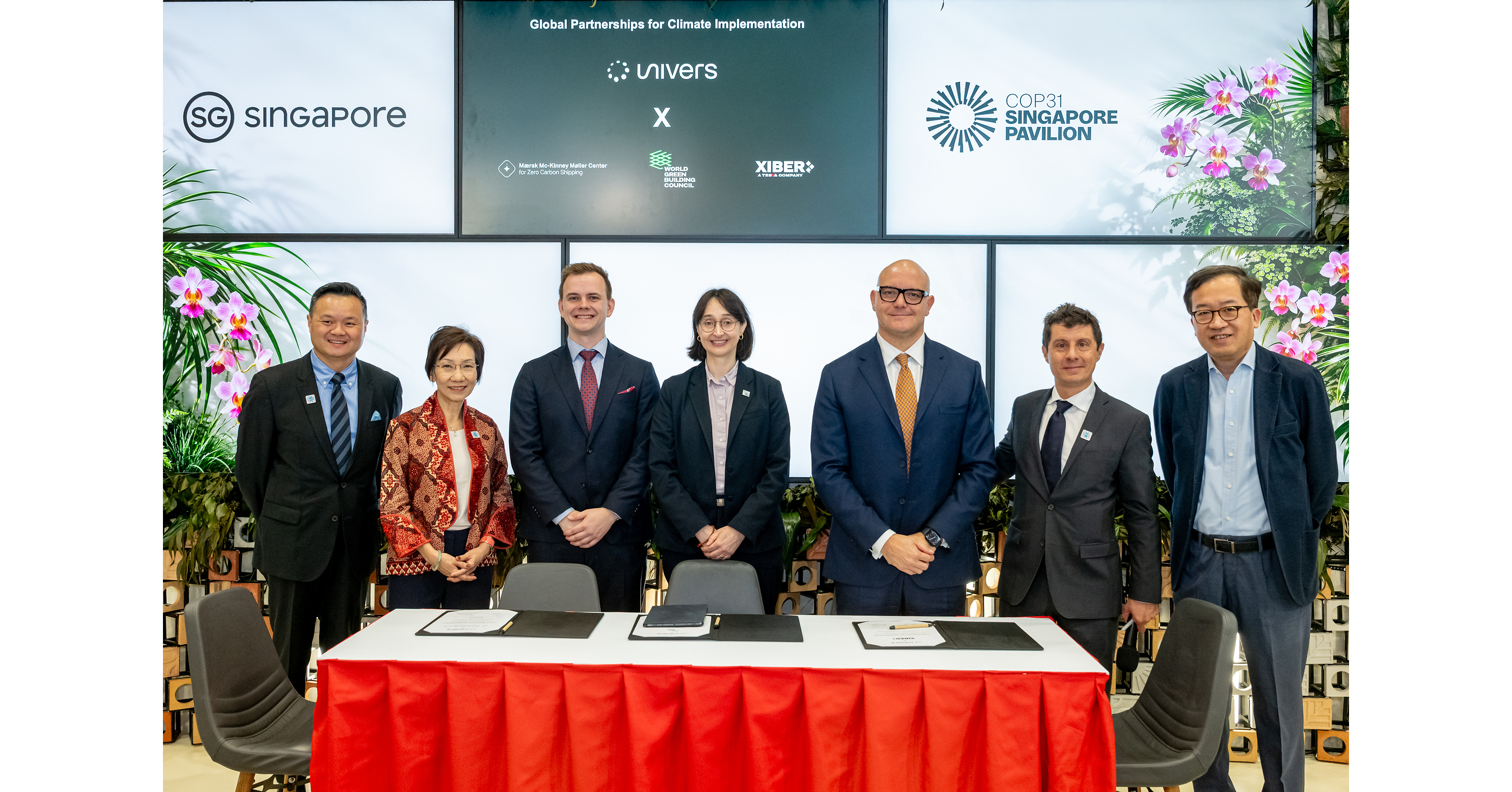
These three agreements were signed with the World Green Building Council, Mæ rsk Mc - Kinney M ø ller Zero Carbon Shipping Center, and XIBER Energy Solutions during the COP31 period at the Singapore Pavilion. The Minister for Sustainable Development and Environment of Singapore, Grace Fu, attended the signing ceremony. Although the scope of cooperation varies, these three initiatives collectively extend the application of physical AI to key areas of the real economy: building environments, maritime activities, and industrial operations.
As energy systems and infrastructure become increasingly electrified and interconnected, the challenge is no longer primarily about the climate goals themselves, but rather how to implement these goals. Univers indicates that its physical AI platform connects operational technologies, information technologies, and artificial intelligence to help various organizations understand, optimize, and coordinate large-scale, complex physical systems.
Univers Senior Vice President of Europe Valerio Dilda indicates:
Global climate ambitions have been set. The next challenge is to drive their implementation throughout the real economy. By combining the deep industry expertise of our partners with the physical AI capabilities of Univers, we can help countries accelerate their energy transition towards sustainable, resilient, affordable, and sovereign energy systems, while deploying proven methods on a large scale across various markets.
Integrate physical AI into the global industry
As the world's first global AI knowledge partner of the World Green Building Council, Univers will collaborate with its global network to promote the role of AI in more intelligent building operations and sustainable infrastructure. This partnership provides an opportunity to embed physical AI professional capabilities into a global network dedicated to accelerating the decarbonization of the building environment.
The CEO of the World Green Building Council, Cristina Gamboa, stated:
The requirements for decarbonizing the built environment mean that we cannot merely focus on performance measurement; rather, we must continuously improve the actual way buildings operate. This collaboration will explore how artificial intelligence can help buildings become smarter, more responsive, and more sustainable in large-scale applications.
By collaborating with XIBER Energy Solutions, a startup within the TESYA group that focuses on decarbonization, Univers will deploy physical AI to XIBER Energy Solutions's global industrial and manufacturing customer base, helping companies improve their energy and operational performance while reducing emissions.
XIBER Energy Solutions CEO Giovanni Longari indicates:
Industrial decarbonization must be translated into tangible results within factories. Combining AI with real operational and energy data can help industrial enterprises reduce emissions while improving productivity and energy performance.
Univers will also become one of the first batch of professional partners of the ller zero-carbon shipping center, along with rsk and Mc. The two parties will collaborate on the systematic decarbonization of the shipping industry. This partnership will explore how artificial intelligence can improve maritime operations, including through an "intelligent return" framework that focuses on the economic and environmental benefits brought about by smarter operational decisions.
Mæ rsk Mc - Kinney M ø ller Person in charge of the influence of the zero-carbon shipping center Pernille Dahlgaard states:
These collaborations also coincide with Univers launching a new “Intelligent Return” ( Return on Intelligence ) framework during the COP31 period. This framework provides companies with a new way to assess the value created by AI in their operational activities. The framework has been documented in a new white paper, which was completed with the participation of the Mæ rsk Mc - Kinney M ø ller Zero-Carbon Shipping Center, and is titled “ Return on Intelligence : How AI Changes the Economics of Transport”. The white paper will be released during the COP31 period and brings together perspectives from the transportation, energy, and financial ecosystems.
Univers, Senior Vice President and Head of Global Aviation, Transportation, and Logistics, Fox Chu stated:
Rather than primarily measuring AI through technical performance or emission reduction effects, this framework focuses more on how better operational decisions can create value for enterprises, including enhancing capital productivity, strengthening operational profitability, generating new revenue opportunities, and removing obstacles to growth.
Create a global development momentum for the physical AI.
Univers indicates that these collaborations established during the period of COP31 are part of a broader expansion of its physical AI ecosystem, and they are also built upon the foundation of collaborations that were signed prior to COP31.
Prior to COP31, Univers has expanded its collaboration with Voltalis in Europe, aiming to transform commercial real estate portfolios into assets that enhance grid flexibility. Following the strong start in the UK and France announced in June, both parties are now exploring opportunities in new regions. This collaboration combines demand-side flexibility with physical AI to help buildings adapt more intelligently to grid and market conditions.
In Singapore, Univers is also strengthening its strategic cooperation with SBS Transit, expanding the collaboration to physical AI applications in the fields of energy and operations. The efforts begin with the operation of electric buses, and they are also exploring potential applications in railway maintenance.
Univers indicates that these various collaborations have collectively extended their physical AI ecosystem to the fields of construction, energy, public transportation, maritime, and industry, demonstrating how intelligent technologies can be applied to real-world infrastructure and achieve scaled deployment in different industries and markets.
About Univers
Univers is a global leader in the field of energy and infrastructure physical AI. Its physical AI platform integrates operational technology, information technology, and artificial intelligence to help various organizations understand, optimize, and coordinate complex physical systems. Headquartered in Singapore, its business covers global areas such as energy, construction, transportation, and industry, with a commitment to making infrastructure smarter, more efficient, more resilient, and more sustainable.
The company stated that currently, over 450 million devices and sensors are connected to its system, and approximately 20% of the global renewable energy capacity in 45 markets utilizes Univers's technology.
For more information, please visit univers.com.