

After a failed on-chain transaction, developers often attempt to simulate it again a few minutes later and end up with a successful result. The reason may not necessarily be that the code has suddenly become correct, but rather that the simulation takes into account the current account and program state, which by that time has changed, including the balance, account data, and even the program version at the time of the original transaction. Solana Developer Weekly Report of November 12 includes Circular Replay, attempting to bring back the actual state at the time of the transaction to the debugging environment.
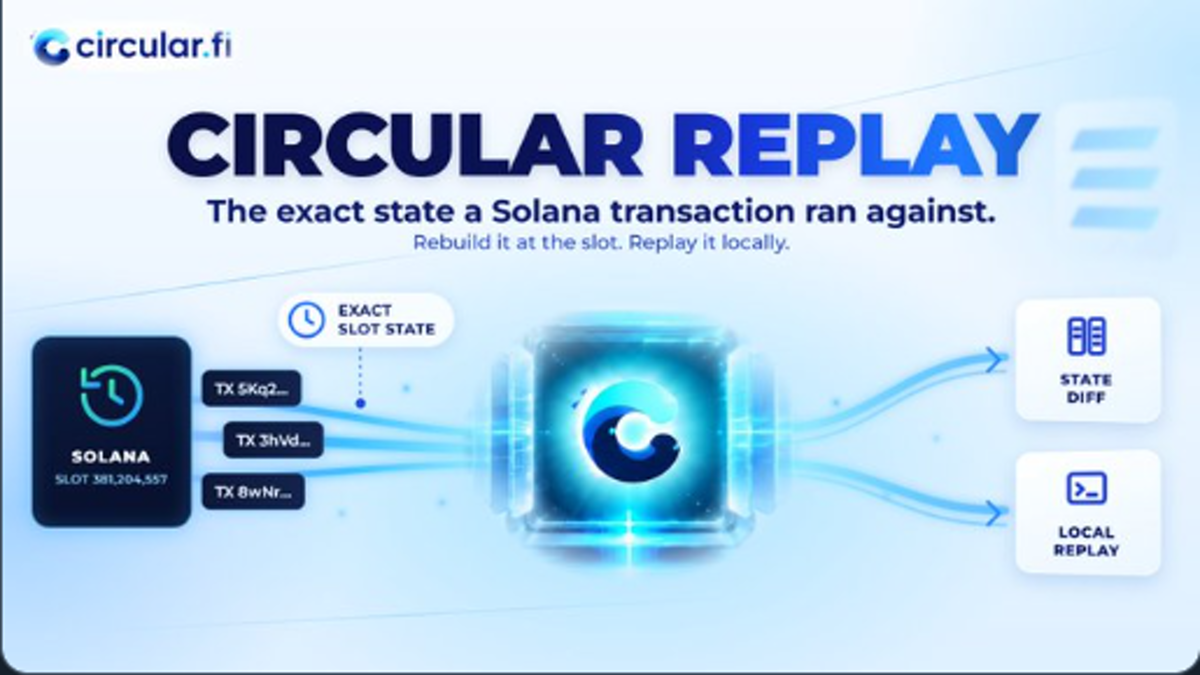
The Circular team claims that this tool can reconstruct the state of each account before and after a transaction is executed, and can pinpoint the specific slot where the transaction was finalized. Developers can not only observe the differences but also replay the transactions locally in LiteSVM, obtaining the same unit consumption and logs as on the blockchain. What it solves is the issue of reproducibility, not to re-evaluate the outcome of the transactions.
The current state cannot explain past failures.
After the Solana program reads the account data, it executes according to the rules. If there are changes in price, balance, permissions, or program version after the original transaction, a regular RPC simulation will run based on the new state, and the same set of instructions may lead to different outcomes. As a result, situations such as "failure on the chain but success in simulation" can occur, making it difficult for developers to determine whether it is due to slippage, account competition, or a program error.
Precise replay requires more than just the transaction signature. The tool must know which accounts were loaded for the original transaction, what the data was before execution, and which fields changed after execution. It also needs to align with the program bytecode and the slot environment at that time. Lacking any of these components could result in seemingly reasonable but unexplainable outcomes that do not reflect the actual situation on-site.
Circular Replay Treating the previous and subsequent states as a set that can be checked for differences can help developers narrow down the scope of the issue. For example, insufficient balance, changes in serial numbers, or updates to permission fields can all be directly observed in the account differences. Compared to simply reading a string of failure logs, state comparison is closer to the reproducible test cases used in traditional software.
LiteSVM Turning accidents into test samples for playback
LiteSVM is a lightweight local testing environment for the Solana program. After importing historical states, the team can rerun the same transactions without affecting the mainnet to check the computing units, program logs, and error paths. If the re-enforcement results are consistently reproducible, developers can then modify the code or parameters and compare whether the outcomes have truly changed.
This is particularly important for searchers, transaction protocols, and high-concurrency applications. They often rely on accounts that change rapidly within the same slot. Failures may only occur in specific sequences or combinations of states. By saving the environment at that time, a one-time online incident can be turned into a regression test, preventing similar issues from being reintroduced in subsequent versions.
However, local replay is not part of the mainnet consensus, nor will it revoke or rewrite already executed transactions. It can only help to explain what has occurred. If the accounts collected by the tool are incomplete, there are errors in the program version, or the context of slot is missing, the replay may still be inaccurate. Therefore, the results must be cross-verified with on-chain signatures, block data, and the original logs.
Status profiles also bring about data boundaries.
Rebuilding a historical account requires indexing and saving a large amount of data. The Solana account undergoes frequent changes, and long-term storage will increase infrastructure costs, as well as involve issues related to retention periods and availability. Tool providers should clarify which transactions can be replayed, how long the data will be saved, and how missing states should be marked, rather than providing definitive answers when the evidence is incomplete.
The account data itself is located on the public blockchain, but aggregating, parsing, and retaining it for a long time can lower the threshold for queries and may also expose clearer behavioral correlations. When used by enterprises, it is necessary to control access, record exported data, and manage sensitive business information in incident samples. A public ledger does not mean that all index results should be freely disseminated without boundaries.
The supply chain also deserves to be checked. Developers need to know which versions of RPC and LiteSVM the playback tool is using, as well as the program artifacts. It's best to save the input hash along with the environmental version. Otherwise, a case that can be reproduced today may not be able to be replicated in a few months due to dependency upgrades. Debugging evidence can only be considered verifiable if it is versioned, in order to be included in audits and incident reviews.
More accurate debugging does not equal a safer program.
Precise playback can improve localization efficiency, but it does not automatically detect defects in business logic. One successful interpretation of a failure does not mean that other inputs, concurrent sequences, or attack paths have been covered. The team still needs to conduct fuzzy testing, attribute testing, permission auditing, and mainnet monitoring, and incorporate real accident samples into a larger set of tests.
The long-term value of a tool depends on its ability to fail. If there is a lack of status, inconsistencies in computing units, or logs that cannot be aligned, it should clearly refuse to draw a conclusion of “complete reproducibility.” A replayer that always displays a green success will obscure the boundaries of evidence and instead lead developers to overestimate the reliability of their judgments.
Circular Replay addresses a specific and common issue: past transactions cannot be explained using today's conditions. By saving the account's state before and after slot is implemented and replaying it locally, developers can obtain evidence that is closer to the "scene of the accident." While it does not make on-chain programs automatically secure, it transforms irrepeatable failures into engineering materials that can be checked, compared, and used for regression testing.