















In addition to the latest global outage, there is another issue to worry about regarding Microsoft's stock price. Outlook, Teams, and Copilot have been affected, putting the reliability of its cloud services under scrutiny; at the same time, the company's aggressive AI infrastructure spending also presents another challenge for investors. Microsoft is growing rapidly, but to maintain this momentum, it requires substantial capital investment. As MSFT approaches a key technical resistance zone, investors need to assess more than just one risk.
Global outages have put Microsoft's cloud reliability under scrutiny.
The incident lasted for over 12 hours, disrupting the normal operations of businesses, government agencies, and other organizations. Microsoft attributed the problem to server and infrastructure failures and stated that no signs of malicious activity were detected. The company's initial efforts to restore service were not successful, as some servers that had been restored became unresponsive again after the traffic returned.
This interruption also occurred after another Microsoft 365 service outage earlier this year, once again bringing reliability concerns to the forefront. For corporate customers, stable and uninterrupted operational time is at the core of Microsoft's competitive position. Repeated failures may prompt large organizations to reconsider their reliance on a single cloud ecosystem.
The current financial losses are still unclear, but the reputational risks are even more difficult to quantify. Investors will be watching Microsoft's subsequent explanations for the incident, as well as whether the company can demonstrate that its infrastructure is becoming more resilient.
Microsoft's $170 billion AI expenditure plan raises questions about returns
The second concern is the scale of Microsoft's investments. The company is expanding its data center capacity to support the workloads of Azure and AI, as well as the growing demand for computing infrastructure. Microsoft disclosed that its capital expenditure in the first quarter of the fiscal year 2027 was $45.2 billion, and management expects the annual expenditure for 2026 to reach approximately $170 billion. The company also stated that the capital expenditure for the December quarter could exceed $50 billion.
This investment is supported by strong demand. Azure's revenue increased by 48% in the September quarter, and Microsoft's cloud revenue grew by 30% to $63.9 billion. The remaining commercial performance obligations also increased by 73% to $677 billion.
However, the core issue is how quickly these demands can be translated into returns. Heavy infrastructure expenditures may suppress free cash flow and operating profit margins, especially when it takes time for newly added capacity to begin generating output.
Microsoft's own documents warn that factors such as slowed down speeds, underutilization of infrastructure, and rising computing costs could all affect future returns for AI. As a result, the company is facing a difficult balance: it needs to invest sufficient funds to capitalize on the growth of AI without allowing capital costs to outpace revenue growth.
Azure has strong growth, but competition and production capacity are equally important.
Microsoft's cloud business remains its main strength, but it is not easy to maintain the current growth rate. Azure saw a 48% increase in the latest quarter, and management expects a 49% to 50% growth in the December quarter when calculated using a fixed exchange rate. However, Microsoft also acknowledges that customer demand still exceeds available supply, and there have been delays in the delivery of capacity from some third-party GPU.
Microsoft Stock Analysis: Can MSFT Break Through $550?
Microsoft's stock price closed at $539.44 on November 13, up 1.08%. The stock is approaching the major supply zone between $550 and $560, where previous gains have encountered selling pressure. If it can continue to break through this area, it may strengthen the rebound and bring $575 into sight.
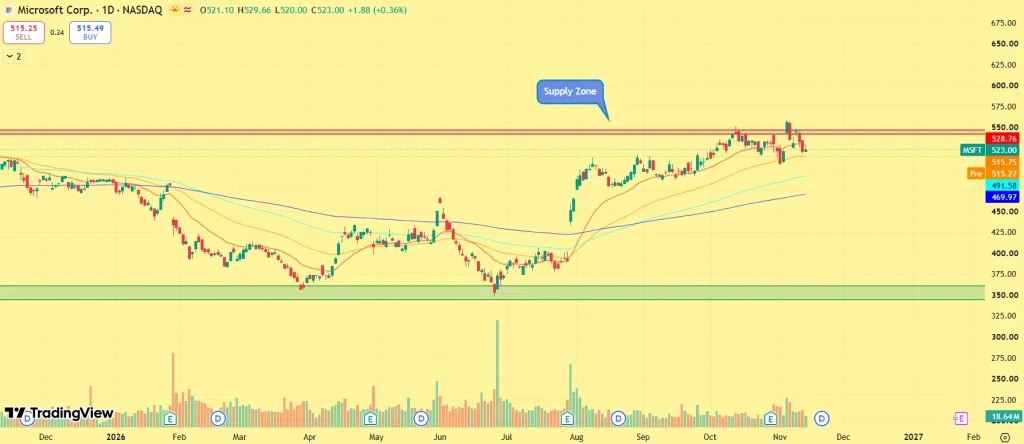
On the downside, $515 is the current support level, followed by $490 to $500. A broader support zone is located between $375 and $390, but this is still far below the current trading range. The moving average continues to provide support below the current price, however, recent resistance near the supply zone indicates that buyers have not yet taken control. If the price breaks above $560, the technical outlook will improve; if it falls below $515, the rebound momentum may weaken.
What should Microsoft's investors focus on next?
The next phase will depend on whether Microsoft can restore customer confidence, transform the demand for AI into sustainable revenue, and maintain cloud growth without sacrificing profit margins.