











A market inflection point is approaching. Tony Pasquariello, the global head of Goldman Sachs' hedge fund business, has issued a warning: although the main upward trend in the U.S. stock market has not yet broken, we have entered a countdown period. He expects the S&P 500 index to complete its final round of gains, followed by the largest net supply shock of stocks since the bursting of the internet bubble in 2000 in 2027.
Pasquariello pointed out in the latest weekly report that the three core factors driving the strong performance of U.S. stocks over the past four years – earnings growth, capital flows, and the AI narrative – have begun to deteriorate simultaneously. He stated clearly: "It is expected that the S&P will complete one last upward surge before a turning point, but 2027 is destined to be a year with more modest returns," and warned that the benchmark level of index volatility will tend to rise.
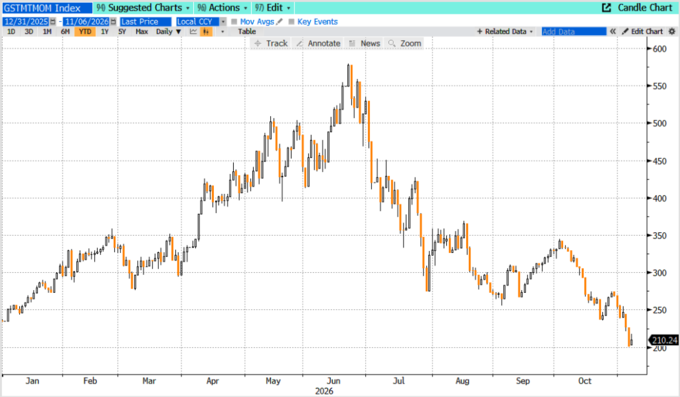
It is worth noting that in the same week, another strategist at Goldman Sachs, Rich Privorotsky, also cited a comparison with the peak of the internet bubble during this round of market activity in his report titled "1998 or 2000?" – this indicates that within the same week, there were two implicit references to the 2000 tech stock crash within Goldman Sachs. Meanwhile, this week the Nasdaq 100 index experienced a single-day decline of 6.36%, which is the largest single-day drop since the onset of the COVID-19 pandemic, and hedge funds have almost completely lost all of their gains for the year.
Profit growth has peaked, and it will be difficult to sustain the upward momentum.
On the earnings side, the S&P 500 index saw a profit growth rate of 33% in the second quarter, and it is expected to reach 35% in the third quarter. He noted that "this is the fastest profit growth rate in 30 years, except during the recovery periods after economic recessions."
However, a slowdown in growth rate has become a high-probability event. Pasquariello frankly stated that the market is highly sensitive to rates of change, "The tension between the second derivative and the first derivative is the core contradiction I have been repeatedly weighing, and this contradiction is becoming increasingly complex." Although Goldman Sachs predicts that the S&P EPS will still achieve growth of about 18% next year, and historical data shows that the bulls still have a chance of winning, he clearly stated, "It is becoming increasingly difficult to imagine that profits will once again provide us with the upward convexity we have enjoyed in recent years."
He also specifically noted that Goldman Sachs' profit forecasts are "extremely sensitive to AI capital expenditures," and the developments of this week have significantly increased the downside risks of those forecasts.
Deteriorating funding conditions, with net supply reaching a new high since 2000 in 2027
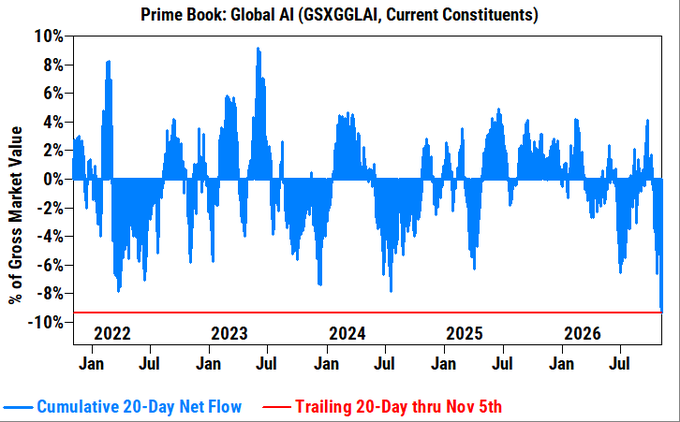
The signals at the level of capital flow are even more severe. Pasquariello writes that over the past three months, the market has continuously absorbed widespread and intense selling pressure, and this week, the selling has entered a state of "full-scale outbreak." According to data from Goldman Sachs' principal brokers, over the past 20 trading days, hedge funds have sold AI stocks at the fastest pace in over five years, deviating from the average by more than 3 standard deviations.
Buyers also showed a collective reluctance to buy. The weakening of corporate repurchase efforts, the shrinkage in buying interest from overseas investors, and the mechanical selling following quantitative strategies such as CTA, all contributed to a situation known as 'buyers' market boycott'.
What is more concerning is the supply pressure in 2027: Pasquariello clearly indicates that the net supply increase in the U.S. stock market in 2027 is expected to reach its highest level since 2000. The resonance between large IPO pipelines such as SpaceX and Anthropic, which have shifted their corporate cash flows to prioritize capital expenditures over share repurchases, will create pressure on both the supply and demand sides. Although he holds a relatively optimistic view of the funding situation in the last eight weeks of the year and notes that the scale of share repurchases has rebounded to about $5 billion per day, this short-term support cannot conceal the structural pressures of 2027.
AI Narrative shows cracks, with expanding risks on the left tail
Pasquariello has listed AI's narrative as "the most difficult variable to clarify." As the market entered this week, there was a widespread expectation that the growth rate of capital expenditures by tech giants had peaked—market consensus indicated that this growth rate would decline from 96% this year to 44% next year. At the same time, hyperscale cloud providers experienced a net consumption of free cash flow of $31 billion in the third quarter, and market concerns regarding their ongoing "negative free cash flow" continued to accumulate.
He summarized the impact of this week's developments on the prospects of AI in four points: First, AI capital expenditure was previously the "rocket fuel" for the market, but now the market is forced to seriously consider whether the intensity of construction can be sustained; second, the prospects for AI capital expenditure have broadened the possible range of outcomes, "introducing more left-tail risks into a market that previously only pursued the right tail"; third, if the pace of construction slows down, the cycle may lengthen, but a cautiously optimistic outlook can still be maintained in the medium term; fourth, it is difficult for the upward convexity of infrastructure-related targets such as "shovels and picks" under AI not to be compressed.
For Rich Privorotsky, who holds an optimistic stance, he tends to compare this round of adjustments to 1998 rather than 2000, viewing it as a liquidity event rather than the end of a cycle, believing that "postponing data center construction does not equate to destroying the demand for computing power." However, he also acknowledges that "what is disturbingly similar to 2000 is the scale of spending and the uncertainty of returns"—which coincides with Pasquariello's warnings about supply in 2000.
Valuation corrections provide a buffer, but the credit market has already issued warnings.
Pasquariello did not avoid the core argument of the bulls: after this round of valuation cuts, 'the market is now at a reasonable valuation level.' He pointed out that both the forward price-earnings ratios of the Nasdaq 100 and the Philadelphia Semiconductor Index are below the levels before ChatGPT was released in November 2022, by about 4 valuation multiples. The forward price-earnings ratio of the Nasdaq 100 has dropped to 18.4 times, which is the lowest since 2020.
However, at the end of his report, he revealed a deeper concern: Recently, two investors whom he highly respects told him that "the stock market is too complacent compared to the credit market." With the reintroduction of interest rate hikes in December into discussion, the pressure on high-yield bonds related to AI, and the triple overlap of the greatest net supply pressures in 2027, the credit market is taking the lead in pricing the issues related to financing for development. Whether the stock market has fully reflected this remains an unresolved core question.
The final conclusion of Pasquariello is clear and cautious: the main upward trend of the bull market still exists, and there may be a final surge at the end of the year. However, the "turning point" has already been mentioned in the outlook assessment. 2027 will be a trading environment that "requires even more flexibility and adaptability."