NVIDIA Places an Order; TSMC Is Also Going to Produce Memory Chips
Wallstreetcn
2h ago
Ai Focus
According to The Information, TSMC is evaluating the feasibility of producing advanced memory chips, a move prompted by NVIDIA's request. If the plan is implemented, TSMC will play a more central role in the AI hardware supply chain. However, no production commitments have been made yet, and the report does not disclose a timeline, investment scale, or production capacity targets.
Helpful
No.Help

The global chip shortage continues to intensify, and TSMC is considering entering the field of memory chips. This move will profoundly reshape the hardware supply chain landscape of AI.

According to The Information on Friday, TSMC is evaluating the feasibility of producing advanced memory chips, a move prompted by NVIDIA's request. If the plan is implemented, this world's largest wafer foundry will play a more central role in AI's hardware supply chain. This will not only provide clearer chip supply prospects for NVIDIA and other AI customers but is also expected to alleviate the current supply shortage in the medium to long term.

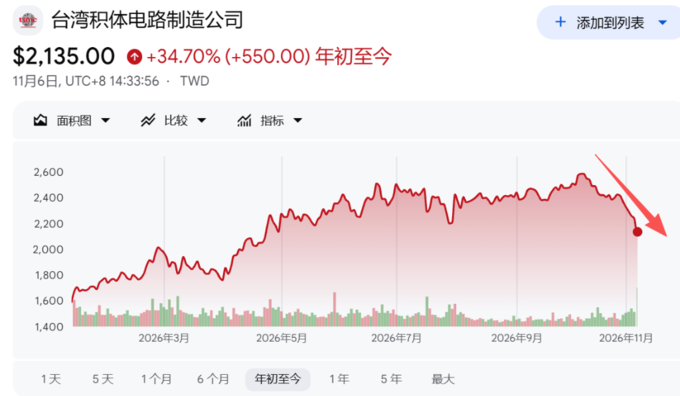
This round of chip shortages has clearly put pressure on the profit margins of major global equipment manufacturers and has driven up the retail prices of consumer electronics products ranging from Apple iPhone to Sony PlayStation. Meanwhile, TSMC's stock price tumbled significantly this week along with China Taiwan's benchmark index Taiex, which plummeted by nearly 9% at one point during trading on Friday, entering a bear market and recording its worst weekly performance since 2001.
NVIDIA "urges orders," 3D DRAM becomes the focus

According to The Information, TSMC's core technology focus this time is on three-dimensional dynamic random access memory (3D DRAM). This technological approach represents the cutting-edge development direction of storage chips and has certain synergistic potential with TSMC's existing advanced process logic chip business.

TSMC is currently the main foundry for NVIDIA AI processors. If it further takes on the production of memory chips, this will extend its coverage in the AI hardware supply chain from logic chips to the memory sector, thereby helping customers such as NVIDIA to gain a more comprehensive forecast and control over future chip supplies.

However, TSMC has not made any production commitments regarding this yet. The reports with The Information also do not disclose a specific timeline, investment scale, or production capacity targets.

Supply gap persists, with multiple parties competing to expand production

One of the causes of this round of storage chip shortages is the debt-driven investment boom in AI infrastructure construction, which has significantly increased the demand for high-bandwidth memory. As can be seen from the price tracking data of 64GB memory sticks on the Amazon platform, the market pressure at the retail level has already begun to manifest.

On the supply side, ChangXin Memory, a leading company on the mainland, also plans to expand its production capacity. If TSMC enters the market, it will introduce a new competitive force with strong technical capabilities into the global memory chip market.

It is worth noting that on the political front in the United States, after the Democrats swept both houses of Congress this week, AI companies and investors have begun to worry about potential restrictions on data center construction. They fear these measures could slow down the pace of AI investment and even burst the AI bubble. This policy uncertainty has added variables to the demand prospects for the entire AI supply chain.

Tip
$0
Like
0
Save
0
Views 42
CoinMeta reminds readers to view blockchain rationally, stay aware of risks, and beware of virtual token issuance and speculation. All content on this site represents market information or related viewpoints only and does not constitute any form of investment advice. If you find sensitive content, please click“Report”,and we will handle it promptly。
Submit
Comment 0
Hot
Latest
No comments yet. Be the first!
Related
Goldman Sachs' US stock panic indicator hits extreme levels, which historically often corresponds to mid-term rebound opportunities
Goldman Sachs traders said that the intense selling in U.S. stocks has pushed the Volatility Panic Index to 9.57, entering an extreme range. Historical data shows that after this index has broken through 9.5 15 times in the past, the S&P 500 has often recorded gains in the following three months and six months. However, traders also remind that the market is still seeking a bottom, and caution is still needed in the short term.
Wallstreetcn
·2026-11-07 15:29:11
5
Bubblemaps Accuses Crypto Influencers of Abusing Hidden Wallets
Bubblemaps accuses some crypto influencers of profiting from fans using hidden wallets, and calls for launchpad to audit top traders and ban repeat offenders. The company claims that public trading wallets attract followers, while the undisclosed addresses are responsible for selling tokens; it has previously investigated cases such as Ethan, Anglio, Solstice, and Kimchi.
crypto.news
·2026-11-07 15:19:04
14
South Korean stocks decline, while individual investors in South Korea bought more US stocks in five days than in the entire month of August
As South Korea's local stock market declines, Korean retail investors are increasing their purchases of U.S. stocks. Data from SEIBro shows that from August 2 to 6, Korean retail investors bought a net $2.19753 billion in U.S. stocks, exceeding the total for the entire month of August. Among these purchases, the buying intensity for Direxion (semiconductors) was three times that of ETF ( SOXL ).
The Block
·2026-11-07 14:59:16
20
Tesla's mass-produced Cybercab autonomous electric vehicle makes its Asian debut: gold color, no steering wheel, no pedals
Tesla showcased the Cybercab autonomous taxi at the 9th China International Import Expo, which marked the first mass-produced Cybercab appearance in Asia in gold color, without a steering wheel or pedals. Reports also indicate that the vehicle began operations in Austin, USA on September 3rd, with over 300 vehicles put into service within 30 days, expanding the scale tenfold from the initial number; as of October 18th, the Robotaxi fleet had accumulated approximately 5 million kilometers of driving without any active collisions resulting in injuries to passengers.
The Block
·2026-11-07 14:39:19
23
Sequoia The closure of the Scouts project marks the end of an era
Sequoia announced major adjustments this week, including closing its London office and terminating the scout project. The article states that this decision better reflects the changes in the investment methods of the venture capital industry.
TechCrunch
·2026-11-07 13:09:39
45
View More