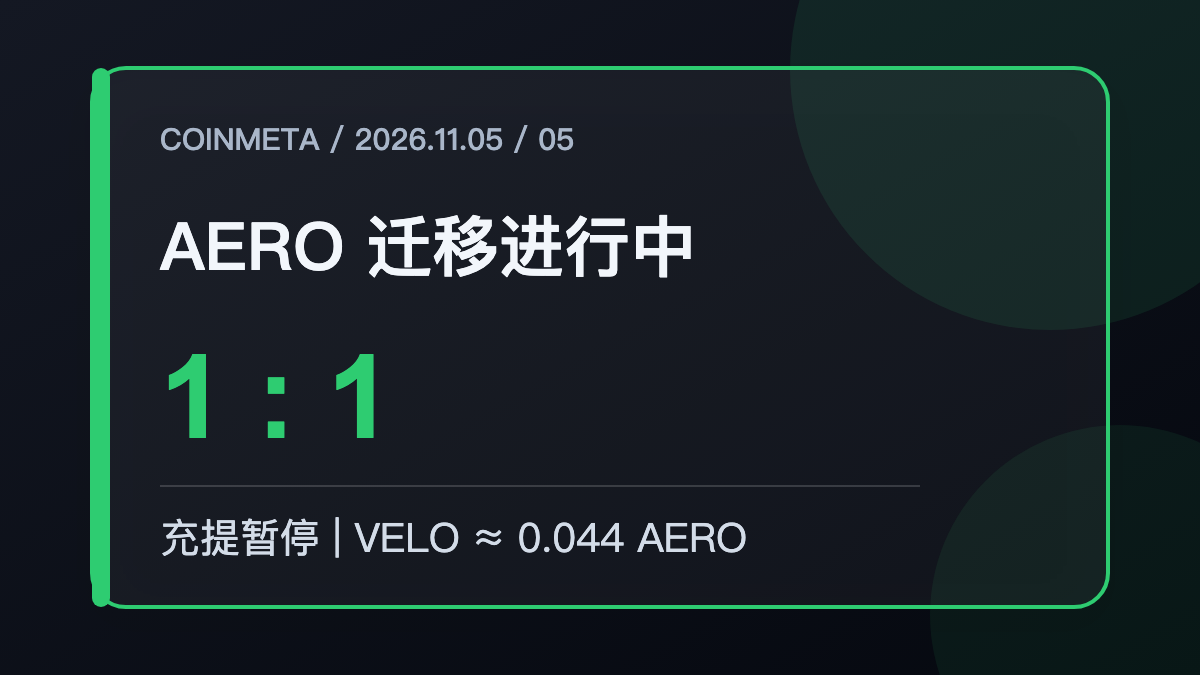


Coinbase originally planned to complete the token migration from Aerodrome Finance to Velodrome Finance from November 2nd to 4th, but as of early morning on November 5th, Beijing time, their status page still indicated that the migration maintenance was in progress. The latest official update was released at 06:57 on November 4th, Pacific Time (22:57 on November 4th, Beijing time), stating that the sending and receiving of AERO and VELO would continue to be suspended until the migration was completed, while the buying, selling, and trading of AERO would not be affected. According to the announcement, each original AERO token will be converted to one new AERO token, and each VELO token will be converted to approximately 0.044 new AERO tokens. The platform will not charge any conversion fees. After the migration is complete, Coinbase will only support recharging and withdrawing with the new AERO token; if users continue to send old AERO tokens to the original recharge address, the assets may not be retrievable. For token holders, this is not just an upgrade that requires remembering a conversion ratio; it also involves changes to both the identity of the assets and the recharge rules.
Recovering a withdrawal does not mean that all operations are automatically secure.
During the migration period, the sending and receiving of AERO and VELO will be temporarily closed. VELO transactions were stopped on November 2nd, while AERO transactions were not affected. The official plan was to reopen deposits and withdrawals on November 4th, but the latest status indicates that these services are still suspended. The time of resumption will be subject to subsequent updates on the status page. Even if the related on-chain functions are restored, it will only apply to the new tokens. When users see the message "Services have been restored," they tend to overlook the second half of the announcement: old tokens will no longer be supported.
The recharge addresses of centralized exchanges may appear to be stable entry points, but in reality, they depend on the network, contract addresses, and asset mappings. After token migrations, the names and codes may remain similar, yet the underlying contracts have changed. If the wallet interface still displays the old AERO, and users transfer funds to Coinbase based solely on the identical code, even if the on-chain transaction is successful, it does not guarantee that the exchange will record it in the user's account. On-chain confirmation and actual account crediting by the platform are two separate processes.
Two tokens adopt different processing methods.
AERO conversion is on a one-to-one basis, which is relatively straightforward: the quantity remains unchanged, but the asset version changes. VELO conversion rate is approximately 0.044. AERO exchange will result in a significant change in quantity; users need to multiply the original VELO quantity by the exchange ratio to estimate the new AERO they will receive after migration. This ratio is an approximate value stated in the official announcement and should not be regarded as the market price, nor does it imply that the dollar value of AERO will remain unchanged after migration.
VELO transactions were closed at the start of the migration, which means users cannot continue to buy and sell old assets on Coinbase while waiting for the conversion. If AERO transactions remain open, it indicates that the transaction functionality can be maintained separately from the on-chain sending and receiving functions. In the event of similar occurrences, users need to confirm individually whether "transactions are possible," "recharges are possible," "withdrawals are possible," and "which contracts are supported." One status should not be used to infer the others.
Why it may be impossible to retrieve old tokens
Exchanges typically identify recharges by scanning transactions based on the supported networks, contracts, and internal accounting rules. After the migration is complete, if the platform stops recognizing the old AERO contracts, although the funds are still in the blockchain addresses, there may be no automatic crediting process. To restore them manually, exchanges need to confirm private key control, technical feasibility, compliance requirements, and operational costs. In many cases, no guarantees are provided.
Therefore, the safest approach is not to "try a small amount first," but to verify the contract addresses and networks currently supported by Coinbase before making a transfer, and to ensure that the assets in your wallet have been successfully migrated. A small test amount can reduce the risk of loss, but it does not guarantee that older assets will be supported; if the type of asset is incorrect, even a small amount could be lost. Do not copy contract addresses from search results, social media screenshots, or old tutorials. Instead, cross-check them with the platform's current recharge page and the official project information.
Automatic conversion may result in tax records.
Coinbase Special reminder: VELO automatic conversion may have tax consequences. Different jurisdictions have different interpretations of token exchanges; some may consider it as an asset disposal, while others will focus on the cost basis and the fair value at the time of receiving new assets. The platform does not charge a handling fee, but that does not mean the tax implications do not exist.
Users should save the quantity of VELO before migration, the official exchange rate, the migration time, the quantity of AERO after migration, as well as the price records at that time. If the historical cost comes from multiple purchases, it is also necessary to retain the original transaction records. Tax handling should be based on local regulations and professional advice, and cannot be determined solely based on exchange announcements. For institutional accounts, changes in asset codes may also affect accounting systems, risk limits, and custody reconciliation.
What are the responsibilities of projects and exchanges respectively?
Token projects decide on the migration plan, contract, and economic design, while exchanges decide whether to support it, when to suspend certain functions, and how to perform conversions for users. The timelines of both must be aligned, but their responsibilities are not the same. When a project announces the launch of a new token, it does not mean that every exchange has already provided support; similarly, when an exchange completes the migration, it does not imply that all external wallets and protocols have been updated accordingly.
Users need to clearly map the flow of their assets: which wallet the tokens are currently in, which contract they belong to, which version is supported by the target platform, and whether the transfer networks are consistent. Decentralized applications may still retain old pools or old authorizations; after migration, it is necessary to check the liquidity positions, staking, lending, and authorization statuses. Focusing only on the spot balance can lead to overlooking risks in other locations on the blockchain.
General lessons learned from this migration
The key figures for the AERO event are quite simple: one to one, approximately 0.044, and no conversion fees. However, what truly determines the safety of the asset are the version, network, contract, and platform status. When the token name remains unchanged, users are more likely to make misjudgments, as there is no clear reminder on the interface that this is an old asset.
In the future, when encountering token mergers, coin exchanges, or mainnet migrations, you can follow these four steps: first, confirm the official schedule; then, check which exchanges support the migration; during the migration period, pause any self-initiated transfers; after completion, re-check the contracts and the network; finally, save your balance and tax records. The announcement of the successful migration marks the end of the process, but it is not the end of the user's checks and verifications. Being cautious about the old token addresses is often more valuable than simply remembering the exchange ratios.