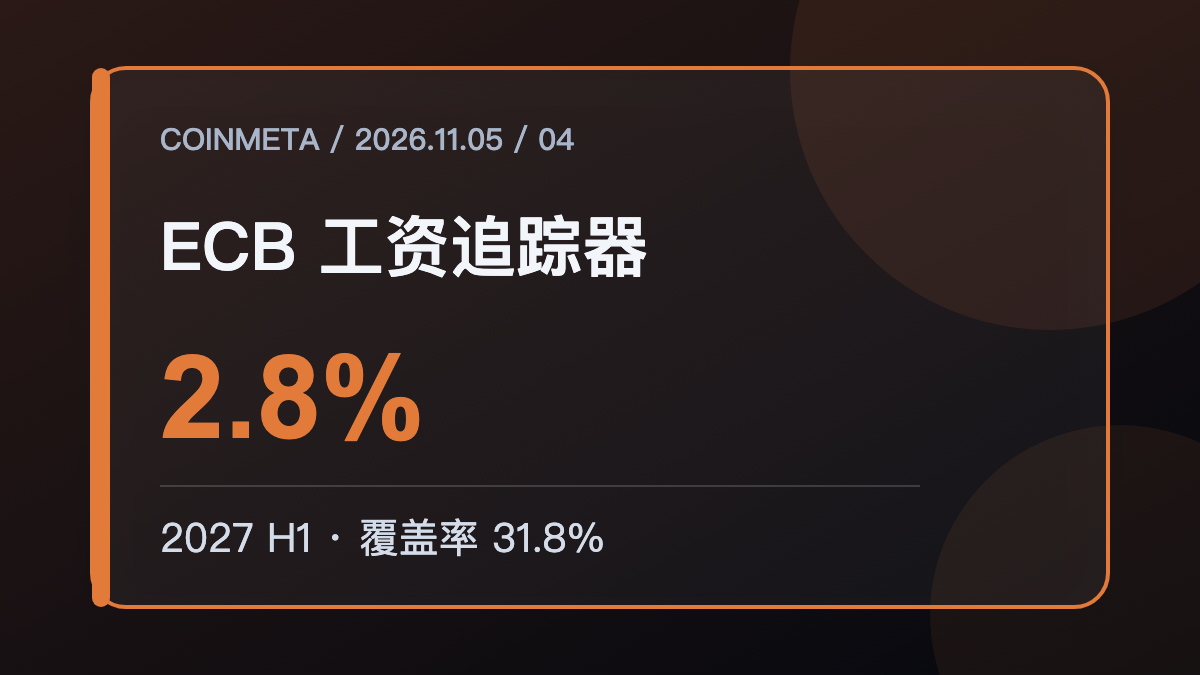


The European Central Bank updated its wage tracker on November 4th: It includes overall indicators that take into account one-time payments and are smoothed out. The forecast is 2.3% for the whole of 2026, 2.7% for the second half of 2026, rising to 2.8% in the first half of 2027, and then falling back to 2.4% in the third quarter of 2027. If one only looks at this curve, it would be easy to conclude that "wage pressures will first rise and then fall." However, the data for the third quarter of 2027 currently only covers 23.3% of the relevant employees. The further into the future we look, the weaker the signal becomes, and this is precisely the part of the report that requires careful attention.
A salary tracker is not a salary predictor.
This set of indicators comes from collective bargaining agreements in effect in nine Eurozone countries, and uses the wage arrangements within these agreements to observe known future changes. It can detect how signed wages will evolve earlier than traditional statistics, but it does not cover new agreements that have not yet been signed, nor is it a complete forecast of all workers' wages. The European Central Bank clearly reminds that the forward-looking part depends on the current database and will be revised as new agreements are added.
In 2026, the employee coverage rate was 46.2%, which dropped to 31.8% in the first half of 2027, and further decreased to 23.3% in the third quarter. Therefore, the figure of 2.4% in the third quarter of 2027 cannot be compared on an equal footing with the annual figure of 2.3% in 2026. The former is more like a "temporary path indicated by the agreed-upon protocol," while the latter represents a wider coverage rate. Treating the lower long-term coverage values as a definite wage reduction would be misusing statistical tools as a forecasting tool.
A one-time payment makes the curve difficult to read.
In recent years' collective bargaining in Europe, one-time inflation compensation, bonuses, and retroactive wage increases are quite common. Overall wage trackers smooth out these one-time payments over 12 months to observe quarterly and monthly trends; another indicator retains the unsmoothed one-time payments, which is more suitable for observing annual changes; a version that excludes one-time payments is closer to reflecting long-term or structural wage growth from negotiations.
The overall indicators in the first half of 2026 were relatively low, partly due to the one-time payments made in the second half of 2024 not being repeated thereafter, creating a mechanical drag on year-on-year comparisons. This impact completely subsided in the second half of 2026, so the return of overall indicators to around 2.7% from their low levels in the first half does not mean that companies suddenly gave out substantial salary increases. Changes in the statistical base and the actual results of negotiations must be considered separately.
After excluding one-time payments, the pressure becomes more stable.
Excluding one-time payments, the average wage tracker was 2.6% in 2026 and 2.8% in the first three quarters of 2027. Specifically, it was 2.8% in the first quarter of 2027, 2.9% in the second quarter, and 2.5% in the third quarter. These figures indicate that permanent negotiated wage increases may be slightly higher than in 2026, but there has been no uncontrolled acceleration.
The overall indicator was 2.8% in the first half of 2027 and dropped to 2.4% in the third quarter; after excluding one-time payments, it was 2.5% in the third quarter. The fact that the two curves are close indicates that the role of one-time payments in the recently signed agreements is limited. However, the decline in coverage rate still limits the strength of the conclusions. In the future, as more agreements are signed, the long-term figures may be significantly revised.
What does it mean for inflation?
Wage increases are an important source of service inflation and corporate costs, but they cannot be mechanically translated into consumer prices. Productivity improvements can absorb some of the wage costs, and corporate profit margins may also adjust; the speed at which wages are passed on varies across different industries. In the European Central Bank's macroeconomic forecasts for September, the projected growth rate of per employee compensation in 2026 is 3.3%, which is higher than the 2.3% estimated by wage trackers, indicating that negotiated wages are only a part of overall labor income.
What monetary policy makers are truly concerned about is the unit labor cost resulting from the combined effects of wages, productivity, and profit margins. If structural wage growth remains stable at around 3%, while productivity improvements are limited, service prices may still remain sticky; if productivity increases or firms absorb costs, inflationary pressures will ease. Tracers provide a piece of the puzzle, but they cannot determine the direction of interest rates on their own.
Revision is information in itself.
Compared to the data released in September, the overall indicators for the second half of 2026 and the first half of 2027 have been revised upward by an average of 0.1 percentage points. The increase is not significant, but it indicates that as the new protocol is integrated into the database, the projected path will continue to evolve. For traders, rather than focusing on a certain forward point, it is more worthwhile to observe the direction of each revision, changes in coverage rates, and the composition of countries involved.
There are also significant differences in coverage across different countries. In the third quarter of 2027, France had a coverage rate of only 1.3%, Finland at 59.1%, and Italy at 42.4%. Therefore, the overall figures for the Eurozone may more accurately reflect the situation in some countries that have signed agreements, rather than a synchronized trend among all member states. The weight of each country and the pace of agreement updates can both affect short-term readings.
A more honest conclusion
The conclusions supported by this update are quite cautious: from the second half of 2026 to the first half of 2027, known protocols indicate that the growth rate of negotiations in wages is slightly higher; after excluding one-time payments, the average growth rate for the first three quarters of 2027 is also slightly higher than that of 2026. However, the long-term coverage is insufficient, and the indicators will be revised, so it cannot be concluded that wages will inevitably rise or fall.
The most valuable aspect of data is precisely when both certainty and uncertainty are presented simultaneously. The 2.8% indicates the direction in which agreements have been signed to the market, while the 31.8% coverage rate suggests that there is still much unknown to the market. In terms of macro analysis, acknowledging the importance of the latter figure is often closer to the truth than using the former figure as a prominent headline.