


American Bitcoin CEO Mike Ho stated: "Our third-quarter results demonstrate our commitment to building a well-disciplined business that is priced in Bitcoin. Despite the pressures of seasonal electricity costs, we continued to mine at a structural discount below spot prices, expanded our strategic reserves, and increased Satoshis per share by approximately 5%. At the same time, we neither issued shares through the ATM program nor purchased Bitcoin during this quarter. This is an important distinction in today's market. Our focus remains on efficiently accumulating Bitcoin, maintaining operational flexibility, and allocating capital in a way that supports long-term growth of Bitcoin per share. We believe that this discipline enables American Bitcoin to create lasting value for shareholders across different market cycles."
American Bitcoin, co-founder and Chief Strategy Officer, and Eric Trump stated: "We are building American Bitcoin and believe that Bitcoin and American energy will play an increasingly important role in the future of the U.S. economy. This quarter, we achieved a net profit of approximately $126 million and an adjusted EBITDA of $221 million, while also expanding our Bitcoin reserves and increasing the number of Bitcoins held per share. In the challenging digital asset market, these achievements are particularly significant and reflect the discipline and long-term belief behind this business. However, our opportunities are not limited to just one quarter. As the demand for energy and critical infrastructure in the United States accelerates, I believe we are at the intersection of two industries that will help define the future of the U.S. economy. We are working towards building American Bitcoin for the long term, and I am full of anticipation for the future."
Strategic reserve growth
Mining Platform Performance
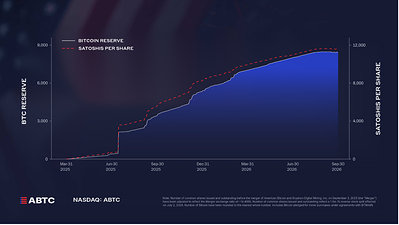
In the third quarter of 2026, mining revenue amounted to approximately $63.4 million, which is lower than the $67 million in the second quarter of 2026. The revenue per Bitcoin mined in the third quarter was about $71,100, compared to around $71,900 in the second quarter.
In the third quarter of 2026, approximately 891 bitcoins were mined, which is lower than the 932 bitcoins mined in the second quarter. The production in the third quarter accounted for about 21% of the total number of bitcoins mined by the company since its inception on March 31, 2025.
Gross profit was approximately $25.8 million, with a gross margin of about 41%; in the second quarter, it was around $33 million and 49% respectively. The company stated that seasonal increases in electricity costs for the site put pressure on the quarterly margin compared to the previous quarter.
The company sold some of its Bitcoin production to cover operating costs, while continuing to build up the company's strategic Bitcoin reserves.
In the third quarter, the mining cost per Bitcoin was approximately $42,100, compared to about $36,500 in the second quarter, which mainly reflects the increase in seasonal electricity costs at various mining sites.
The net profit in the third quarter was approximately $126 million, while in the second quarter there was a net loss of about $57.2 million; after adjustments in the third quarter, EBITDA was around $221 million, whereas in the second quarter after adjustments, EBITDA resulted in a loss of about $45 million.
As of the end of the quarter, the company owned a total of approximately 89,242 mining machines, with a computing power capacity of about 28.1 EH /s.
Teleconference
The company's third-quarter 2026 financial report conference call will be held on Wednesday, November 4th, at 4:30 PM Eastern Time. Investors can watch the live web seminar via https :// app.webinar.net / pymQJ5mJ37e. To join the call, please register by calling 1 (888) 880-3330 10 minutes before it starts. International callers can dial 1 (646) 357-8766.
Supplementary materials and subsequent communication
The company expects to publish various materials and updates on its website and/or official social media channels to complement the discussion of financial performance, and to provide additional financial information and other data, including Bitcoin holdings and related performance indicators. For important news and information about the company, including investor presentation materials and future investor meeting schedules, please visit the company's investor relations pages at abtc.com / investors on its website, as well as its social media accounts, which include X, Instagram and LinkedIn. The company uses its website and social media accounts as the main channels for disclosing key information to investors, some of which may contain material and previously undisclosed information.
About American Bitcoin
American Bitcoin Corp is a subsidiary held by Hut and Corp, holding the majority of the shares. It is a Bitcoin accumulation platform dedicated to building the infrastructure for Bitcoin in the United States. The company provides institutional-level Bitcoin exposure through a business model that is pioneering in the industry, combining large-scale self-mining operations with a prudent accumulation strategy. For more information, please visit abtc.com and follow @ABTC on X.
Warning Regarding Forward-Looking Statements
This press release contains “forward-looking statements” as defined by the Private Securities Litigation Reform Act of 1995, Section 27A of the Securities Act of 1933 as amended and its Rule 175, and Section 21E of the Securities Exchange Act of 1934 as amended and its Rules 3b-6. These statements involve inherent risks and uncertainties. Examples of forward-looking statements include, but are not limited to: the company’s ability to efficiently accumulate Bitcoin and continue to expand its strategic Bitcoin reserves; the company’s ability to mine at a price lower than the current Bitcoin price; the company’s ability to increase its Bitcoin holdings and Satoshis per share over time; the company’s ability to maintain operational flexibility; the company’s ability to allocate capital in a manner that supports long-term growth of Bitcoin per share; the company’s ability to create lasting value for shareholders across different market cycles; the impact of seasonal electricity costs on the company’s profit margins and mining costs; the expected role of Bitcoin and energy infrastructure in the future economy and the company’s position within the industry; as well as the company’s future business strategy, competitive advantages, expansion, and broader business and operational growth.
Forward-looking statements are not statements of historical fact, but rather expectations, estimates, and projections about future events based on certain important factors and assumptions at the time such statements are made by management. Although the company believes these statements to be reasonable as of the date of this press release, they are subject to known and unknown risks, uncertainties, assumptions, and other factors that may cause actual results, levels of activity, performance, or achievements to differ materially from those expressed or implied in the forward-looking statements. These factors include, but are not limited to: Bitcoin price and concentration of Bitcoin holdings; failure in the growth of computing power; procurement of mining machines; competition from other Bitcoin investment methods; uncertainties regarding the development and acceptance of the Bitcoin network; dependence on third-party mining pool service providers; hedging transactions; Bitcoin halving events; failure to achieve the expected benefits from mergers and acquisitions; dependence on Hut; liquidity constraints and inability to raise additional capital; critical system failures; competition from current and future competitors; changes in leasing arrangements; risks associated with hazards and operations; electricity demand; geopolitical, social, economic, and other events and circumstances; cybersecurity threats and vulnerabilities; internet-related interruptions; dependence on key personnel; limited operating history; rapid technological changes; predictions of facility requirements; acquisitions, strategic alliances, or joint ventures; international operations and expansion; legal, regulatory, governmental, and technological uncertainties; physical risks related to climate change; involvement in legal proceedings; stock price fluctuations; the company's multi-class capital structure and status as a controlled company; and other factors that may affect the company's future business, performance, financial condition, and prospects. Other factors that could cause results to differ materially from those mentioned above are discussed in the company's 10-K annual report for the fiscal year ending December 31, 2025, as well as other documents submitted from time to time to the U.S. Securities and Exchange Commission.
After adjustment, EBITDA
In addition to the performance indicators determined by GAAP, the company also relies on the adjusted EBITDA to evaluate its business, measure its performance, and make strategic decisions. The adjusted EBITDA is a non-financial indicator (not a GAAP financial metric). The company defines the adjusted EBITDA as net profit (loss) and makes adjustments for income tax provisions, depreciation and amortization, derivative gains and losses, benefits from warrant liabilities, exclusion of non-recurring transactions, and equity incentive expenses for the period. The company advises investors to consider these adjustments and the reasons why the board of directors and management deems it appropriate to provide additional analysis.
The board of directors and management use the adjusted EBITDA to evaluate financial performance, as it allows for a consistent comparison of operational performance across different periods by eliminating the impact of capital structure (such as varying levels of interest expenses and income), the impact of the asset base (such as depreciation and amortization), and other items that affect the comparability of financial results over time (such as non-recurring transactions).
Net profit (loss) is the GAAP indicator that is most directly comparable to the adjusted EBITDA. When evaluating the adjusted EBITDA, investors should be aware that the company may incur expenses in the future that are identical to or similar to some of the adjustments made in this indicator. The presentation of the adjusted EBITDA by the company should not be construed as implying that future performance will not be affected by exceptional or non-recurring items. The company cannot guarantee that it will not modify the presentation of the adjusted EBITDA in the future, and any such modifications could have a significant impact. The adjusted EBITDA has important limitations as an analytical tool; it should not be viewed in isolation, nor should it replace the analysis of the company's results reported according to the GAAP. Since other peer companies may define the adjusted EBITDA differently, the definition of this non-GAAP financial indicator may not be comparable to the indicators with the same name used by other companies, which reduces its usefulness.