


The strong rise in Apple's stock price over the past few months has left it with almost no room for error before the release of its financial report after the U.S. market closes on Monday.
Since the low point at the end of June, Apple's stock price has risen by 25% in total, with its market value increasing by about $1 trillion. While large tech peers such as Google and Amazon have made substantial investments in AI infrastructure, sparking market concerns, Apple's steady revenue growth and steadily climbing free cash flow have made it a "safe haven" in the eyes of investors. However, this upward trend has also pushed Apple's valuation to its highest level since 2008—measured by the expected price-earnings ratio for the next 12 months, Apple has reached 36 times, which is approximately twice that of the S&P 500 index.
Last Friday, while Google and Amazon's disappointing financial reports caused a collective decline in stocks related to AI, with the Philadelphia Semiconductor Index plummeting by 7.2% in a single day, Apple's stock price only fell by 1.2%, significantly outperforming the market. Taking advantage of NVIDIA's sell-off, Apple regained its title as the world's most valuable company after several months, with a market value of $5.03 trillion. This set of financial reports will be the first real stress test for this "safe haven" narrative.
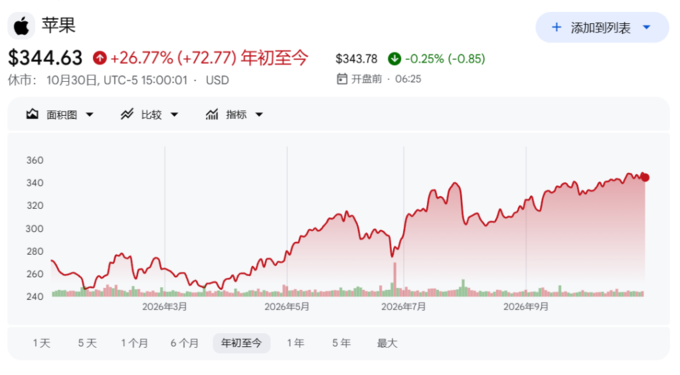
Under high valuations, there is little room for error left.
Apple's recent rise has brought its stock price to a state of extreme overvaluation, and any unexpected event could trigger a re-evaluation of its valuation.
Co-Chief Investment Officer Tandem Investment Advisors and Ben Carew stated: "Apple's current valuation is at the 99th percentile of its history. When a stock is priced so fully, risks follow any unexpected events. Currently, it serves as a safe-haven asset, but if growth falls short of market expectations, people will question its true safety, and at that point, its valuation multiple may need to be re-evaluated."
This risk is not unfamiliar to long-term observers of Apple. Three months ago, due to a shortage of components that dragged down quarterly revenue expectations, Apple's stock price tumbled by the largest amount in 16 months in a single day.
Wall Street expects Apple's revenue in the fourth fiscal quarter to grow by 11% year-on-year to $113.5 billion, with net profit increasing by 6% to $29.2 billion. If achieved, this would mark Apple's best annual sales growth rate since 2021 – 15%. However, according to the average expectations of analysts compiled by Bloomberg, the growth rate is expected to slow down over the next two years.
Foldable screens iPhone and Duo become key variables
This financial report will for the first time disclose the market performance of Apple's new foldable screen models iPhone and Duo, which is also the core highlight of these earnings. The device was officially released last month, and Apple has stated that demand has been "unusual," with delivery times being postponed until next year.
Duo is of great significance to Apple. It not only represents the largest design change for Apple's flagship products in many years, but also has a starting price of up to $1,999. Investors hope that this high price will boost growth. According to Bloomberg Industry Research forecasts, iPhone Duo could contribute $28 billion to $32 billion in sales by the fiscal year 2027, and as consumers migrate from lower-priced models such as Pro and Pro Max, it is expected to drive the average selling price even higher.
However, analysts also point out concerns: the supply is limited, and since reports have shown that the Duo screens develop cracks after a small amount of use, this may diminish their market appeal beyond the early user base.
Free cash flow supports the “safe harbor” logic
Compared to most large tech peers, Apple's revenue growth rate is relatively lagging behind, but its free cash flow performance stands out notably, and this is precisely the indicator that the market values most at present. As investors become increasingly skeptical about the spending spree on AI, Apple's ability to generate cash returns constitutes its core attractiveness.
It is expected that Apple's free cash flow for the fiscal year 2026 will increase by more than 40% to $141.5 billion, and it is also anticipated to continue growing in the following three fiscal years. In contrast, Google, Meta, and Amazon all face a gap in free cash flow, and it is expected that this situation will persist.
Neuberger Berman Senior Research Analyst Daniel Flax stated: "The market recognizes Apple's advantage in free cash flow, and if this trend continues, I believe there is still room for the stock price to create further value from its current level. The ability to execute the product cycle and to convert it into strong free cash flow growth will be the most critical factors determining the stock price trend. At least for now, preliminary signs indicate that Duo has received considerable attention."
Analysts' enthusiasm has cooled down; stock price has already exceeded the target price.
Nevertheless, the combination of high valuations and low growth rates has dampened Wall Street's enthusiasm. Since Apple's last earnings report at the end of July, at least six analysts have downgraded their ratings. Loop Capital downgraded Apple from "Buy" to "Hold" in October, citing a weak trend in iPhone shipments; Bank of America removed Apple from its "U.S. Select One" best-in-class portfolio last Friday, stating that it "takes a cautious approach to recent positioning due to potential headwinds relative to market consensus expectations."
Among the analysts tracked by Bloomberg, less than 60% recommended buying Apple, while the buy recommendations for Microsoft, Amazon, and Meta all exceeded 90%. What is more noteworthy is that Apple's stock price has already surpassed the average target price set by analysts, making it the only member of the "Big Seven" with a implied return that is negative over the next 12 months.
Tandem's Ben Carew summarized, 'Valuation is the core risk Apple faces, but given the relative certainty of its business model, a certain degree of valuation premium is reasonable. The fluctuations in other parts of the tech sector precisely reflect the market's uncertainty about their prospects. Unless this earnings report truly shakes the market's fundamental judgment of Apple—which I don't think is likely to happen—Apple should at least be able to remain immune to some of these fluctuations.'