


After a heavy setback for U.S. tech stocks last week, most Asian and Pacific stock markets rebounded on Monday, with U.S. stock futures also strengthening, indicating signs of stabilization in market risk sentiment.
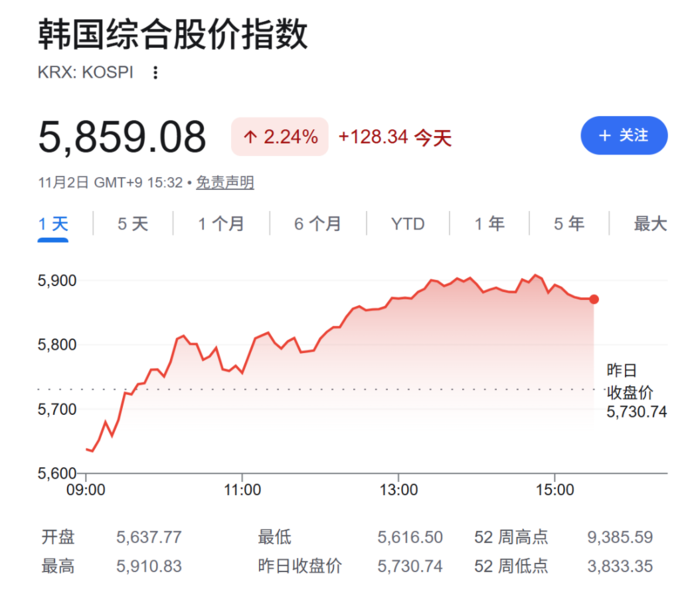
Most major Asian stock markets closed higher, with South Korea's KOSPI index rising by 2.24%, and the MSCI Asia-Pacific index overall increasing by 0.1%. Nasdaq 100 index futures rose by more than 1%, and S&P 500 index futures rose by 0.53%, with European stock index futures also following suit. This has alleviated some of the market's concerns about the spreading downward trend in tech stocks to some extent. Previously, the Nasdaq 100 index tumbled 3.5% on Friday, recording its worst single-day performance since March 2025, while the Philadelphia Semiconductor Index plummeted by 7.2% on the same day.
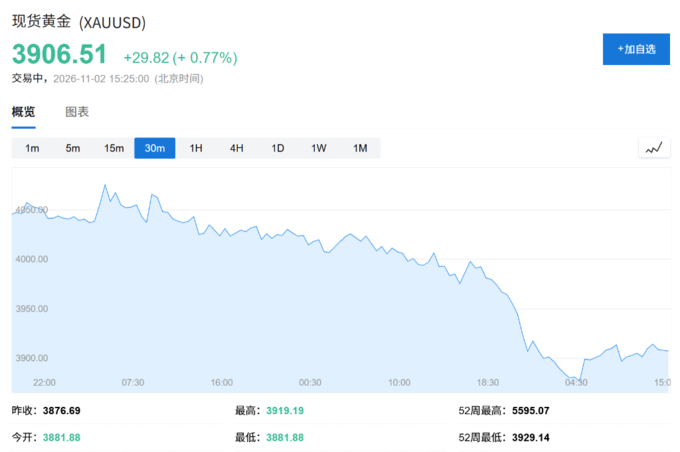
The decline in oil prices has also supported market sentiment. It is reported that U.S. President Donald Trump hopes to assess whether to resume military strikes against Iran after the results of the mid-term elections on Tuesday are announced, preferring to give more time to diplomatic efforts. Brent crude oil immediately fell by about 3% to $109.87 per barrel, and the drop in oil prices helps to ease expectations of inflationary pressures. Meanwhile, gold prices rose by 0.8% to $3,906 per ounce, rebounding after hitting a over-one-year low closing price last Friday.
The Nikkei 225 index closed down 0.3% at 63,081.86 points. The Tokyo Stock Exchange index in Japan closed down 0.9% at 3,930.28 points. South Korea's KOSPI index closed up 2.24% at 5,859.07 points. U.S. stock index futures rose collectively, with NASDAQ 100 index futures rising by more than 1%, S&P 500 index futures rising by 0.53%, and Dow Jones index futures rising by 0.41%. There was little change in the spot dollar index. The yield on 10-year U.S. Treasury bonds remained relatively stable at 4.92%. The yield on 10-year Japanese Treasury bonds increased by 1.5 basis points to 2.770%. West Texas Intermediate crude oil fell 3.4% to $100.53 per barrel. Spot gold rose 0.77% to $3,906.5 per ounce. Bitcoin rose 0.6% to $78,259.88.
The Asia-Pacific market showed mixed performance on Monday. South Korea's KOSPI index rose by 2.24% to 5859.07 points; however, Australia's benchmark index fell. Overall, the MSCI Asia-Pacific index saw a slight increase of 0.1%. The Japanese market was weaker, with the Nikkei 225 index closing down 0.3% at 63081.86 points, and the TSE index falling 0.9% to 3930.28 points.
The stock price of Kioxia Holdings (Kioxia Holdings Corp), a Japanese semiconductor memory chip manufacturer, tumbled by 17% during trading in Tokyo. The reason was that the company's outlook released was rather cautious, which exacerbated market concerns that the explosive growth driven by artificial intelligence is beginning to stabilize.
HashKey Capital Portfolio Manager Chaltan Wang stated that the Asian stock market has regained "some of its lost ground, with buyers returning to certain tech stocks on dips." He also pointed out, "The core question is whether what we are witnessing now is just a temporary correction in these popular tech trades, or whether it marks the beginning of a market re-evaluation of all AI-related investments."
Last Friday, tech stocks in the U.S. market faced selling pressure, reflecting a decline in investors' patience with a certain type of company—those whose core business growth has slowed down but which are still making substantial bets on artificial intelligence (AI) spending. The financial reports released last week by Alphabet and Amazon.com sparked market concerns, as it is believed that AI investments are eroding the profitability of their core businesses that provide the funding for these companies.
Co-chairs Oaktree Capital Management and Howard Marks stated in an interview with Bloomberg TV that the recent market fluctuations related to artificial intelligence have, to some extent, shattered the myth that this sector is "impeccable."
Morgan Stanley's chief equity strategist, Mike Wilson, believes that this decline may provide an entry opportunity. He stated that there are several "liquidation events" ahead that could temporarily push down stock prices, creating a chance for investors to increase their positions. Lombard Odier Investment Management, the head of macro research, also holds a relatively optimistic stance, believing that this adjustment "seems more like a rotation within a bull market centered on valuation revaluation, rather than the beginning of a widespread market deterioration."
The current market is facing several key time points. The U.S. mid-term elections will take place on Tuesday of this week, and NVIDIA's financial report is scheduled to be released later in November. Both events could trigger a new round of fluctuations.
The Volatility Index (VIX) VIX reached its highest level since April last week, leading to a surge in demand for put options to hedge against further declines. The correlation between stocks also increased, indicating rising market stress. However, these indicators are still far below their peak levels seen in March this year after the joint US-Israeli strikes against Iran.
In the foreign exchange market, the US dollar has seen mixed movements against the G10 currency, with limited changes in the prices of US Treasury bonds. OCBC Moh Siong Sim, a foreign exchange strategist at a bank in Singapore, stated, "The US dollar is still caught between two forces: artificial intelligence and oil prices." A slight rebound in NASDAQ futures provided some support, while softer oil prices help to ease inflation expectations. However, the mid-term elections on November 3rd pose additional risks. He added, "We maintain a constructive view on the US dollar, but the risks are becoming more two-way."