

A mosaic work is created by piecing together fragments. From the floors of ancient Rome to the churches of Byzantium, artists have used fragments of stone, glass, and ceramics to construct images that have endured for hundreds of years.
For the generative artist named BitArt, these fragments are what is known as satoshi, which is also the smallest unit of Bitcoin.
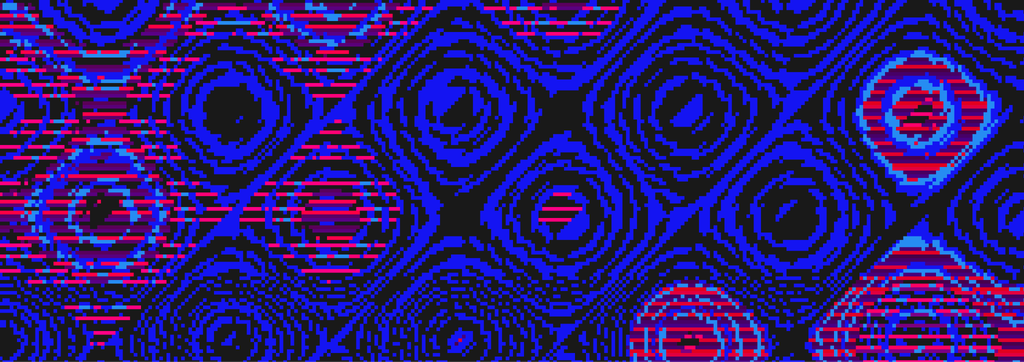
In this work, Mosaic, which has been developed and continuously evolved through Bitcoin Art Society ( BAS ), the numerical attributes of satoshi are transformed into colors and spatial coordinates. Each contribution adds pixels to this ever-expanding work, which overall resembles digital textiles, early computer graphics, or abstract paintings.
Mosaic does not rely on familiar Bitcoin images to depict Bitcoin; instead, it treats the network itself as artistic material. The position of satoshi and unspent transaction outputs (UTXO) become inputs for a rule-based system, which in turn determines the appearance of the work. BitArt starts with the underlying data of Bitcoin and then allows the images to be generated naturally.
This approach reminds one of the ideas of conceptual artist Sol LeWitt: a work can exist as a set of instructions, rather than necessarily being a single handmade object. Generative artists such as Vera Moln and Manfred Mohr have also explored how mathematical systems and computational programs can produce visual compositions. Mosaic extends this tradition to an economic network shaped by transactions and human decisions.
Its scale is quite astonishing. According to BitArt, Mosaic currently contains over 127 million tile and 1 billion layers. If one were to view all the layers at a rate of one layer per second, it would take more than 30 years.
This project has also been extended to include sound. The musical portion utilizes the same satoshi data used for generating images, converting numerical values into evolving musical scores. Together, these elements constitute an audio-visual work shaped by both the underlying structure of Bitcoin and the contributions of its participants.
These experiments are part of a broader goal of Bitcoin Art Society. The organization was founded by Serge Ajamian and Yara Al Chammaa with the aim of supporting the creation, exhibition, and preservation of digital art on Bitcoin.
For Al Chammaa, preservation holds particular personal significance. After the explosion at the Port of Beirut in 2020 destroyed a large number of artworks in her family's gallery, she began to rethink how cultural heritage can continue to exist after physical destruction. This experience prompted BAS to see Bitcoin as a potential medium for preserving cultural works while avoiding the vulnerabilities of physical institutions.
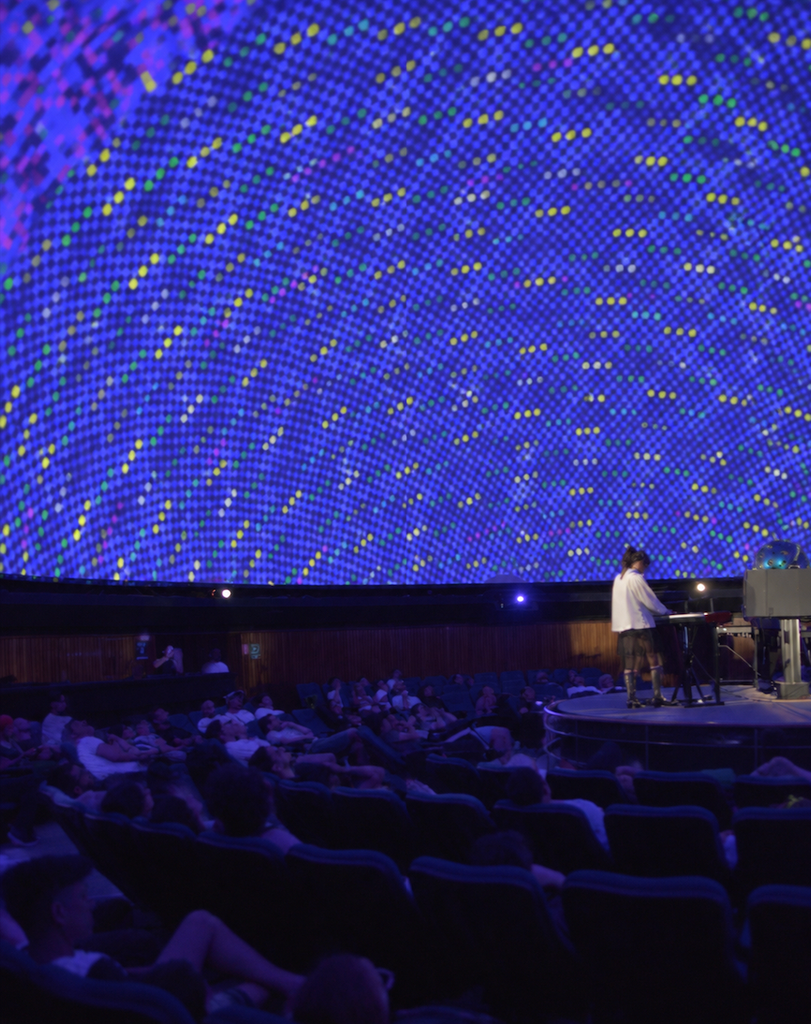
BAS Since then, Bitcoin-based digital art has been showcased internationally, including at Galileo Galilei Planetarium accompanied by live music. Mosaic Its first artist residency program included BitArt and CyberSea, both of which explored the production of generative systems and blockchain-native art.
However, permanent issues are not limited to the durability of the Bitcoin ledger alone. Art based on software has long been a challenge to museums: they not only need to preserve the underlying materials but also the technologies and experiences that visitors rely upon when engaging with the works. For Mosaic, what constitutes the work itself: the code, the rendered images, the accumulated contributions, or the experience of browsing this system?
On Bitcoin Amsterdam 2026, Mosaic will be presented on the main stage of the conference on a LED device, showcasing its complex visual structure on a architectural scale, which is similar to BAS's immersive display in Buenos Aires, Galileo Galilei Planetarium.
On the eve of the event, BMAG interviewed BitArt to discuss the artistic origins of the project, collective authorship, and the possibility of preserving a work that may never be completed.
BMAG:You once described Bitcoin as a time-based medium of exchange, rather than just a platform for displaying art. How did you initially realize that its underlying mathematical and economic structures could become material for art, and how did that idea evolve into Mosaic?
BitArt:Bitcoin records the flow of value through a series of events, which are secured by computational work, forming a history that becomes increasingly irreversible over time. What attracts me is not just a single event, but rather the chain of events that leads to it. In an artistic context, this shifts the question from “What is the work?” to “What must have happened for the work to become what it is today?”
With the emergence of the Ordinals protocol, each satoshi can be assigned a unique identifier. This opens up new possibilities.
From that point on, the development of Mosaic was almost natural. All I needed to do was bring out what already existed. Once each satoshi had a ordinal number assigned to it, it became relatively easy to determine its position, and I could then derive its color or musical parameters based on a set of rules.
What's interesting is that these structures come from a system driven by human decision-making, rather than a system designed specifically for art.
BMAG:From Sol LeWitt to Vera Moln, artists have been exploring how preset rules can produce unexpected visual results. In Mosaic, how do your decisions shape the system, and where does the underlying data of Bitcoin begin to take over?
BitArt:In a sense, Mosaic continues the tradition of rule-based art explored by LeWitt and Moln, and is also built upon the concepts of protocol art discussed in Holly Herndon and Mat Dryhurst. However, it adds another layer: the input is the result of cumulative human decision-making within the economic system.
My art determines the rules of interpretation, while the underlying data determines the final visual and auditory structures that are formed.
These rules are deterministic, but the outcomes are not necessarily predictable in practice. I find this tension very interesting. What artists create are certain conditions that allow things to emerge, rather than directly specifying what they should look like or sound like.
BMAG:Participants contribute to Mosaic through their own transactions, becoming part of this work that is not controlled by any single individual. Does this mean they are collectors, collaborators, or something else?
BitArt:I believe that the right of attribution is distributed across multiple levels.
Perhaps the most interesting aspect is that individual intentions can generate collective structures that no one could have anticipated. Everyone contributes a specific element, but the larger composition belongs to the entire system.
Participants can be collectors, but they also become contributors to the ongoing evolution of the work's structure. The boundary between collecting and creating becomes less distinct. Each contribution changes the work, but no one, including myself, can control the final composition that results.
The right to attribution is no longer about controlling the outcome, but rather about establishing the conditions that allow that outcome to occur.
BMAG:You are developing a system for the upcoming Postmasters exhibition, which will allow visitors to directly interact with the artworks and receive responses. How is this different from participating in Mosaic through Bitcoin transactions? Is this a different form of communication that is achieved through computational systems?
BitArt:Yes, both are intentional actions mediated by computing systems, but there is an important semantic difference between them.
Making a contribution through the Bitcoin transaction pair Mosaic is a non-verbal act that becomes part of a verifiable record. We can accurately know what has happened and how it has changed the work. This action leaves a trace that the system can process directly.
It's different when engaging in a dialogue with a work. Natural language must first be interpreted and translated into the formal language used by the work for communication.
In the first case, the action causes a verifiable change in the state of the work; in the second case, it initiates an interpretive process.
Both express human intention, but one establishes computational facts, while the other opens up space for interpretation.
BMAG:You have written about the creative uncertainties that arise during the programming process and have also attempted to study the relationship between these uncertainties and the block generation time of Bitcoin in real-time. How important are uncertainty, randomness, and duration to your practice? Mosaic Have there been any results that surprised you or challenged your original intentions?
BitArt:I designed the algorithm for Mosaic to be as simple as possible. It is deterministic, so technically speaking, its results are predictable and reproducible. From a technical perspective, there shouldn't be any surprises at all. Nevertheless, the results are full of unexpected and surprising elements.
I believe that being computationally predictable is one thing, and whether we can foresee or understand its outcome is another matter.
Currently, Mosaic contains over 127 million tile and more than 1 billion layers. To view all layers at a rate of one layer per second would take over 30 years. I've discovered many things that surprised me, and I'm still constantly finding new content.
I am also interested in the time difference between real-time and the block generation time of Bitcoin. Bitcoin evolves at its own pace, unaffected by how or when we observe it. This introduces another dimension of duration to the work.
BMAG:The introduction of sound adds another dimension to Mosaic. The musical works are generated from the same data that determines the visual structure. What aspects of the underlying system can sound reveal that images cannot present?
BitArt:From the very beginning, Mosaic was built on three fundamental ideas.
Firstly, it is possible to capture traces of human intent within a financial or algorithmic system, and to reveal the structures of vision and sound from them.
Secondly, it is to develop a formal system that enables Mosaic to possess metacognitive abilities, that is, self-reference and introspection, and to be able to communicate and collaborate with other works.
Thirdly, it is collective creation. Anyone can contribute content to Mosaic and become a part of its continuously evolving structure.
From any one of these perspectives, Mosaic reveals different aspects. In terms of sound, it uncovers melodies, harmonies, counterpoints, and rhythmic structures that may not be immediately apparent in the visual presentation.
BMAG:Your works have been exhibited at institutions such as Whitney, ZKM, and ICC Tokyo, which are all very important in the history of digital and media art. How do you view the position of Mosaic within the broader history of generative art and systems art? What can be achieved by using Bitcoin directly, compared to earlier computing media?
BitArt:I regard Mosaic as part of the tradition of generative art and systems art, but what particularly interests me is extending this tradition beyond image and sound generation.
I am currently collaborating with BAS to plan an exhibition for the Postmasters gallery in New York. The exhibition will showcase the interactions and collaborations between Mosaic and other artworks.
In principle, any work that can be represented digitally can be included in the dialogue, whether it is Leonardo da Vinci's "Mona Lisa," Malevich's "Black Square," works inscribed on Bitcoin, or music of various styles ranging from traditional folk songs, Nine Inch Nails's "34 Ghosts IV," to Ravel's "Bolero."
Through the system I mentioned earlier, these works can reference each other, exchange statements, and initiate collaboration using a machine-readable form of language. What's particularly interesting is that audiences will also be able to directly converse with the works in natural language, joining in these exchanges as well.
Historically, discussions about art took place outside of the works themselves, within texts, institutions, discussions, and criticism. The works themselves were mostly merely objects of silent interpretation. By endowing works with the formal capacity to reference each other, to reflect on themselves and others, and to exchange verifiable statements, this project treats discourse itself as artistic material.
Art history usually describes causal relationships retrospectively. But here, through the collaboration between artworks, influence becomes something that can be actively enacted; influence turns into an action that the artworks themselves can perform.
Works are no longer merely the result of a process, or the process itself. They become participants in a continuous process of interpretation, communication, and creation.
BMAG:Mosaic has already been exhibited in immersive environments that include Buenos Aires, Galileo Galilei Planetarium. By Bitcoin Amsterdam, this work will be adapted for a large main stage and presented on LED screens. Considering that it was originally interactive and continuously evolving, how will this change the way audiences interact with the work?
BitArt:The surface of a work is not fixed, nor is it the work itself. It is merely the representation of the work in a certain moment.
I really like the approach of BAS: presenting it in intimate spaces, large-scale immersive environments, and various scenarios in between. Each scenario allows the audience to experience different aspects of the same underlying system.
For the Postmasters exhibition, I am still developing a physical component to provide another way of experiencing Mosaic.
What interests me is that this work can present very different forms without changing its underlying identity. The way it is displayed may vary, but the system that constitutes the work remains the same.
Exhibition and Extended Reading
You can learn about the constantly evolving Mosaic project of BitArt through Bitcoin Art Society. To gain more information about its exhibition and artist residency programs, follow BAS on X.
BAS will also be holding Art on Bitcoin : BAS Night from 8 PM to 11 PM on November 6th at WiHH Gallery ( What Is Happening Here ) in Amsterdam. This event is co-organized with Bitcoin Amsterdam and brings together artists, collectors, and the Bitcoin community, featuring exhibitions, receptions, dining, music, and networking sessions. More information can be found here: RSVP.
Read more content from the BMAG Bitcoin Amsterdam series: The Undercurrent, Three European Artists, on, Making Money Visible, The Architecture, of, Money, Mapping Financial Power, in, the, Age, of, Bitcoin.
Bitcoin Museum and Art Gallery (in collaboration with BMAG) organize international exhibitions, auctions, and artist collaborations to explore Bitcoin and its cultural impact.
Mosaic of BitArt will make its debut on the main stage LED at Bitcoin Amsterdam from November 5th to 6th, 2026, as part of the BMAG project. Welcome to Amsterdam, and use the code BA26-BMAG20 to enjoy discounted tickets. You can purchase tickets here.
Label
Art
BitArt
Bitcoin
Bitcoin Art Society
BMAG
Culture