After the Federal Reserve decided to maintain interest rates unchanged, the price of Bitcoin fell below $80,000, despite the fact that US spot Bitcoin ETF attracted over $423 million in capital inflows for three consecutive trading days.
Following the Federal Reserve's interest rate decision on October 28, the price of Bitcoin fell by 1.50% to $79,810.94.
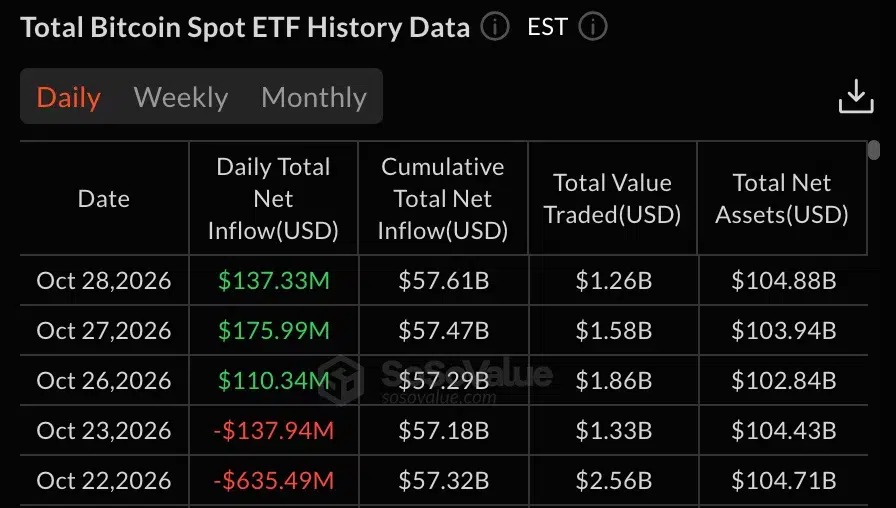
According to SoSoValue data, spot Bitcoin ETF attracted a total of $423.66 million in capital inflows over three consecutive trading days.
The Federal Reserve maintains interest rates between 3.75% and 4%, with two officials supporting another rate hike.
Santiment has observed that the volume of Bitcoin transactions and the number of active addresses are below the average levels on weekdays from July to September.
The price of Bitcoin is currently facing immediate support around $79,700, and if it can once again exceed $82,000, it may improve market momentum.
The Federal Reserve's decision on October 28 was passed with a vote of 10 to 2. Federal Reserve Governor Lisa Cook and the President of the Cleveland Federal Reserve Beth Hammack supported a 25-basis-point interest rate hike, as inflation remained above the central bank's target. After the announcement, the price of Bitcoin initially rebounded above $81,000, but then fell back to around $79,800. Traders are watching to see if this level will be lost again.
As of press time, Bitcoin was trading at $79,800, a decrease of 1.50% within 24 hours; according to crypto.news market data, the cryptocurrency market as a whole fell by about 1.57%. This decline occurred against the backdrop of renewed concerns about inflation, rising oil prices, and the possibility that U.S. borrowing costs will remain high.
After the Federal Reserve maintained interest rates unchanged, Bitcoin weakened.
The October meeting concluded with a vote of 10 to 2. Federal Reserve Board member Lisa Cook and the President of the Cleveland Federal Reserve Beth Hammack supported raising interest rates by a quarter of a percentage point. Their opposition to this decision reflects that, despite continued economic growth, inflation remains stubborn.
Federal Reserve Chairman Kevin Warsh admitted that inflation is still too high and stated that the central bank needs more evidence to prove that monetary policy is restoring price stability. In response to questions about political pressure, Warsh indicated that the committee's decisions are not influenced by political factors.
Investors are now awaiting the inflation report for September's personal consumption expenditures ( PCE ) to be released on October 29th. Economists surveyed by The Associated Press expect that the annualized PCE inflation rate will reach 3.6%, up from 3.4% in August.
Oil prices also add complexity to the outlook. Trading firm Wintermute points out that Brent crude oil prices above $115 per barrel pose inflation risks, especially in a context where higher energy costs may threaten household spending and corporate expenditures.
Before the Federal Reserve decided to announce its decision, Bitcoin had already struggled to recover from its decline in October. crypto.news previously reported that before the announcement on Wednesday, this cryptocurrency once rose above $80,000, due to investors assessing exchange capital flows and geopolitical developments.
Bitcoin ETF has recorded capital inflows for three consecutive days
SoSoValue data shows that on October 26, there was a net inflow of $110.34 million, on October 27 it was $175.99 million, and on October 28 it was $137.33 million. The total inflow over these three days amounted to $423.66 million, which partially reversed the capital outflow that occurred in the previous week.
Previous sell-offs have left Bitcoin vulnerable even as demand from funds has picked up. On October 22, spot ETF saw a net outflow of approximately $635.6 million, and further outflows occurred the following day. As a result, there remains uncertainty in the spot market demand as institutional funds begin to flow back later on.
ETF The inflow of funds measures the net subscriptions to investment funds, which does not necessarily lead to an immediate increase in the price of the Bitcoin market or at the same proportion.
Bitcoin Price Forecast: $80,000 Remains a Key Level
Pressure has already spread to the derivatives market, and within the past 24 hours, it is claimed that over $69 million in Bitcoin positions were liquidated, with most of the losses coming from long positions.
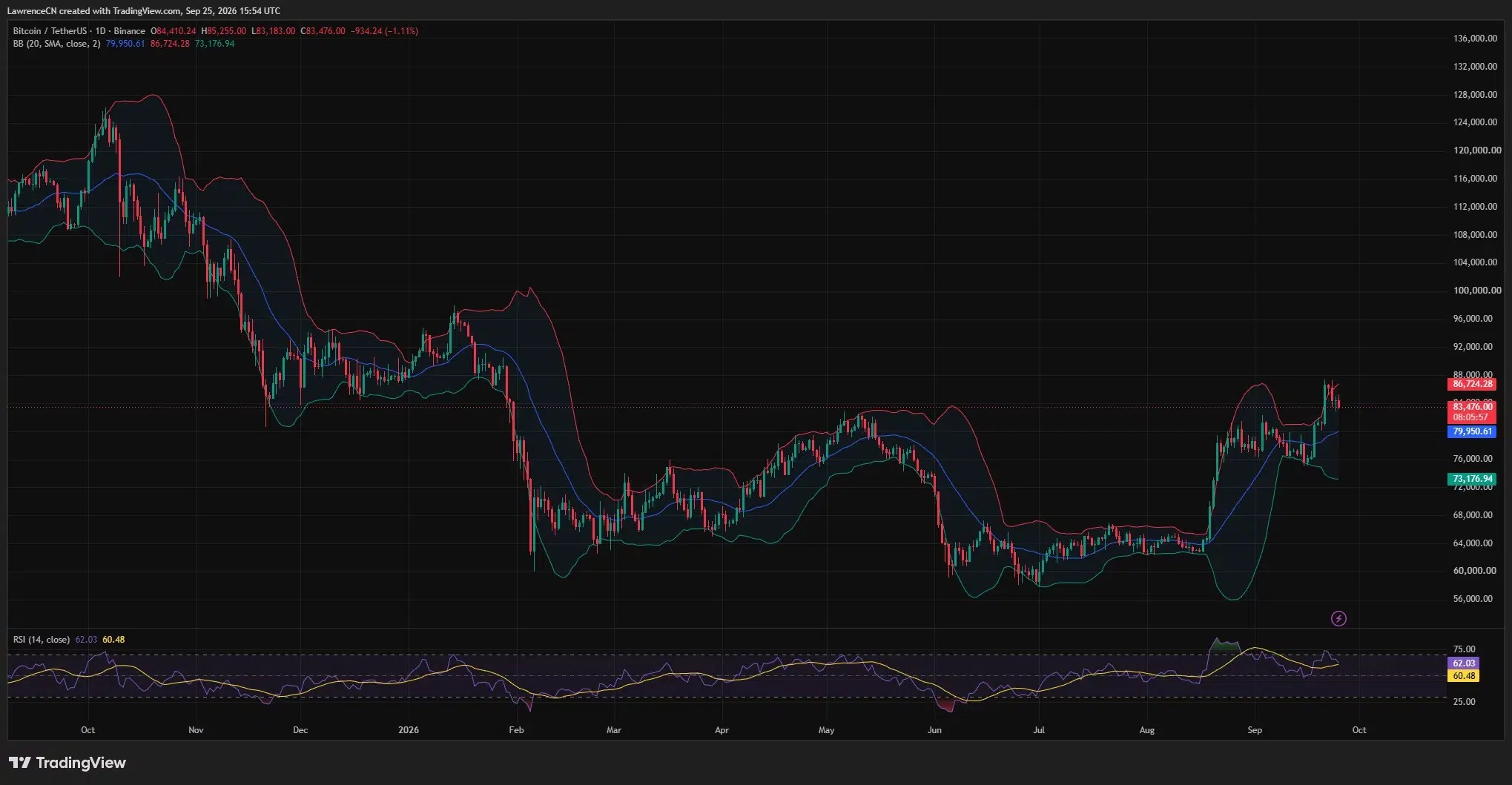
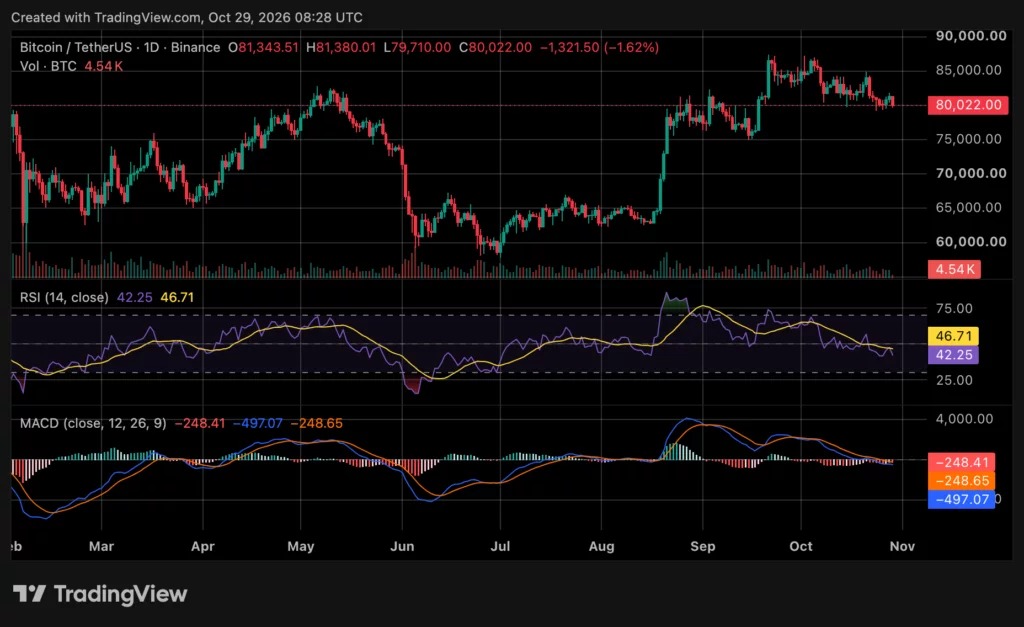
On the TradingView daily chart, Bitcoin once fell to $79,710 before rebounding to around $80,022. The Relative Strength Index (RSI) was at 42.25, which is below its moving average of 46.71, while the MACD indicator remained negative at -497.07.
Cryptography analyst Daan Crypto Trades pointed out that Bitcoin has failed multiple times to maintain a local rebound near $80,000, indicating a persistent short-term downward trend since September 20th.
Another analyst, Crypto Patel, pointed out that seller liquidity is around $74,911, with potential support levels lower between $62,000 and $69,000. His judgment is based on the premise of a more significant decline.
The current support level is around $79,700 to $80,000; if it breaks below this range, it could fall further to around $78,000, and then to $75,000 to $76,000. Buyers will need to regain the $82,000 level in order to challenge the resistance around $84,000 to $85,000.
Limited growth in Bitcoin network activity
On-chain analysis firm Santiment has raised doubts about the claim that "Bitcoin trading activities are accelerating." Its analysis on October 28th showed that from October 14th to 27th, the average number of transactions on weekdays was 271,800, whereas the average from July to September was 278,800.
In the past two weeks, the average number of active addresses on weekdays was 637,000, which is lower than the summer average of 662,000. Santiment noted that at the beginning of October, the number of transactions on weekdays was around 295,500, after which activity dropped back to previous levels.
In addition, market analysts are watching the inflation data release on October 29th and the financial reports of large technology companies, as these could affect short-term risk appetite. The next regular policy meeting of the Federal Reserve is scheduled for December 8th to 9th, and the minutes of the October meeting will be published on November 18th.
Disclosure: This article does not constitute investment advice. The content and materials on this page are for educational purposes only.