The Federal Reserve maintains interest rates unchanged; two officials advocate for rate hikes; Bitcoin approaches $80,800.
On October 28, the Federal Reserve Board of the United States maintained the benchmark interest rate unchanged at 3.75% to 4.00%, but two officials favored an additional 25 basis point increase in interest rates, at a time when the trading price of Bitcoin was near $80,800.
- After raising interest rates by 25 basis points in September, the Federal Reserve will maintain the interest rate range at 3.75% to 4.00% this time.
- Two officials opposed a pause in interest rate hikes, voting in favor of raising rates by another 25 basis points.
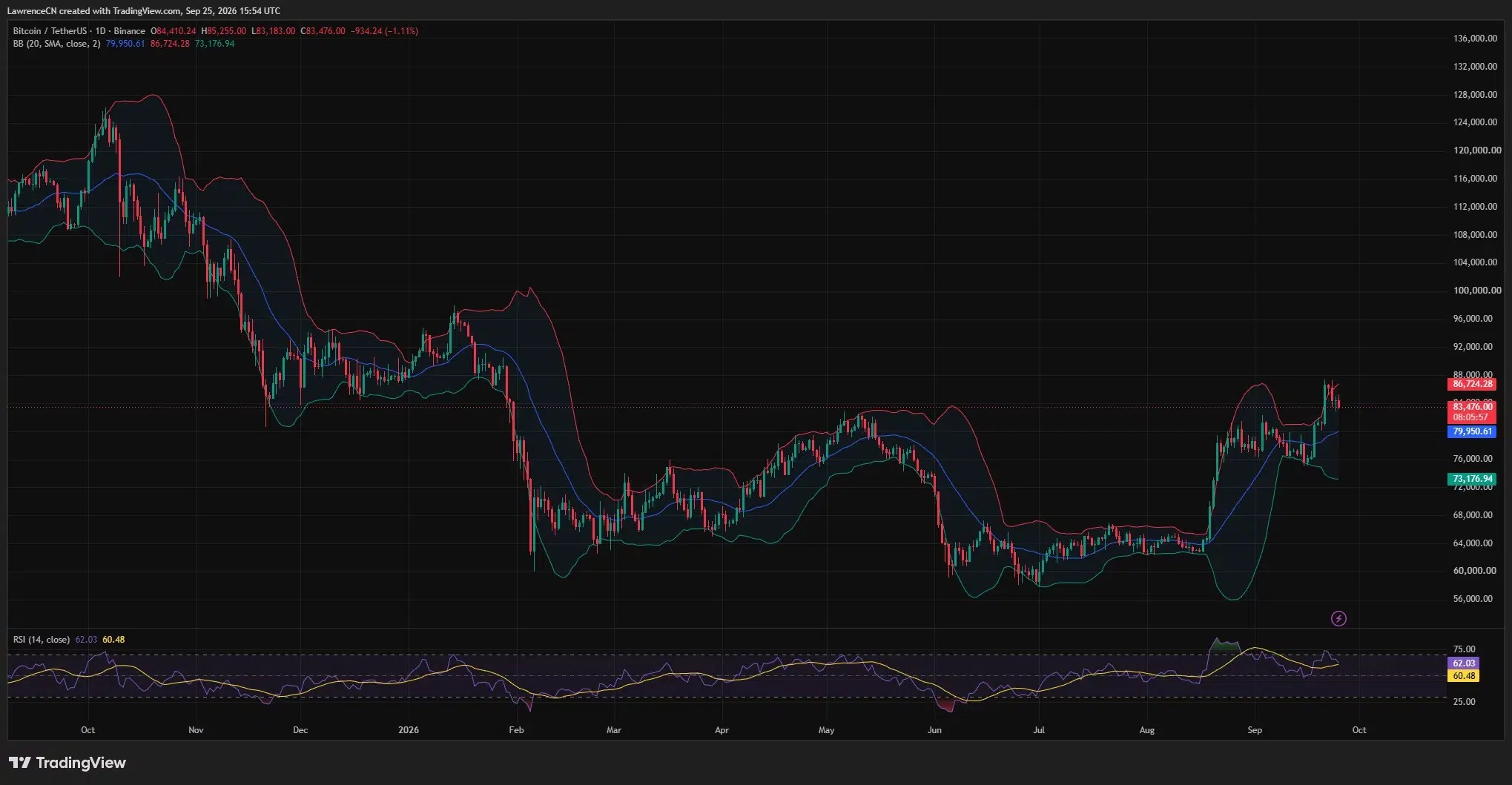
- Bitcoin trading is approaching $80,800, with earlier analyses suggesting that there is resistance above $81,400.
- The consumer inflation rate in September was 3.7%, higher than 3.4% in August.
According to the Federal Reserve's statement in October, the Federal Open Market Committee made this decision with 10 votes in favor and 2 against. Lisa Cook ( Lisa Cook ) and Beth Harker ( Beth Hammack ) voted against, advocating for higher interest rates.
The Federal Reserve paused its actions after raising interest rates in September.
In a statement released at 2 p.m. Eastern Time, the committee stated that economic growth is strong, while inflation remains on the high side. Policymakers noted that domestic spending has remained resilient, capital investment is solid, and there has been little change in the unemployment rate.
The committee stated that more information would help it determine an appropriate policy stance in order to bring inflation back to the 2% target in a timely manner. The statement read: "The committee will achieve price stability."
The October disagreement followed a unanimous decision to raise interest rates on September 16th. At that time, all 12 voters supported an increase of 25 basis points in interest rates, raising the benchmark interest rate range to its current level, as stated in the September statement.
In September, the statement described economic activity as expanding at a “steady pace”; in October, the description was changed to a “strong pace.” Both statements retained the central bank’s commitment to maintaining sufficient reserves for the banking system.
Prior to the announcement, KPMG ( KPMG ) predicted in its meeting preview on October 22 that interest rates would remain unchanged, with an expectation of a rate hike in December. At that time, the firm anticipated a unanimous vote to keep interest rates stable, but also noted the risk of one official advocating for a rate hike. On Wednesday's decision, there were ultimately two such opposing votes.
KPMG economists stated that the pause between quarterly interest rate hikes will allow officials to assess inflation, employment, and financial conditions. Their preview indicates that the challenge lies in tightening policy without causing market problems, as the market is already facing higher borrowing costs and relatively high long-term yields. The firm's prediction of a rate hike in December is still just an expectation and not a decision that has been announced by the Federal Reserve.
Bitcoin remains above $80,000 after a rebound in volatility
As of the time of viewing, the market panel attached to the report dated October 28 showed that Bitcoin was trading at $80,771, up 0.47% in the past 24 hours. The intraday trading range displayed was from $80,334 to $81,636.
Earlier in the day, crypto.news reported that Bitcoin had rebounded above $80,000, but was still below the short-term moving average. The technical analysis in that report indicated that the 9-day moving average was at $81,416, and the 21-day moving average was at $81,905.
Citing analyst Rekt Capital, the report identifies $81,400 as the three-day closing level that Bitcoin needs to regain, as this level has previously lost its support. The rebound scenario suggests that the target range above $81,400 is between $82,000 and $82,500, with a potential further rise to $84,202 thereafter.
The same analysis also identifies $80,000 as the immediate support level, followed by $78,000 and $76,000 respectively. These levels come from analyses published before the Federal Reserve's announcement, rather than being the latest assessments of trading activity after the resolution.
Analysts continue to pay attention to the capital flow and leverage of Bitcoin ETF.
HashKey Group Senior Researcher Tim Sun Previously identified treasury bond yields, US spot Bitcoin ETF capital flows, and derivatives leverage as the main factors to watch before and after the Fed's next decision.
In a comment published on September 29th, Sun stated that if there is a second consecutive interest rate hike, investors might regard the September increase as the beginning of a continuous tightening cycle. He mentioned that higher long-term yields and tighter dollar liquidity could suppress demand, while leveraged positions might affect the extent of Bitcoin's reaction.
Comments from Sun preceded the decision to suspend interest rate hikes on Wednesday. His judgment is that the continuous inflow of funds into ETF may provide support for Bitcoin, while excessively high derivatives leverage could expose the market to risks in times of environmental changes.
An analysis on October 17th showed that, according to the daily statistics of Farside Investors, US spot Bitcoin funds experienced a net outflow of $614.7 million over the first 12 trading days of October.
The report indicates that daily capital flows are not stable: on October 13, there was an inflow of $175.7 million, followed by an outflow of $261.4 million on October 14. The report notes that the total amount of fund capital flows may be subject to adjustment and does not directly equate to the spot buying volume on the exchange on the same day.
Inflation heated up in September due to rising gasoline prices.
A report from the U.S. Bureau of Labor Statistics in September showed that the annualized consumer inflation rate was 3.7%, higher than 3.4% in August. After seasonal adjustment, consumer prices rose by 0.6% that month, compared to a 0.4% increase in August.
The institution stated that in September, gasoline prices rose by 9.1%, contributing more than half of the overall monthly increase in the index. Excluding food and energy, prices increased by 0.3% that month and by 2.6% year-on-year.
In another measure, the Federal Reserve's economic forecast for September set the median inflation rate for 2026 at 3.7% and 2.3% for 2027. These forecasts measure changes in the fourth quarter compared to the same period last year, while the September reading measures the previous 12 months.
In September, the forecast set the median federal funds rate at 4.1% for both the end of 2026 and 2027, higher than the June forecasts of 3.8% and 3.6%. The Federal Reserve described these figures as participants' individual assessments of appropriate policy.
In September, the forecast set the median growth rate for GDP in 2026 at 2.3%, which is higher than the 2.2% predicted in June; the unemployment rate was projected to be 4.1%, lower than the previous estimate of 4.3%. Participants expected core PCE inflation to be 3.4%, down from the previous forecast of 3.3%.
According to the implementation guidelines from October, starting from October 29th, the interest rate on reserve balances will be maintained at 3.90%. The operating rate for regular overnight repurchase transactions will remain at 4.00%, while the quoted rate for overnight reverse repurchase transactions is set at 3.75%. Additionally, there is a daily limit of $160 billion for each counterparty.