As AI becomes increasingly integrated into corporate operations, the dependency relationships between employees and suppliers are changing, and geopolitical pressures are also reshaping procurement methods. Global research and API have driven consulting firm Infotech to release its annual report "Tech Trends 2027," which outlines 14 trends under four main themes and indicates that these trends will shape strategic and technological investments in the coming year.
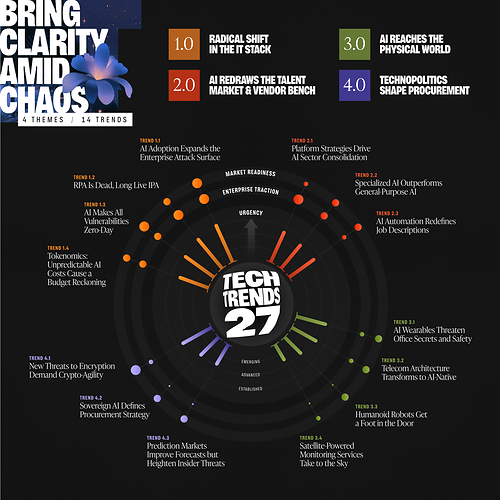
Arlington, Virginia, October 27th ( PRNewswire ) – Technology leaders preparing for 2027 need to consider several changes that may affect their investment costs, security, and feasibility. Infotech has released its annual flagship report " Tech Trends 2027: Bring Clarity Amid Chaos ", which identifies four major themes and 14 trends for the coming months.
Infotech This highly anticipated report points out that as the capabilities of the AI model converge, the supporting infrastructure, tools, and governance will become increasingly important for a company's AI outcomes. How AI is deployed will increasingly determine whether an organization can control costs, switch suppliers, and maintain oversight during automated expansion.
The report, based on expert interviews as well as primary and secondary research, examines how these trends apply to various industries such as financial services, healthcare, legal services, manufacturing, and government, and tracks the policy and procurement progress in the United States, Canada, the United Kingdom, Australia, and the European Union.
Each trend is assessed based on the maturity of the market and the adoption by enterprises, reflecting the level of market support for such adoption, as well as the approaches taken by organizations. These assessments are intended to help technology leaders determine which developments require action and which are worth further testing or monitoring.
The lead author of the report, Infotech, Chief Research Director Brian Jackson, stated: "By 2027, technology leaders will face pressure from suppliers who are eager to drive AI demands; they will also face pressure from executives who require the use of AI without defining the desired outcomes; in addition, they will face pressure from employees who simply want to get their hands on it. Those leaders had better remember that their priority is not to unleash uncontrolled AI forces within the organization, but to steer its potential in the direction the organization intends to go."
Four Major Themes and 14 Trends Worth Paying Attention To in 2027
Emerging technologies will require different approaches in the coming year. Some of these, such as the AI agents embedded in enterprise software, already require operational-level supervision; whereas humanoid robots are still only suitable for limited pilot projects. The Infotech report "Tech Trends 2027" assesses these developments within the broader context of changes in the supplier market, labor demand, and access to technology.
Under the four main themes, the following 14 trends summarize the developments that technology leaders need to consider when planning for 2027:
Topic 1: A Fundamental Shift in the IT Technology Stack
AI is transforming the way enterprise systems perform tasks, consume resources, and expose organizations to risks. Under this theme, the report explores four trends that are reshaping automation architectures and operational controls:
- Trend 1 – AI adopts a strategy to expand the attack surface of enterprises: Personal AI accounts, unauthorized connections, and proxies embedded in approved software all create new entry points. As usage increases, stronger identity control, as well as assigning a responsible human owner to each proxy, will become crucial.
- Trend 2 – RPA is dead; IPA lives on: In the IPA platform, AI agents can interpret information and plan actions, while mature robotic process automation is responsible for repeatable executions. Combining these two capabilities will allow organizations to extend the lifespan of their existing automation investments when advancing more complex workflows.
- Trend 3 – AI turns all vulnerabilities into “zero-day” issues: AI is accelerating the speed at which software flaws are discovered and exploited, putting pressure on repair capabilities. To keep up with this pace, continuous security testing and greater responsibility on the part of suppliers are required.
- Trend 4 – Tokenomics: Unpredictable AI costs lead to budget reevaluations: Pay-per-use billing and multi-step proxy workflows complicate expenditure forecasting. Linking AI expenditures with business value will depend on clearer cost attribution, appropriate model selection, and control over usage patterns.
Topic 2: AI Reshaping the Talent Market and Supplier Portfolio
As AI changes the work content of organizational automation and the capabilities for purchasing, technical leaders face new dependencies in terms of suppliers and employee teams. This topic covers three trends:
- Trend 5 – Platform strategy drives integration in the AI industry: Competition centered around enterprise orchestration and support tools is expected to be driven by integration by 2027. Transactions that poach core teams from suppliers may disrupt product development and support, but they will not trigger contract protections related to mergers and acquisitions. Contracts should take into account these continuity risks and should stipulate terms for ongoing services, data portability, and transition periods while the buyer still has bargaining power.
- Trend 6 – Dedicated AI is superior to general-purpose AI: This advantage is most evident in regulated industries such as healthcare, law, and financial services. Dedicated models and tools may have almost no credible alternatives, which can make it more difficult to switch suppliers and grant suppliers greater pricing power. When choosing them, it is necessary to weigh performance and industry suitability, as well as supplier dependence and the availability of feasible alternative solutions.
- Trend 7 – AI Automation Redefines Job Descriptions: AI Agents are taking over tasks that once helped junior employees gain experience. As these tasks become automated, organizations need to redesign entry-level positions while maintaining development paths that can cultivate future professional skills and institutional knowledge.
Topic 3: AI Entering the Physical World
Wearable devices, programmable networks, robots, and satellite services are extending digital capabilities into the physical environment. Centering around these four trends, the report from Infotech identifies matters that require immediate governance, as well as opportunities that are better suited for evaluation through targeted pilots:
- Trend 8 – AI Wearable devices threaten office confidentiality and security: Devices with recording capabilities can be useful for fieldwork and accessibility assistance, but they also pose risks to privacy and confidentiality. Acceptable usage policies should specify when these devices can be worn and used for recording, while also accommodating employees who rely on them as assistive tools.
- Trend 9 – Telecommunications Architecture Moving Towards AI Native: With the gradual rollout of 5G around 2027 and 6G expected to arrive by 2030, mobile networks are becoming the core of AI service layers. Networks will offer services such as fraud detection and low-latency processing, but organizations adopting these services will need clear API security strategies, stricter control over non-human identities, and measures to prevent cost surges associated with pay-as-you-go models.
- Trend 10 – Humanoid robots are beginning to gain pilot opportunities: With declining unit costs and increasing investment, more opportunities for piloting humanoid robots are being created, although their autonomy is still limited. Before broader deployment, limited testing should be conducted first; supplier evaluations also need to take into account dependence on human remote operators and integration requirements.
- Trend 11 – Satellite-driven monitoring services take off: Better image quality and new satellite services are expanding the opportunities for monitoring assets, infrastructure, and environmental conditions. Organizations that evaluate these services should weigh their availability against the operational value brought by more frequent and detailed observations.
Topic 4: Technopolitics Shaping Procurement
Geopolitical uncertainties and emerging security risks are affecting technology choices, supplier relationships, and information governance. This trend brings three key developments for 2027:
- Trend 12 – Cryptography Faces New Threats, Requiring Cryptographic Agility: Quantum computing and AI assisted attacks may undermine widely used encryption methods, while governments around the world are issuing guidelines and timelines for post-quantum migration. Preparation efforts should begin with identifying where cryptographic technologies are embedded, planning algorithm replacements that minimize disruption, and incorporating post-quantum readiness into supplier evaluations.
- Trend 13 – Sovereignty: As organizations assess where technology operates and who controls it, data sovereignty and AI sovereignty will influence infrastructure choices. Supplier selection will increasingly involve considerations of jurisdiction, operational control, and the ability to maintain continuous access. For critical applications, it is advisable to retain access rights to at least two competitive, cutting-edge AI suppliers and to design workloads that can be switched between them, which can reduce dependence on a single service.
- Trend 14 – Predicting market improvements, but also intensifying insider threats: Platforms with rapid growth such as Kalshi and Polymarket are expanding the prediction market, and contracts regarding executive resignations, layoffs, and financial reports provide new incentives for insiders to exploit confidential information. IT, legal departments, corporate communications, and investor relations teams must collaborate in monitoring and policy updates, including clearly defining the prediction market within insider trading policies.
The Infotech report " Tech Trends 2027" also emphasizes the cross-effects between these developments. For example, choosing a dedicated AI may affect supplier flexibility and labor demand, while physical AI will pose new requirements for connectivity, security, and workplace policies. Infotech recommends that technology leaders take these interdependencies into consideration when planning investments for 2027 and beyond.
Jackson indicates: "The correct response to emerging technologies may involve limited pilots, modifying procurement requirements, or deciding to continue to observe. The key is to know where urgent decisions are needed and where more evidence is required before making organizational commitments."
On November 11th, at the Infotech LIVE 2026 held in Toronto, Infotech's Chief Research Honorary Director, Gord Harrison, will interpret the findings of a report during his keynote speech for Tech Trends 2027. This event will discuss how technological acceleration and global dynamic changes are reshaping corporate capabilities, risks, and business models.
For more insights into the coming year, you can download and read the report “Tech Trends 2027: Bring Clarity Amid Chaos” available at Infotech.
For media inquiries or to arrange interviews with experts from Infotech (including Brian Jackson), please contact [ email protected ].
Infotech LIVE 2026 Dolun Multimedia Pass
Media professionals, including journalists, podcast hosts, and industry influencers, were invited to attend the Toronto Infotech LIVE 2026 event to gain exclusive access to research, content, and interview opportunities with industry leaders.
Media personnel can apply for free offline access passes by contacting [ email protected ].
About Infotech
Infotech (formerly Info - Tech Research Group) provides consulting services driven by API to over 30,000 IT leaders worldwide, helping them systematically improve their organizations. With 30 years of credible professional experience and proven influence, Infotech offers industry-leading expert guidance, mature methods, practical tools, training, coaching, and consulting to technical leaders to accelerate decision-making and achieve measurable results.
For more information on human resources research and consulting services related to Infotech, please visit McLean & Company; for insights into data-driven software procurement and supplier evaluation, please visit the company's SoftwareReviews platform.
Media professionals can register through the company's Media Insiders project to obtain unrestricted access to IT, human resources, software research, as well as hundreds of industry analysts. To obtain access, please contact [ email protected ].