

Executives in the crypto industry disagree on whether "self-hosted" solutions were designed from the beginning for beginners, and options such as multi-signature wallets and backups without mnemonic phrases come with their own trade-offs between security and ease of use.
Safe Labs CEO Rahul Rumalla said to Cointelegraph: "We don't expect every driver to become a mechanic, nor should we expect everyone who wants to own their own assets to become a security expert."
He believes that making self-hosting more user-friendly could be crucial for the broader adoption of Bitcoin, as "being your own bank" remains one of Bitcoin's most iconic features.
However, implants in some Ledger devices have stolen recovery phrases, and firmware vulnerabilities in Coldcard have also allowed attackers to reconstruct private keys and steal funds.
The CEO of Bitcoin custody service provider Onramp, Michael Tanguma, compared Bitcoin custody to personal computers in the 1970s: at that time, users needed to have technical skills in order to assemble and operate these devices.
He said about Cointelegraph: "Self-hosting was never designed for beginners."
He stated that a simpler design helps computers reach a wider range of users, and Bitcoin hosting also faces similar challenges today.
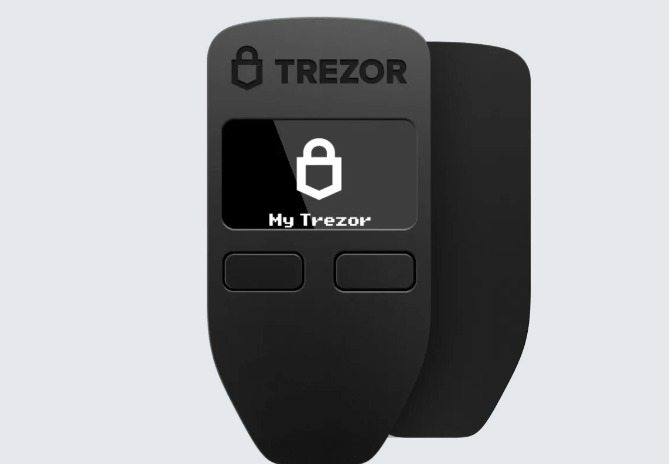
Trezor Model One is the world's first hardware wallet, released in 2014. Source: Trezor
Rumalla disagrees with this statement. He argues that self-hosting 'has always been intended for everyone,' and that 'being able to own and control one's own assets is precisely the whole point of cryptocurrencies.'
He added that self-hosting "does not mean that one has to do everything by themselves."
Multiple signatures enhance security, but there are costs involved.
Multi-signature, also known as multisig wallets, requires multiple keys to authorize transactions together, but it may not be easy for beginners to manage.
Synergy Network Chief Technology Officer Justin Hutzler stated: "Traditional multi-signature implementations introduce additional complexities, including coordination among signatories, key backup, recovery processes, and transaction approval."
Comparison between single signature and multiple signatures. Source: BitGo
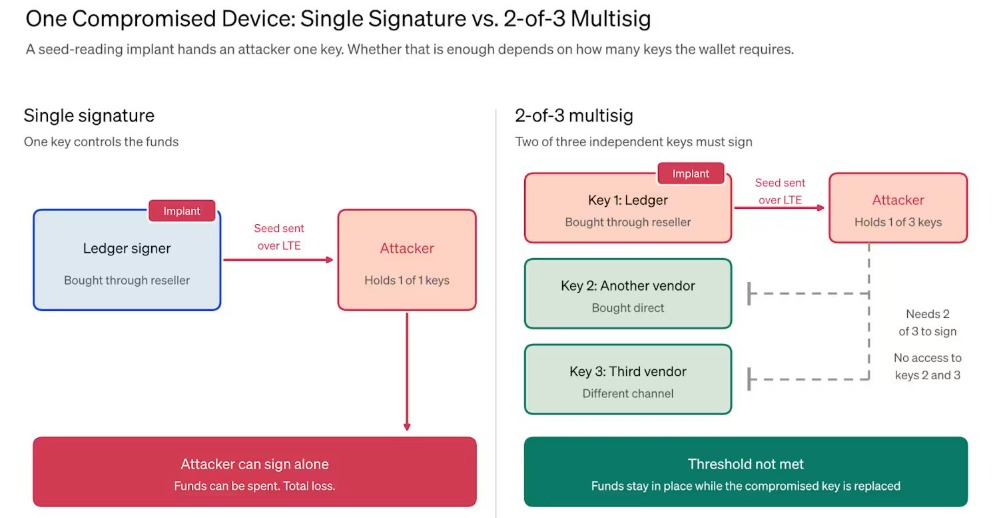
Multiple layers of approval cannot prevent all attacks.
The Rumalla of Safe Labs indicates that if multiple signatories are deceived by the same compromised interface, they may still authorize a malicious transaction.
Removing a mnemonic wallet eliminates one risk, but it also introduces new ones.
Tangem indicates that its lack of mnemonic design simplifies self-management by eliminating the need to manage recovery phrases. Users, on the other hand, must take extra care to secure the physical devices that provide access to their funds.
The private key will be generated on a single card, with backup copies stored on at most two additional devices. Tangem confirmed with Cointelegraph: if all devices are lost, the user will permanently be unable to access their funds.
The company stated that it has not yet received reports from users regarding the loss of all their cards.
Properly keeping the card does not protect users from approving malicious transactions. Zach Herbert, the CEO of competitor hardware wallet manufacturer Foundation, stated that the lack of a mnemonic backup may preserve self-management capabilities, but he criticized Tangem for not having a built-in screen, which means users can only rely on their smartphones to verify transaction details.
He said, "If attackers can trick you into authorizing a transaction that would empty your wallet, they wouldn't need to extract your private key."
Magazine: 5 Alternative Ledger Solutions for Storing Bitcoin