


U.S. Treasury Secretary Scott Branson compared the Trump administration's milestone stablecoin legislation to the banking reforms implemented during President Abraham Lincoln's tenure, stating that both represent efforts to establish a national framework for the U.S. currency more than 160 years later.
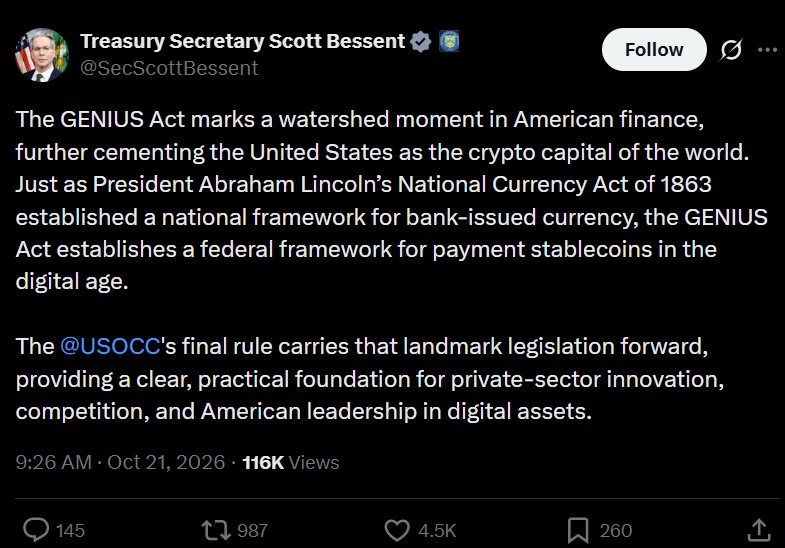
On Wednesday, Bessent posted on platform X, praising the final rules issued by the Federal Reserve (OCC) to implement the GENIUS Act, and described this legislation as a "watershed moment in American finance."
Bessent compares it to the National Currency Act of 1863, which established a federal framework for banks with nationwide licenses to issue currency. He believes that in the digital age, the GENIUS Act serves a similar purpose for payment-stablecoins.
Bessent stated that this rule of OCC will support "innovation in the private sector, competition, and the United States' leadership in the field of digital assets."
Comptroller of the Currency Jonathan Gould stated that this set of regulatory provisions provides a "clear and pragmatic framework" for innovation in payment-style stablecoins.
What do the stablecoin rules for OCC mean for issuers?
The GENIUS Act, signed into law in 2025, established a federal regulatory framework for payment-style stablecoins. The final rules of OCC clarify how this framework will apply to issuers within its regulatory scope, including requirements for reserves, redemptions, and risk management.
Starting from January 18, 2027, companies in the United States that issue payment stablecoins will generally need to obtain regulatory approval in accordance with the GENIUS Act. Issuing stablecoins without the required authorization may result in penalties.
OCC indicates that the final rules apply to national banks, federal savings associations, federal branches of foreign banks, as well as non-bank companies seeking approval to issue payment-stablecoins under federal regulation. Some foreign issuers of payment-stablecoins are also within the scope of coverage.
At the time these regulations were introduced, stablecoins denominated in US dollars were gaining more adoption in the fields of payments and remittances, despite the fact that their overall supply growth had already stagnated.