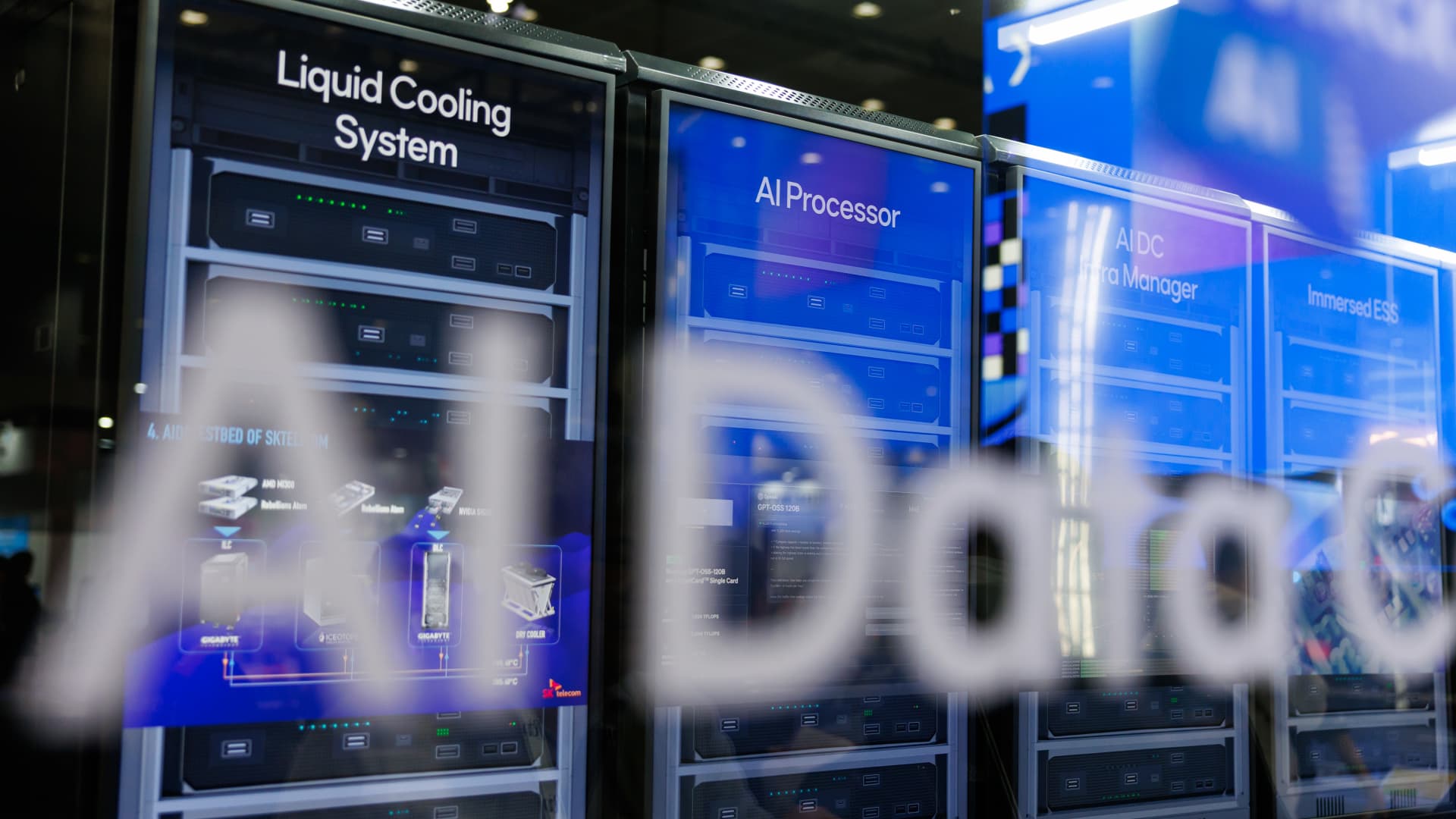


Internal documents from the world's largest cloud computing provider have revealed a rather embarrassing aspect of the AI arms race: billions of dollars worth of NVIDIA's latest generation of chips are sitting idle in Amazon warehouses because they cannot be powered on.
According to internal Amazon documents obtained by Business Insider and a recording of an employee meeting, Amazon's cloud computing division AWS is temporarily storing NVIDIA GB300 racks in a "intermediate warehouse." The reason is that the target data center "has space to accommodate more racks, but does not have sufficient available power to power them on."
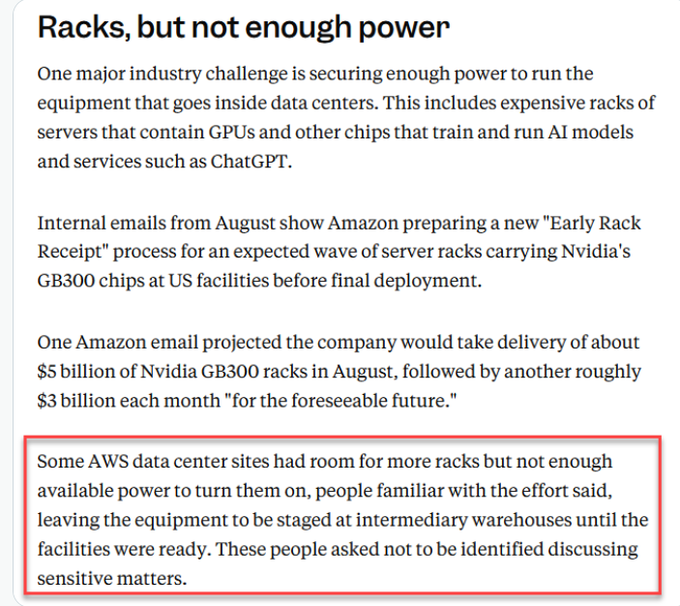
Internal emails show that Amazon expects to receive approximately $5 billion worth of GB300 racks in just August alone, and thereafter continue to receive about $3 billion per month, maintaining this pace for the ‘foreseeable future’.
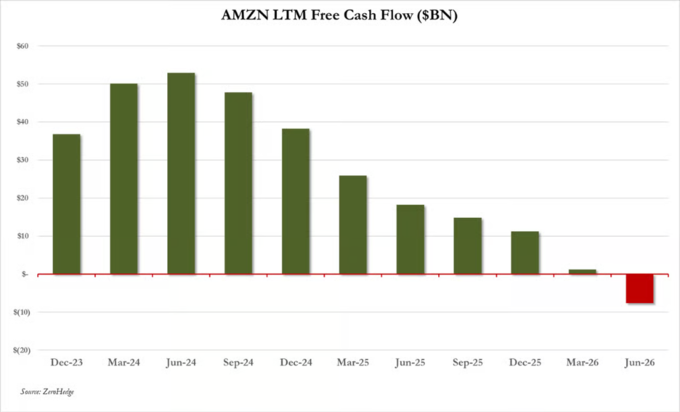
AWS, the Chief Financial Officer, joked with Prasad Kalyanaraman, the executive in charge of AI infrastructure construction, at a September internal staff meeting: "You've managed to turn our company's free cash flow negative. Congratulations." Kalyanaraman did not refute this and stated that the company's free cash flow is expected to remain negative for "the next few years or so."
In July this year, when Amazon announced its financial results for the second quarter, its rolling free cash flow turned significantly negative, recording a loss of $7.6 billion, for the first time in many years.
The impact of this situation on the market has already become apparent. The idle chips in the warehouses are unable to provide any computing power, leading to a persistent shortage of online computing power. As a result, the rental prices for GPU remain high, creating a typical inflationary bottleneck—large amounts of capital, labor, and energy are consumed in advance, while output is delayed by several months or even years.
"Early delivery": The chip competition forces payment to be moved forward
Amazon's previous practice was to make payments only after the devices were actually installed in the data center, with the suppliers bearing the financial cost of the devices during transit. However, internal documents show that Amazon has introduced a new process called “Early Rack Receipt” (early receipt of goods), which allows them to take ownership of the devices before they even arrive at the data center.
Media analysis suggests that the competition for NVIDIA GPU is so fierce that Amazon must secure the hardware in advance, even before determining whether there will be a space for installation, to prevent it from being seized by competitors. This means that Amazon is making payments before the hardware is even powered on, and any delay in installation will push back the timing when these assets begin to generate revenue, during which time cash has already been disbursed.
The report also pointed out that at least one AWS supply chain team did not have a “clear forecast path” for “how to deliver the racks into the data center.” In response, an Amazon spokesperson stated that the company’s usual practice is to temporarily store the hardware near the deployment site until the power is ready, calling this approach “best business practice.”
Research institution Bernstein concludes that power licensing, cooling systems, electrical equipment, construction, and hardware are all progressing at different paces, making it 'difficult to perfectly synchronize the timing.'
Power bottleneck: The core constraint in data center construction
The root cause of the chip backlog lies in the severe lag in power infrastructure. Kalyanaraman revealed in an internal meeting that due to a shortage of plumbers and electricians in West Texas, Amazon had to fund the construction of worker accommodations so that the construction personnel could live on-site for two to three years before the project was completed.
According to Cleanview Research data, Amazon is currently developing data center capacity of 44 gigawatts in 16 states across the United States, which is more than three times its current operational capacity of 13.9 gigawatts. These 13.9 gigawatts are already the largest in the industry, representing a 69% increase over Microsoft's capacity and approximately twice that of Google and Meta.
AWS even has a dedicated dashboard named “Secured Power at Risk” (protected power under threat), which tracks transmission bottlenecks, power rationing requirements, and the “use it or lose it” policy – if a project misses a milestone, Amazon may lose the grid quotas it has obtained.
Kalyanaraman also revealed that Amazon promised CEO Andy Jassy in 2023 that AWS would overcome the capacity shortage by 2027. However, now Amazon expects that demand in 2027 will still exceed available capacity.
Chips are piled up in the warehouse, yet the rent for GPU has actually gone up.
According to conventional logic, a large backlog of chips in warehouses should lower the price of computing power. But quite the opposite is true.
The reason is simple: the GPU contained within the crate produces zero hours of GPU. What is truly scarce is "powered computing capacity," and its price continues to rise.
Rich Pivrotzky, the head of the trading desk at Goldman Sachs Delta-One, pointed out in an internal report on October 16:
Compared to the available supply of investable computing power, there is too much capital seeking a place to go. Repricing is a process that the market will continue to experience, sometimes gradually and sometimes sharply, and it could potentially evolve into systemic risks. An interesting contradiction is that the pricing of immediate computing power remains extremely strong. B200, H200, H100, and even the older A100 all maintain considerable rents. Computing power that should theoretically depreciate quickly still retains its value. The scarcity of available computing power is undeniable, which is structurally beneficial for those who already hold it.
The Sil token tracked by Goldman Sachs, which represents the Data B200 Instant Rental Index (not for ultra-large-scale cloud), is priced at $6.01 per GPU hour, approaching the historical high of $6.11 in March and representing a rise of about 40% from the low of $4.29 in January.
$8 billion in chip sales: A way to reduce the balance sheet pressure or is there more to it?
The aforementioned background provides a new perspective for interpreting a recent transaction involving Amazon. According to a report by The Financial Times on October 2nd, Amazon is seeking to sell approximately $8 billion worth of NVIDIA Grace Blackwell chips to external investors through a special purpose vehicle ( SPV ), and then rent the chips back for use. This SPV entity plans to raise funds through debt financing and will sell up to 10% of its equity. Amazon will not hold any shares in this entity, with the official goal of achieving a more “light-asset” balance sheet.
However, when comparing this transaction with internal documents, the timeline is quite intriguing: in August, Amazon initiated a "pre-delivery" process and received approximately $5 billion worth of GB300 racks that month, with about $3 billion per month thereafter; in September, the AWS Chief Financial Officer confirmed during an internal meeting that the company's free cash flow was negative; on October 2nd, Amazon sought to sell $8 billion worth of chips externally. The total estimated delivery amount for August and September happens to equal the scale of SPV.
The UK's Financial Times cited sources stating that the chips involved with SPV have been deployed in over a dozen data centers across five states in the United States. However, the report does not explicitly clarify whether they are GB300. Regardless, investors who purchase these SPV chips are actually buying an asset that continues to depreciate. The Grace Blackwell chips will soon be replaced by NVIDIA's next-generation Vera Rubin architecture. Each month that the chips sit idle in storage represents a month wasted from their five-year economic lifespan, without generating any revenue at all.
Who pays the interest for these chips covered in dust?
Microsoft's Satya Nadella publicly acknowledged this issue back in November last year. He said, "The biggest problem we face now is no longer an overabundance of computing power, but rather electricity," and admitted that Microsoft "actually might have a bunch of chips in inventory that cannot be used."
As of April this year, among the American data centers that were originally planned to be launched in 2026, about half are facing cancellation or postponement, and only about 5 gigawatts of the planned 16 gigawatts are actually under construction.
According to media reports, Kalyanaraman's own principle is: "It is more advantageous for us if we can spend capital as late as possible." However, the arms race has completely overturned this logic: Amazon is now competing to spend money as early as possible to acquire chips that they may not even need, simply to prevent their competitors from getting them first – and if competitors do obtain these chips, they are likely to end up not using them either.
If we apply this logic to each of the large-scale cloud providers and emerging cloud service providers competing for the same batch of NVIDIA quotas, we will come across a problem of idle warehouses amounting to tens of billions of dollars. Most of this inventory is recorded under the "construction in progress" category, and before it is officially put into use, it is not even included in the depreciation calculations, thus disappearing completely from the financial statements.
From a more macroscopic perspective, this upsurge in AI infrastructure construction is increasingly relying on debt financing. Every month that chips are not in use (i.e., not powered on), it means paying interest for a month on an asset that generates no revenue. At the same time, the cost of computing power rental continues to rise, and these costs are ultimately passed on to every AI laboratory, enterprise, and startup that rents GPU.