U.S. stock markets fell across the board on Friday, as investors' concerns about whether artificial intelligence-related companies can generate sufficient profits in a timely manner to repay their high debts continued to grow, with the tech sector bearing the brunt of the decline. The Nasdaq Composite Index tumbled by about 4.5% this week, recording the largest weekly drop since the week of June 26.
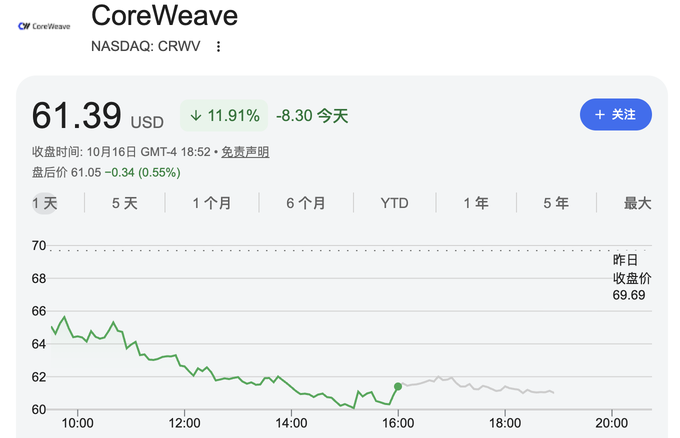
Market concerns about the debt risks of AI infrastructure companies continue to rise, and on Thursday, the yield on some CoreWeave bonds broke through 15%, remaining high on Friday as well. CoreWeave stock prices tumbled another 12% on Friday, with a cumulative decline of over 50% since the year-high.
Meanwhile, Federal Reserve Chairman Jerome Powell refused to provide any guidance on the prospects for the October interest rate meeting at an event of the International Monetary Fund in Bangkok, leaving the market without support regarding policy direction. As oil prices rose and inflation concerns increased, long-term U.S. Treasury yields further climbed, with the yield on 10-year Treasuries reaching 5.097%.
A wave of selling in semiconductor and tech stocks spread to Asian markets starting from Wednesday. South Korea's composite stock index tumbled 14% this week, marking the largest single-week decline since the global financial crisis in 2008, and has fallen by more than 37% from its summer peak.
Credit pressure has become a core pain point for tech stocks.
The underlying logic behind the decline in the technology sector lies in the growing concerns of the market regarding the mismatch between the commercialization pace of AI and financing costs.
CoreWeave borrowed at least $35 billion to build data centers, and despite the public support of one of its largest suppliers, NVIDIA CEO Jensen Huang, the company's stock price still fell by 12% in a single day.
The founder and chief investment officer of the hedge fund company Sibilla Capital, Lorenzo Di Mattia, stated: "As credit and capital costs rise to unaffordable levels, companies will sooner or later have to scale back their plans and cut capital expenditures." Lorenzo Di Mattia mentioned that he currently holds a small short position in the U.S. stock market.
NVIDIA's stock price fell 1.4% to $214.13, while another CoreWeave supplier, Dell Technologies, saw a decline of 4.6% to $451.71. Dell has experienced a cumulative drop of over 22% this week, which is the largest single-week decline since its re-listing in 2018.
CBOE Global Markets Senior Vice President JJ Kinahan pointed out: "We are in a high-risk area, but such credit pressures often lead to mergers and acquisitions, which is a common outcome in such situations."
The Fed takes a cautious stance, leading to a divergence between short- and long-term bond markets
The U.S. debt market exhibits a clear trend of maturity differentiation, reflecting the market's complex forecasts regarding inflation and growth prospects.
The yield on 10-year U.S. Treasury bonds rose by 0.011 percentage points to 5.097%, and the yield on 30-year Treasury bonds rose by 0.009 percentage points to 5.436%, partially making up for the decline on Thursday, but still recorded the largest weekly decline in over a year.
In contrast, the yield on 2-year government bonds fell by 0.013 percentage points to 4.734%, marking the largest single-week decline since August.
Wash's statements at the International Monetary Fund event in Bangkok were generally cautious, and he refused to provide any forward guidance on the interest rate trends for the October policy meeting. Rising oil prices and broader concerns about inflation constitute the main drivers of increasing long-term yields.
Market structural differentiation: Banks and defensive technologies resist declines relatively well
In a general downward trend, some sectors have shown relative resilience, indicating a clear differentiation within the market.
The financial sector became one of the few bright spots, with regional bank holding companies such as M& T Bank and Citizens Financial reporting generally strong quarterly results. Apple's stock price rose slightly by 0.4% to $343.46. The company has always been more cautious than its peers in its AI strategy, and the initial orders for its foldable smartphone iPhone Duo are promising.
In the field of cybersecurity, the stock price of Varonis Systems rose by 2.9% to $48.72. Previously, the unlisted company Proofpoint announced its acquisition of this data security firm for approximately $6.3 billion in order to strengthen its presence in the AI security sector.
In terms of small-cap stocks, the Russell 2000 index has further slipped into a correction zone, with its year-to-date gain narrowing to around 10%.