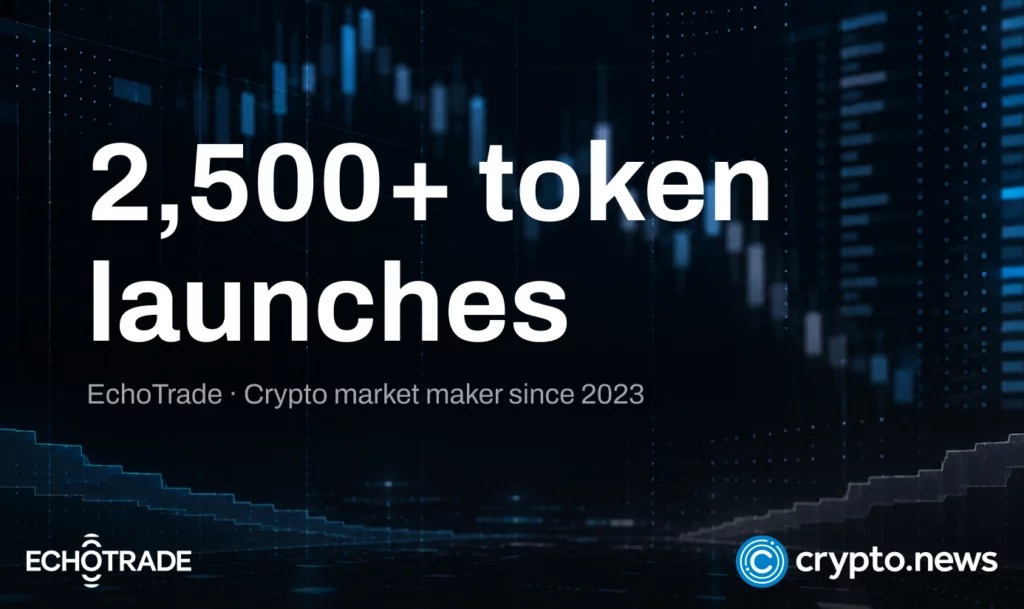
Since its establishment in 2023, the crypto market maker EchoTrade has supported over 2,500 token issuances. The company currently manages order books for more than 100 active projects on over 90 centralized and decentralized exchanges, and has become an official liquidity partner for several major exchanges, including MEXC, in the past year. It has also become one of the largest crypto market makers providing support for token listings on Binance Alpha, with a dedicated trading team responsible for Alpha issuances.
EchoTrade says that since 2023, it has supported over 2,500 token issuances and is currently managing order books for more than 100 projects on over 90 exchanges.
In recent months, the company has expanded its Binance Alpha business, supporting more than 40 issuances through this platform.
EchoTrade provides market-making and issuance advisory services, covering exchange selection, token unlocking schedules, and coin listing coordination.
The company stated that as exchanges tighten their listing standards, stronger liquidity, more realistic marketing budgets, and experienced service providers are becoming increasingly important.
In order to understand the uniqueness of EchoTrade, we examined its operation mode, communicated with its team, and sorted out the views of the founders who collaborated with it on the issuance regarding this experience. The following is our analysis of why the project chose EchoTrade for the issuance, as well as what insights 2500 issuances can bring to the next founder.
The competition among crypto market makers is fierce, and the bear market has also reshaped this industry. Many companies have had to change their business models in order to survive the bear market: some have turned to token auditing, some have shifted to providing pure advisory services without offering issuance support, while the largest players are expanding into ETF, predictive markets, and traditional trading. EchoTrade, on the other hand, continues to focus on token issuance and has built its business around token offerings of various scales, ranging from initial Binance Alpha launches to simultaneous listing of spot and futures on top-tier exchanges, covering more than 10 trading venues.
EchoTrade Who is it?
EchoTrade is a crypto market-making company established in 2023. It provides bilateral quotes for token projects on over 90 exchanges, including Binance, Bybit, OKX, KuCoin, Gate.io, and MEXC. Among them, MEXC is its official liquidity partner.
The team consists of over 50 professionals, and the entry requirements for the trading desk are among the strictest in the industry: only about 5% of applicants are able to gain access to it. This trading desk has become one of the company's main selling points. Founders who have previously collaborated with EchoTrade also stated that it was this team that convinced them to continue working together. Traders are distributed across Asia, Europe, and the United States, working in shifts, ensuring that there is always someone monitoring the market 24/7 for each order book.
What will the token issuance market look like in 2026?
To understand why companies like EchoTrade are growing, one must first look at the broader environment. The token issuance market in 2026 is smaller, more selective, and less tolerant than what the founders remember from 2024.
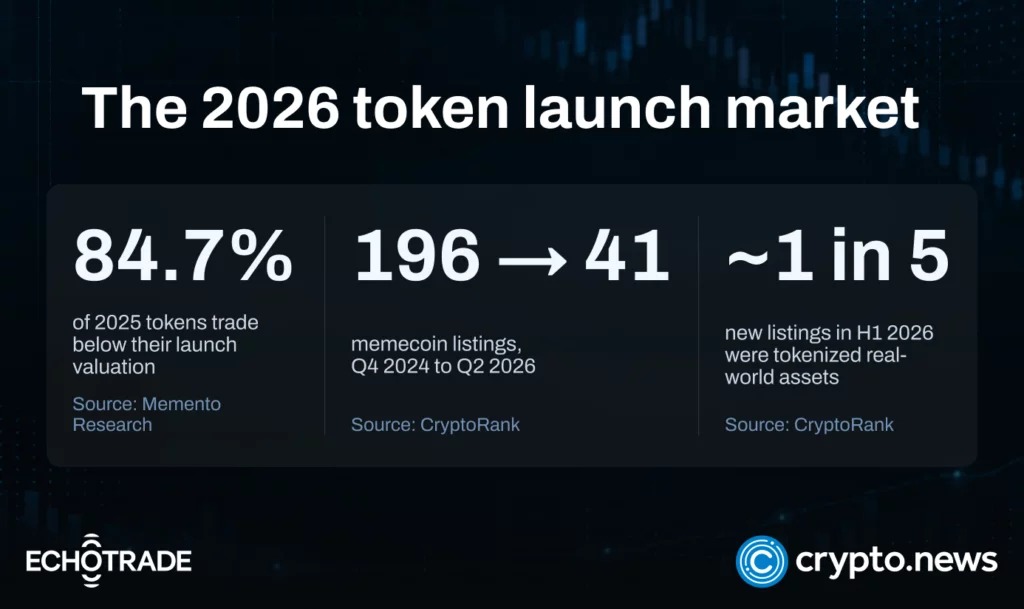
The data also illustrates this point. According to the Memento Research data cited by crypto.news, among the tokens that will complete their TGE in 2025, 84.7% are currently trading below their issuance valuations, with a median decline of 71%. Exchanges have also become more selective. An analysis of token listings on the top ten centralized exchanges by CryptoRank shows that the number of new tokens listed on these exchanges has been declining for six consecutive quarters, from 196 in the fourth quarter of 2024 to 41 in the second quarter of 2026; meanwhile, tokenized real-world assets accounted for nearly one-fifth of new listings in the first half of 2026.
Liquidity is also contracting simultaneously. Trading activity is concentrated on Bitcoin, Ethereum, and a few other large-cap cryptocurrencies, which means new tokens can only compete for a thinner pool of buyers. In such a market, issuance can no longer rely on cycles to drive demand; whether a new token can establish itself depends on its preparedness: who is offering quotes in the order book, how deep that order book is, and whether there will still be people remaining in the market a month later.
This change has also altered the founders' requirements for market makers. In the past, price was the primary concern; now, the focus is first on experience with similar offerings, as well as whether the company will continue to support the tokens after the initial excitement subsides.
There are also benefits to a quieter market; many founders now see this as an opportune time for launches. Compared to 2024, there is less competition for attention, and the costs associated with launch services—everything from token issuance to marketing to liquidity—are significantly lower. Most importantly, those who join projects now are not in pursuit of a quick surge in value. Communities that are established in a quieter market tend to stay committed to the project over the long term, rather than dissipating just a day after the launch.
EchoTrade How to cooperate with Binance Alpha for issuance?
Binance Alpha has become one of the first stops for many new tokens. It is a section in Binance Wallet that showcases early-stage projects, with the display lasting for about 24 hours, and they can be directly purchased through Quick Buy. More than 40 issuances supported by EchoTrade in recent months have all been completed through Alpha.
Since the Alpha exhibition will compress the demand within a single day, EchoTrade has established a dedicated trading team for this purpose, focusing on Binance Alpha and having a very good understanding of the way the on-chain market operates during the exhibition period.
The selection of Alpha is determined by Binance. No market maker can guarantee selection, nor can they guarantee the subsequent listing of the token in spot or futures markets. What market makers can control is whether the token market is ready when attention is drawn to it. EchoTrade explains this method in more detail in their guide "How to Select Market Makers for the Issuance of Binance Alpha".
Why do market makers also provide issuance advisory services?
In addition to market-making, EchoTrade also provides issuance advisory services for the entire project: which exchanges to apply to, how to arrange the sequence, how to match the ownership and unlocking schedule with the order book, how to coordinate the coin listing date with the announcements, and which partners should be introduced at each stage.
For founders of a first-time issuance, knowing which companies and partners to approach serves two purposes. On one hand, it ensures that the issuance is as strong as possible, as various aspects such as exchanges, auditing, launch platforms, and marketing are handled by people with extensive experience. On the other hand, it also saves a considerable amount of budget, as the project avoids paying for incorrect services, inappropriate venues, or subsequent rework.
Co-founder JRcryptex stated: “EchoTrade has always been the best market maker overall, and their advisory services are also outstanding. It is the only market maker that I would recommend to project parties.” Rio Consultancy has been using EchoTrade as their exclusive market maker for the past year, and the company mentioned that they “have confidently recommended them to many clients, and those clients have all experienced the same excellent service.”
What has 2,500 token issuances taught the trading desk?
When we asked which offerings would stand the test of time and which would fade quickly, the EchoTrade team repeatedly mentioned four pieces of advice they gave to each founder.
A suitable market maker can make your work ten times easier. A single issuance involves dozens of steps: exchange application, listing agreement, inventory management, announcement, unlocking, and so on. A market maker who has handled thousands of issuances knows the proper sequence in which these tasks should be carried out and can identify issues before they become problematic. If the wrong market maker is chosen, founders will have to manage them in addition to handling all the other tasks as well.
2. Do not blindly pursue the number of exchanges. Two exchanges that provide satisfactory services are far more valuable than ten that only barely cover the market. Each trading venue requires deep and tight price spreads, as well as someone monitoring the market, and exchanges will continue to check these three aspects after listing new tokens; for example, MEXC marks those tokens whose average intraday price spread exceeds 2% for 15 consecutive days. A market that is thin across ten trading venues is considered worse in the eyes of traders and the next exchange than two healthy markets.
3. The marketing budget determines the issuance strategy. The scale of the audience that a project can reach usually determines which exchanges are suitable, how large the issuance can be, and how much liquidity is required. If a project with a smaller community tries to list on large exchanges, it often ends up with only a quiet order book on those noisy platforms. It is usually more effective to design the issuance scale based on the audience and to let both grow in sync, rather than doing the opposite.
4. Saving money on service providers often results in higher overall costs in the end. The cheapest market makers, auditors, or agencies can end up being the most expensive items in the budget. Therefore, it’s worth understanding the costs associated with crypto market makers before comparing quotes. Issues such as poor performance in the first week, failed audits, or reaching the wrong audience for a campaign are difficult to fix; and fixing these problems means having to pay another company to do it over again. Founders who choose partners based on past performance rather than price tend to have lower total expenses.
What is the future direction of encrypted market-making?
Looking at the entire crypto market-making industry as a whole, it seems to be dividing into two categories. The top-tier large market makers are transforming into more comprehensive financial companies, engaging in ETF, securities licensing, predictive markets, and traditional asset trading. At the lower end, many smaller trading desks are withdrawing from issuance activities and turning to auditing or consulting services, or they rely mainly on price competition.
This leaves a gap in the middle, and that is precisely where most token projects currently find themselves: they need a partner who can not only bring the project to multiple exchanges from its initial launch but also continue to support it thereafter. The companies that can fill this gap are likely those that possess three key capabilities: a strong trading team, a wide network of exchanges, and experience that allows them to provide advice before the founders make costly mistakes.
Our judgment is that 2026 will reward well-prepared projects more than any other year. There is less competition, but the standards are higher. The market no longer favors weaker offerings, and exchanges are more closely monitoring the market, while buyers will look at the liquidity before making a purchase. For founders, the choice of market makers has shifted from being an item in the budget to becoming one of the key decisions that can affect the entire offering.