The longest period of calm in the U.S. stock market has come to an end, with tech giants leading the declines. The market is also under pressure from inflation and credit risks.
The S&P 500 index fell 1.1% on Wednesday, ending the longest period of calm since January 2020, during which there were no single-day declines of more than 1% for 53 consecutive trading days. This decline was driven by two main factors: the CPI in September in the United States exceeded expectations, and concerns about the sustainability of AI trading continued to rise in the market.
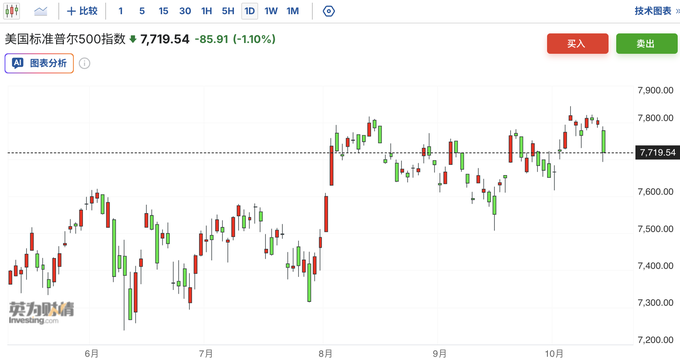
The tech sector was hit the hardest. The Nasdaq 100 index tumbled 2% in a single day, recording the largest one-day decline since July; the Magnificent Seven index, which tracks the "Big Seven of Tech," also saw a similar decline. The semiconductor stock index has fallen for six consecutive days, with the cumulative decline expanding to nearly 12%.
Meanwhile, the corporate bonds of AI cloud computing service provider CoreWeave faced a sell-off, with the trading price of their 2032-maturity unsecured bonds falling below 80 cents face value – a level generally regarded as a warning sign that the borrower is in financial distress. As a result, the company's stock price plummeted by 15%.
This decline has put programmable funds driven by quantitative models in a particularly passive position. These funds had been buying stocks heavily in the preceding weeks during a period of consistently low volatility, and the sudden end of this calm period has directly disrupted their investment strategies.
Inflation data reignites expectations for interest rate hikes
Official data shows that in September, the consumer price index rose by 0.6% month-on-month, marking the fastest growth rate since April, which has made the market more cautious about its predictions regarding the Federal Reserve's interest rate path.
Northlight Asset Management Chief Investment Officer Chris Zaccarelli stated that inflation data has reignited market concerns about further interest rate hikes by the Federal Reserve. "The market originally expected the September rate cut to be a one-off measure, but this morning's data has significantly reduced the likelihood of that scenario."
The Russell 2000 Small Cap Index, which is more sensitive to interest rates, fell by 1.9%, representing a cumulative decline of 11% from its August high. It is noteworthy that even though Treasury yields surged and then declined after the release of the CPI data, the stock market did not stop falling, indicating that this selling pressure was not solely driven by rising interest rates.
AI Synchronous Trigger of Transaction and Credit Risks
The vulnerability of the market was exposed on Wednesday. The bond crisis of CoreWeave resonated with the decline in tech stocks, leaving investors with no way to avoid the impact.
Miller Tabak + Co. Chief Market Strategist Matt Maley pointed out that previously, there was a kind of rotational buffer between credit risk and tech stocks in the market: "On the days when there were concerns about credit issues, tech stocks performed well; on the days when there were concerns about tech stocks, the credit side provided some comfort. Today, both are causing trouble at the same time."
The corporate bonds of CoreWeave have fallen below 80 cents according to the pricing data from Trace. This level is generally regarded in the credit market as a watershed for financial difficulties, exerting additional pressure on overall risk sentiment.
Tech giants under pressure, quantitative funds hit hard
The concentrated decline of tech giants is a core feature of this adjustment. Among the "Big Seven of Tech," only Apple Corporation saw a gain of 0.5%, while the rest all experienced declines.
This decline is particularly unfavorable for programmed quantitative funds. These funds have been continuously increasing their positions in an environment of extremely low volatility recently, based on rule-based models. The sudden disruption of this calm period has directly triggered the need to adjust their positions.
Data from Deutsche Bank shows that the gap in positions held by subjective funds and rule-based funds has widened to its second widest level since 2020. Due to concerns about high Treasury bond yields and geopolitical conflicts, the stock positions of subjective funds have dropped to the latter third of their historical range.
BTIG Chief Market Technical Analyst Jonathan Krinsky warned: "We have already seen semiconductor stocks decline as interest rates rise. Once the seven tech giants also start to fall, it will further confirm our judgment of a 'red October'."
The decline is limited; the market has not yet entered a panic zone.
Nevertheless, the intensity of this round of decline is still considered mild at present. The S&P 500 index has only fallen by 1.3% from its historical high set last week, and the cumulative additional market value of $13 trillion since the end of March remains largely intact.
The Chicago Board Options Exchange Volatility Index (VIX), which measures the level of market panic, hovered around 17, below the usual 20 mark that typically indicates market stress.
For long positions, a continuous decline might attract subjective funds that have been on the sidelines until now. These funds focus on economic growth prospects and the quality of corporate earnings and have hardly participated in the recent stock market rallys that have set new highs. If this trend continues, their willingness to buy at lower prices may increase accordingly.