Equities, bonds, and futures rose on Monday, while oil prices fell from their morning highs. Investors generally chose to ignore the geopolitical risks posed by Houthi attacks on Saudi Arabia's capital airports in Yemen. However, the crisis over the Strait of Hormuz remains unresolved, and inflationary pressures in the energy market may continue, becoming a major source of uncertainty before the release of inflation data in the United States and Europe this week.
S&P 500 futures rose by 0.3%, and the European Stoxx 50 index opened with a gain of 0.4%, indicating that sentiment in Western markets is relatively stable. Asian markets, however, lagged significantly behind; the MSCI Asia-Pacific index fell by 0.3%. The South Korean Composite Stock Price Index resumed trading after the holiday on Friday last week and closed down sharply by 3.6% at 6,384.24 points. On the same day, Goldman Sachs announced that it had upgraded its rating on U.S. stocks to "overweight" based on prospects for earnings growth, with this rating valid for three months.
Meanwhile, Federal Reserve Chairman Jerome Powell is expected to make a public statement this week, and investors will be closely watching the signals he gives regarding the pace of further interest rate hikes. Last week, the yield on 10-year U.S. Treasury bonds approached 5.4%, reaching the highest level since 2002. Whether the continuous rise in bond yields will put pressure on stock market valuations has become a central issue of debate in the market.
The former Bridgewater Associates Chief Investment Strategist, and now a Senior Researcher at the Council on Foreign Relations in the United States, Rebecca Patterson, stated: "At present, rising interest rates are not yet seen as a force that overwhelms the narrative of growth and profitability, and stock and bond yields can rise in tandem. However, if interest rates continue to rise driven by central banks' ongoing tightening measures, the risk that interest rates will dominate and suppress market sentiment will increase accordingly."
S&P 500 futures rose by 0.3%. The European Stoxx 50 index opened up 0.4%, Germany's DAX index rose by 0.4%, the UK FTSE 100 index rose by 0.4%, and France's CAC 40 index rose by 0.3%. South Korean stocks closed down sharply by 3.6% at 6,384.24 points. The U.S. bond market was closed on Monday due to a public holiday, and the yield on Australian 10-year government bonds fell by 2 basis points to 5.32%. The euro traded at $1.1203 per dollar, and the Japanese yen at 158.36 per dollar. The Indian rupee rose by 1% on Monday, standing out in the recent Asian currency markets. Spot gold was at $4,186 per ounce, with a decline of about 0.17%. Brent crude oil briefly climbed to $105.63 per barrel in the early session on Monday, then fell back by 0.8% to $103.91, but still remained above the $100 mark.
Oil prices surge and then fall back; the Hormuz crisis supports the $100 mark
Brent crude oil soared to $105.63 per barrel in the early trading on Monday, before falling back by 0.8% to $103.91, but still remained above the $100 mark. The trigger for the morning rise was a new round of attacks launched by Houthi militants against Riyadh's main airport over the weekend.
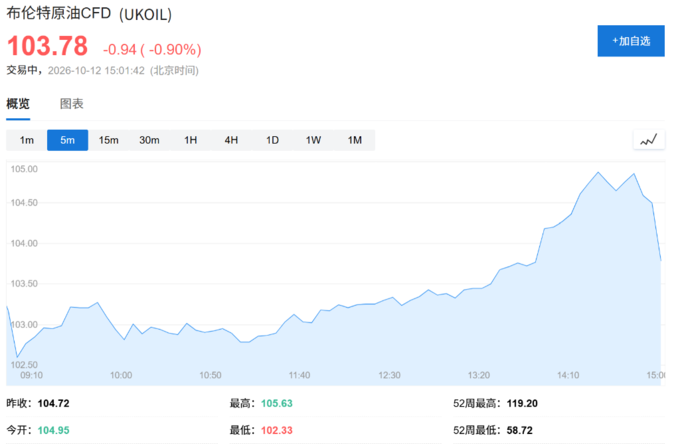
Although market sentiment is generally stable, analysts warn that the uncertainty in the Middle East situation remains a significant support for oil prices. Templeton Global Investments Portfolio Manager Yiping Liao stated in a Bloomberg TV program: "Our baseline scenario is that energy prices will remain high in the near term, and we do not see any possibility of a short-term resolution to the Hormuz crisis before the mid-term elections in the United States."
Meanwhile, Trump announced that the "energy ceasefire" between Russia and Ukraine would take effect immediately, but no details were provided. European diesel futures tumbled by 8.3% on Monday, however traders were cautious about the long-term impact of additional Russian exports – earlier, Ukrainian President Zelensky stated that the ceasefire agreement had not yet been finalized and that the war was still ongoing. Spot gold prices fell below $4,180 per ounce during the day, a decrease of about 0.36%, and the risk-aversion sentiment did not significantly increase due to the heightened geopolitical risks.
Korean stocks become the worst in the world, with foreign capital accelerating its withdrawal
The South Korean Composite Stock Price Index resumed trading after the long holiday, closing down sharply by 3.6% at 6,384.24 points. The South Korean stock market, which was once one of the most popular trading targets in the world, is now experiencing a rapid cooling down. The index led global gains in the first half of the year but has since fallen by 22% in the second half, becoming the worst major stock index globally.
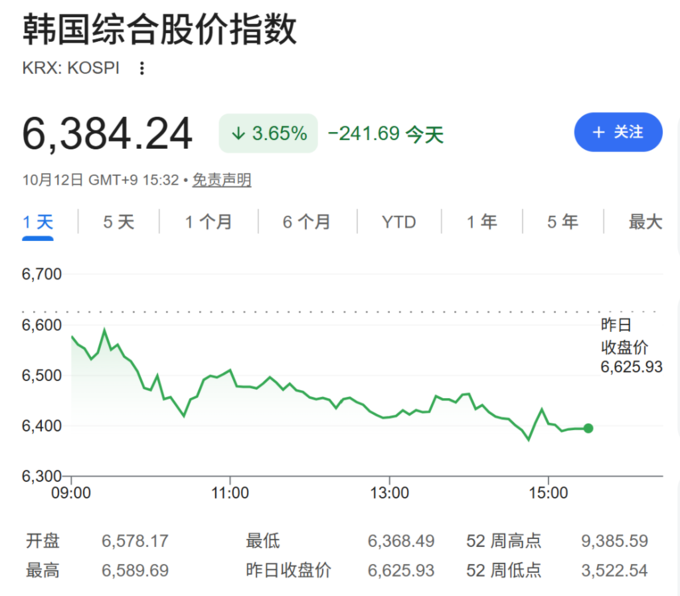
According to Bloomberg, foreign investors have withdrawn a net $131 billion from South Korean stocks this year, the most among major Asian markets. Phillip Wool, the head of portfolio management at Rayliant Global Advisors, said, "For most investors – especially those who recently entered the South Korean market due to memory chip transactions – the easy money to make in this area has already been made." He stated that his fund has taken profits from South Korean AI stocks and currently holds a low position in both SK Hynix and Samsung Electronics.
Another pillar supporting the Korean stock market is also starting to weaken. According to JPMorgan Chase data, the share repurchase plans of Samsung and SK Hynix, totaling approximately 55 trillion Korean won (about $41 billion), are about to be completed. Last month, among the approximately $23 billion in buy orders in the Korean market, the repurchases by these two chip companies accounted for the majority. Once the repurchases are finished, the market will face a clear vacuum in buying interest.
In addition, ASML, the world's largest semiconductor equipment manufacturer, announced a 10% increase in the prices of components for Korean customers across all products. Samsung and SK Hynix have accepted this proposal, and the price increase will take effect in January next year. This further raises the operating costs of Korean chip manufacturers, imposing additional pressure on their profitability.
High U.S. Treasury yields pose a test to the resilience of the stock market
The U.S. bond market was closed on Monday due to a public holiday, and trading of cash Treasurys was suspended. However, Treasury futures saw a slight increase, while Australian and New Zealand Treasurys also rose in value. The yield on Australia's 10-year Treasury note fell by 2 basis points to 5.32%.
Last week, the yield on 10-year U.S. Treasury bonds approached 5.4%, the highest level since 2002. The market is assessing to what extent high yields can replace central banks in carrying out tightening measures. Bloomberg strategist David Savage pointed out that as financial stocks take the lead in kicking off the third-quarter earnings season, U.S. stocks are poised to set new highs this week. However, rising interest rates have become a significant obstacle for most individual stocks, while strong technological performance is expected to support the overall momentum of the index.
The former Bridgewater Associates Chief Investment Strategist, and now a Senior Researcher at the Council on Foreign Relations in the United States, Rebecca Patterson, stated: "At present, rising interest rates are not yet seen as a force that overwhelms the narrative of growth and profitability, so stock and bond yields can rise in tandem. However, if interest rates continue to climb driven by central banks' ongoing tightening measures, the risk that interest rates will dominate and suppress market sentiment will increase accordingly."
U.S. Stock Market Focus: The earnings season has begun, with inflation data yet to be tested
This week, the market's focus will shift to the earnings season of major banks. Bank of America, Citigroup, Goldman Sachs, JPMorgan Chase, Morgan Stanley, and Wells Fargo will all release their financial results this week.
According to the John Butters data from FactSet, the earnings growth rate of the S&P 500 index is expected to reach 29.6% in the third quarter, marking the fourth consecutive quarter in which the index achieves earnings growth of over 25%.
Meanwhile, the data for September CPI and PPI will be released on Wednesday and Thursday of this week, respectively.
Former Chief Investment Strategist of Bridgewater and Senior Researcher at the Council on Foreign Relations, Rebecca Patterson, stated:
For now, rising interest rates have not yet been seen as a force that overwhelms growth and profit stories. Stock and bond yields can rise in tandem. However, if interest rates continue to climb against the backdrop of central banks' ongoing tightening measures, the risk that interest rates will begin to dominate and suppress market sentiment will increase.