


U.S. stocks are at an uneasy high: the index has reached a record high, but there is only one theme supporting it.
The head of Goldman Sachs' hedge fund coverage business, Tony Pasquariello, admitted in the latest client report that the current upward trend in U.S. stocks "is essentially just one big trade" – driven by artificial intelligence. He maintains a bullish stance on U.S. stocks, but his wording has clearly become more cautious, and he is no longer willing to assert a 5% upward movement in the future. Meanwhile, Goldman Sachs data shows that about one-sixth of the components of the S&P 500 index have retreated more than 50% from their highs, while the index itself is just a step away from its historical high.
This fragmented landscape is triggering deep concerns in the market regarding concentration risks. Interest rates continue to rise, market breadth is deteriorating, and positions are extremely concentrated in the AI sector. Multiple warning signs are flashing at the same time, and for the bulls, the only hope left is whether NVIDIA and Micron can meet expectations during the upcoming earnings season.
Extreme polarization: a bull market that only exists in specific corners
The S&P 500 index reached a record high of 7,818 points on Monday this week, but then fell back to 7,765 points due to the OpenAI revenue warning news. On the surface, the flag of the bull market is still flying, but its internal structure has become highly distorted.
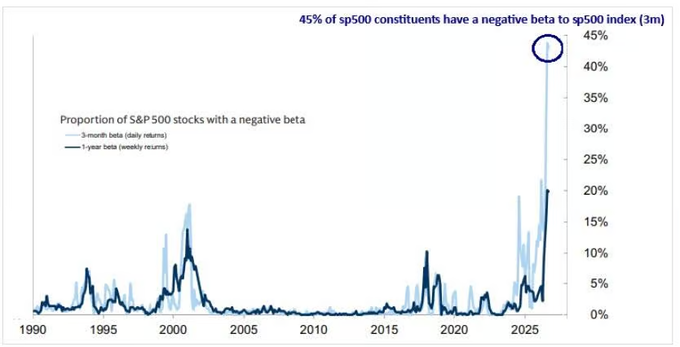
Data compiled by Goldman Sachs colleague Brian Garrett reveals the extent of this divergence: over the past three months, approximately 45% of the constituents in the S&P 500 have shown a negative correlation with the index itself, a proportion that has reached a record high.
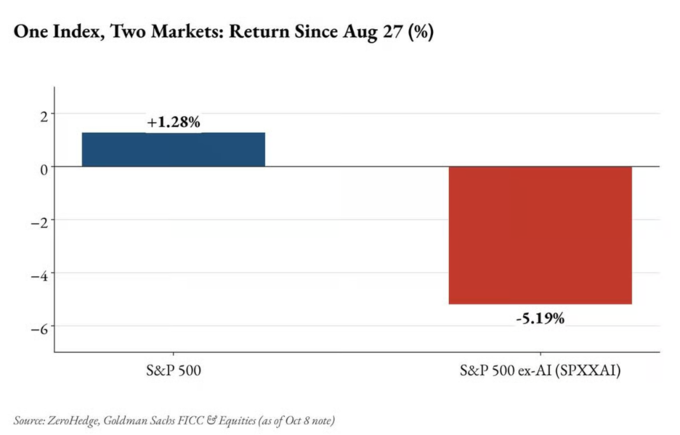
Goldman Sachs' Adrien Simonet further quantifies: Since August 27, the S&P 500 has risen by 1.28% overall, while the "S&P 500 ex-AI" (excluding AI related stocks) has fallen by 5.19%. The rolling 30-day gap between the two is close to the largest value since the AI trading began in January 2023.
In the meantime, the Russell 2000 Index underperformed the Nasdaq in 16 out of the past 20 trading days, lagging by about 9 percentage points. Pasquariello characterized this market trend as "a very narrow rally" – where large American tech stocks raced forward like locomotives, while interest rate-sensitive and cyclical sectors continued to face pressure.
The position is "clean," but the risk is concentrated in one area.
Despite the index being at historical highs, the overall market position is surprisingly low. Data from Goldman Sachs Prime Book shows that in September, hedge funds' net exposure to U.S. stocks was at its lowest levels in one, three, and five years; the net leverage ratio of fundamental long-short strategies has declined for three consecutive weeks, reaching its lowest level since Trump announced reciprocal tariffs last year; Goldman Sachs' sentiment indicators are also hovering near multi-year lows.
The interpretation of Pasquariello is that trading in lower-end U.S. stocks has become quite crowded. For those institutions concerned about missing out on the S&P 500 reaching 8,100 points, the cost of buying bullish options is relatively low.
However, a low net exposure does not equate to low risk, as the total exposure remains high, and the remaining positions are highly concentrated in the same direction.
In September, tech stocks were the only sector in which hedge funds made net purchases, with the scale of these purchases being the largest since February 2025.
Goldman Sachs data Prime Book shows that the “Mag 7” net exposure currently accounts for about 22% of the total US stock exposure, which is the highest level on record since the beginning of 2022; the position in semiconductors has reached 12%, doubling from the beginning of the year. Simonet also notes that the leveraged semiconductor ETF asset size has reached approximately $115 billion, and once the market declines, it will have a mechanical magnifying effect.
On Thursday, following the impact of the OpenAI message, Goldman Sachs' TMT trading desk recorded net sales of over $1 billion in semiconductors, AI, and large tech stocks, which was a small-scale preview of what might happen later.
Earnings growth is impressive, but it relies heavily on a few companies
The earnings season is about to begin, and Pasquariello presents a third argument: Facing S&P 500's expected year-on-year profit growth of 28%, who would want to go short? This figure has been revised upward from last week's forecast of 27%.
But this is also a story that "depends on where you look."
Goldman Sachs' Q3 earnings preview shows that the earnings growth rate of the median stocks in the S&P 500 has slowed from Q2's 14% to Q3's 9%. Broken down by sector, the technology sector has a growth rate of 64%, while the energy sector even reaches 122%.
According to Goldman Sachs' calculations, 68% of the earnings growth for the S&P 500 this quarter will come from the top 10 contributors, up from 48% in the previous quarter; among them, Micron and NVIDIA alone account for half of that 68%. What's more noteworthy is that Goldman Sachs' forecast for full-year earnings growth of 27% represents a peak for this cycle within its own model, with growth slowing down in each of the following three quarters. The capital expenditure growth rate of hyperscalers (estimated at 116%) may also peak this quarter. The simultaneous arrival of these growth peaks and high levels of capital expenditure, coupled with stock prices and positions at historical extremes, is often only described as "a sign of what was to come" in retrospect.
Interest rates have escalated from a headwind to a systemic risk.
This is the part of Pasquariello where the wording change is most significant. Ten days ago, he characterized rising interest rates as a "headwind" for the stock market, but explicitly ruled out the possibility of them being "destructive." However, in his latest report, his statement has been upgraded to: Rising interest rates are becoming a "greater risk" for sovereign and corporate debt.
Market data confirms this shift. On Thursday, the winning bid rate for 30-year U.S. Treasury bonds reached 5.618%, the highest since August 2000; the yield on 10-year U.S. Treasury bonds closed at 5.23%. Economists at Goldman Sachs expect that after the “Federal Reserve” raises interest rates to 3.75%-4% in September, it will raise them again in December. According to Goldman Sachs’ calculations, of the 108 basis points of selling pressure on 10-year yields, 98 basis points came from real interest rates, with the 30-year real yield of 3.33% approaching the upper range since 2010. Their conclusion is that the U.S. Treasury bond market is seeking one of two critical points: either a level at which financing demand becomes sensitive to interest rates, or a level at which other sectors of the economy start to fail first.
At the corporate credit level, Goldman Sachs' credit strategists pointed out that the return on investment-grade US dollar credit bonds from the beginning of the year to date is -292 basis points, and they are focusing on software issuers that are facing refinancing pressures due to loan maturities. Goldman Sachs economists estimate that current interest rate levels could drag down economic growth by 0.5 percentage points in 2027 through channels such as housing, consumption, and capital expenditure.
The warning from Simonet is particularly direct: the impact of maturity premium shocks will not distinguish between the merits of the AI scenario and others; it will reprice all ten-year cash flows simultaneously. He believes that the real left-tail risk lies in the Federal Reserve being forced to raise interest rates beyond expectations in order to maintain its credibility on the long end, and that CPI data will be the trigger in the near term.
Both bull and bear markets, the same bet
Pasquariello cited a statement from an investor whom he clearly holds in high regard in the report, and this is also what he considers to be the most important sentence in the entire text:
"You know, this is basically just a big deal."
He did not refute it. By examining six criteria side by side—trend, position size, profitability, interest rates, concentration—one realizes that they are merely different aspects of the same observation: the trend is upward due to AI; the position size is relatively low, except for AI; the growth in profitability relies on AI and its energy demand; the rise in interest rates is partly due to the financing needs of AI. The arguments for both a bull market and a bear market point to the same underlying asset.
Pasquariello also proposed a friendly perspective of "technology and energy advancing side by side": over the past 11 years, a combination of the two sectors in equal proportions has recorded positive returns for 10 years, with an average annual return of 18.7% and a Sharpe ratio of 1.2. However, this is still describing the same transaction and its energy constraints.
Seasonal and mid-term elections: the last variable
The sixth point of judgment for Pasquariello is relatively brief: The seasonal patterns of Q4 are favorable, but he expects that the mid-term elections on November 3rd will bring a wave of volatility.
Goldman Sachs' Alec Phillips indicates that the market predicts a probability of over 90% for Democrats to regain the House of Representatives, and 65% for the Senate, with General Election vote leads reaching 8.9 percentage points. "Sweeping victory" has become the baseline scenario in the market.
Meanwhile, VIX closed at 15.4 on Thursday, but Goldman Sachs' Volatility Trading Desk reported that buyers purchased approximately $10 million worth of year-end S&P 500 put options on vega within about 6 hours that day. Someone is insuring against a "friendly seasonality."
A market with one exit
Pasquariello ultimately reaches three conclusions: a bull market has been established, but it depends on where you look; the risk-return situation in the near term is unclear, so it is recommended to "pay attention to speed limits"; stick to the two fastest horses – the United States and Japan; and use a combination of long positions in stocks and short positions in interest rates as a hedge.
This hedging strategy is quite thought-provoking: if the advice is to hold stocks while simultaneously short-selling bonds, it implies that both will decline in value at the same time. However, "short-selling interest rates" can only be profitable when yields continue to rise – and this is precisely what the 85% of stocks that have already experienced a significant pullback find most difficult to withstand, and it will ultimately become an additional financing cost burden for the remaining 15%.
A bullish scenario requires Micron and NVIDIA to meet their performance targets, requires that capital expenditures of ultra-large-scale cloud computing providers not peak, needs the Federal Reserve to stop raising interest rates after two hikes, and also requires someone willing to take over long-term bonds at a yield level of 5.6%. A bearish scenario only needs for one of these conditions not to materialize.
A large transaction is indeed wonderful when the price rises. However, its very definition also implies that there is only one exit for the entire market.