














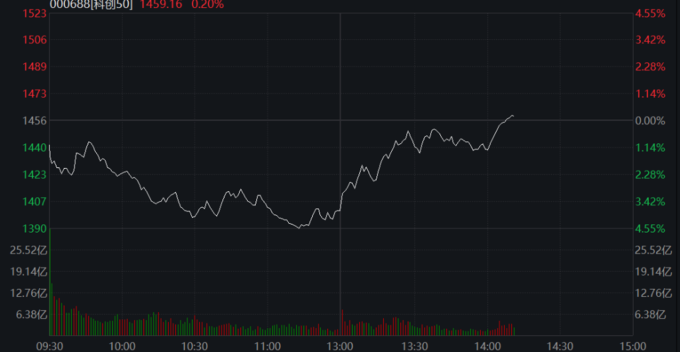
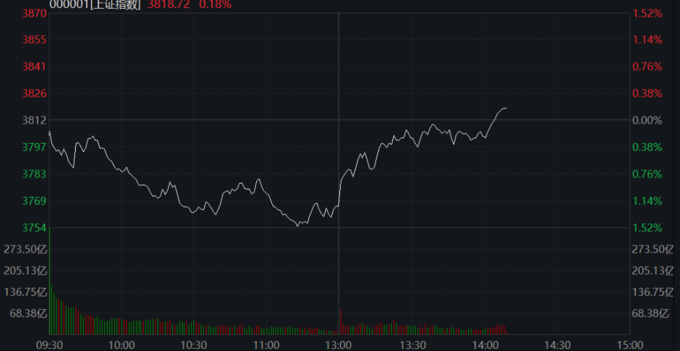
On October 9th, the A-share market saw a rebound in the afternoon, with all three major indices rising. In the morning session, the GEM index fell by more than 3%, while the Sci-Tech 50 index turned positive, although it also fell by over 4% at one point during the day. Sectors such as applications, cultural media, securities firms, gold, chemical fibers, and software were strong. Lithium batteries and solid-state batteries showed strength, whereas chip semiconductors and computing hardware chains continued to be weak. The biopharmaceutical sector experienced a significant decline, with CRO and innovative drugs under collective pressure. Jianghuai Automobile once again hit the daily limit down, following a previous report of a broken brake pedal bracket, and stated that they would further optimize the design.
Hong Kong stocks continued to rise in the afternoon, with both the Hang Seng Index and the Hang Seng Tech Index climbing. The Hang Seng Tech Index rose by nearly 3%, with heavyweight tech stocks rebounding collectively. Meituan, Alibaba, and Tencent all saw increases, while Xiaomi surged by over 8%, driving a rebound in new energy vehicles. Chip stocks faced pressure, with companies such as Huahong Hongli, GigaDevice Technology, and Lanqi Technology declining. In the bond market, treasury bond futures saw gains across the board. In terms of commodities, domestic commodity futures showed a mixed performance with some rising and some falling.
Core Market Trends
- A-share market: As of press time, the Shanghai Composite Index rose by 0.20%, the Shenzhen Component Index rose by 0.22%, and the GEM Index rose by 0.30%.
- Hong Kong stocks: As of press time, the Hang Seng Index has risen by 1.80%, and the Hang Seng Tech Index has risen by 2.90%.
- Debt Market: Treasury bond futures rebounded across the board. As of press time, the 30-year main contract rose by 0.14%, the 10-year main contract rose by 0.05%, the 5-year main contract rose by 0.05%, and the 2-year main contract rose by 0.02%.
- Commodities: Domestic commodity futures showed a mixed performance. As of press time, the black commodities led the gains, with coking coal rising by 4.20%; energy products had a mixed outcome, with LPG rising by 3.43%; most chemical products increased in price, with plastics up 3.15%; most agricultural and sideline products also saw increases, with live pigs rising by 2.35%; all precious metals were on the rise, with palladium increasing by 1.51%; most oils and fats rose, with palm oil climbing by 1.07%; non-metallic building materials had a mixed performance, with PVC rising by 1.04%; basic metals led the declines, with tin falling by 4.55%; shipping futures fell across the board, with the freight index (European line) dropping by 2.97%; most new energy materials decreased in price, with lithium carbonate falling by 1.60%.
At 14:11, the Sci-Tech 50 index regained some of its losses from earlier in the day, having fallen by over 4% at one point. SMIC, Cambricon,澜起科技, and Shenghe Jingwei all made concerted efforts to turn things around.
At 14:06, the Shanghai Composite Index turned positive, with sectors such as culture and media, securities firms, gold, chemical fibers, and software showing strength.
At 14:01 in the afternoon, AI Pharmaceutical and CRO Concept rebounded. Berry Gene hit the daily limit up, achieving a third consecutive limit-up in 6 days. Tainuo Maibo rose by over 10%, while Jinshi Yayao, Tongjing Life, Nuocheng Jianhua, Shenzhou Cell, and others also saw rapid increases.
On the surface, AI pharmaceutical R&D startup Isomorphic Labs is advancing preliminary discussions for a new round of financing. The post-investment valuation for this round is expected to be at least $40 billion, with a potential maximum of up to $50 billion.
At 13:34 on October 9th, several broad-based ETF funds saw increased trading volumes. As of 13:30, the Huaxia Science and Technology 50 ETF traded over 8.3 billion yuan, the GEM ETF ETF (E Fund) traded over 6.6 billion yuan, the CSI 1000 ETF (South Fund) traded over 4 billion yuan, the CSI 500 ETF (South Fund) traded over 3.1 billion yuan, and the CSI 300 ETF (Huatai-PineBridge) traded over 3.9 billion yuan. The trading volumes of the aforementioned ETF funds all exceeded those of the previous day.
CITIC Construction Investment believes that external factors were the main cause of the adjustment in the technology sector yesterday. During the National Day holiday, the yields on long-term U.S. Treasury bonds overseas remained high, suppressing the valuations of high-valuation growth sectors. Coupled with overseas industry rumors that sparked concerns about the optical communication industry chain, related technology sectors faced concentrated selling pressure. Tensions in the Middle East geopolitical situation pushed up international crude oil prices, driving gains in the oil and gas, as well as shipping sectors. Domestically, the fundamentals are generally stable; manufacturing PMI returned to an expansionary range in September, and holiday travel and consumption data were positive. However, the pressure for economic recovery still exists. It is expected that policy measures will be intensified in the fourth quarter. This decline is more of an emotional release at the trading level and a switch between high and low-performing sectors, rather than a reversal in fundamental trends.
At 13:24, there was a surge in the cybersecurity sector, with Green Alliance Technology hitting a 20% limit up. Qilin Xianan, Qi'anxin, Renzixing, Anheng Information, Zhongxin Securitec, and others also saw increases in their prices.
At 13:18, the securities sector began to gain momentum, with Huaxin Securities leading the way in hitting the daily limit up. CITIC Securities, Guotai Haitong, CITIC Construction Investment, and Huatai Securities also saw collective increases. The decline of the Shanghai Composite Index significantly narrowed.
At 12:04, while Jianghuai Automobile was experiencing consecutive daily limit-downs due to the controversy surrounding its Zunjie V800 brake pedal, Xiaomi Group's Hong Kong stock continued to rise thanks to positive news such as locked orders for its Xiaomi cars.
In today's morning session, Xiaomi Group's stock price soared, with a gain of over 9% at one point. As of press time, it has risen by 7.44% to HK$25.42 per share. Meanwhile, a "real test video" by Lei Jun has gone viral on social media.
According to Securities China, on October 9th, Kuaikeji reported that Xiaomi Motors recently officially announced the progress of orders placed for its Pengcheng series in the first month of sales. From the official launch on September 7th to October 7th, the total number of orders placed 30 days after the launch had exceeded 70,000 units.
JPMorgan Chase pointed out in its in-depth observation on the globalization trend of Chinese automakers that the logic behind Chinese cars going global has undergone a qualitative shift, moving from a focus on "simply pursuing shipment volumes" in the early stages to a comprehensive pursuit of "sustainable and profitable expansion of overseas market share," with electrification technology constituting the core driving force behind this change.
At 11:54, on the market, there were more stocks falling than rising. In the Shanghai, Shenzhen, and Beijing markets, over 4,300 stocks showed negative trends, with a total trading volume of 1.18 trillion in the first half of the morning session. The trading volume in the Shanghai and Shenzhen markets alone reached 1.17 trillion, an increase of over 60 billion yuan compared to the previous trading day. In terms of sectors, AI hardware-related stocks faced further selling pressure, with copper-clad laminates, fiberglass, and optical modules leading the declines. Innovation drugs, real estate, and military industries also performed weakly. Coal, power batteries, and traditional Chinese medicine sectors showed strength, while banking and agriculture stocks were active.
Specifically, industries such as fiberglass, copper foil/copper-clad boards, PCB, electronic chemicals, semiconductors, and electronics, as well as concepts in computing hardware like MLCC, PCB, CPO, advanced packaging, memory chips, and high-speed copper cable connections, saw the largest declines.
Zhongji Xuchuang fell 5.58% and lost its annual line; Shenan Circuit fell 8.90%, Dongshan Precision fell 6.44%, Xinyisheng fell 6.15%, Zhao Yi Innovation fell 5.38%, and Changfei Optical Fiber fell 5.61%; Fenghua High-Tech, Jin Anguo Ji, Kangqiang Electronics, and Huazheng New Materials hit the daily limit down. Yunzhong Technology, Guoci Materials, and Fangbang Shares fell more than 10%, with Yuanjie Technology having one of the largest declines.
The direct trigger for the decline came from overseas markets overnight. OpenAI disclosed to investors that as of the end of September, the company's annualized revenue was approximately $50 billion, which is about $20 billion lower than the previously widely reported $70 billion, sparking concerns about the pace of AI's capital expenditure on infrastructure. As a result, the Nasdaq index closed down 1.25% overnight, and the Philadelphia Semiconductor Index fell 3.39%.
However, sources familiar with the matter pointed out that the discrepancy mainly stems from differences in statistical methods. Anthropic includes sales generated through cloud partners such as Amazon AWS and Google Cloud in its revenue figures, while OpenAI only counts its own directly generated income. OpenAI also emphasized that the overall revenue growth rate for the third quarter was 77%, and the revenue growth rate for its enterprise business was 107%, indicating that the long-term trend in demand for computing power has not been disproven.
The battery industry chain has strengthened against the trend: Times Wanheng has achieved 5 consecutive daily limit-up gains, Zizhu High-Tech has had 4 consecutive daily limit-up gains, and Lingpai Technology and Fengyuan Shares have each had 2 consecutive daily limit-up gains.
On the surface of things, according to the latest research in the industry chain, on October, 6 battery manufacturing companies plan to produce a total of 214.6 GWh, which is a significant year-on-year increase of 57% and a month-on-month increase of 4%. The year-on-year growth rates for cathode, anode, and electrolyte production are all approaching or exceeding 48%, confirming the prosperity of the industry chain with these data.
On the policy front, the "14th Five-Year Plan for the Development of New Battery Industries" jointly issued by seven departments including the Ministry of Industry and Information Technology sets targets such as the initial large-scale application of all-solid-state batteries by 2030 and a cycle life of 15,000 times for long-life lithium batteries. It also promotes the development of standards in key areas such as all-solid-state and sodium batteries. Meanwhile, the Ministry of Finance has clarified that from 2026 to the end of 2028, innovative battery types such as sodium-ion and solid-state batteries will be exempt from consumption tax.
Agricultural stocks have been repeatedly active, with Wanxiang Denong and Jinjian Rice Industry hitting daily limit up.
At 10:57, CATL's A-share price rose by nearly 5%, returning to the 300-yuan mark. The decline of the GEM index narrowed to within 2%, after previously falling by more than 3%.
At 10:26, the GEM index fell by more than 3%. Dingtai High-Tech, Runze Technology, Feilihua, Shannon Xinchuang, Tongguan Copper Foil, and Sanhuan Group all tumbled by around 9%.
The Sci-Tech Innovation 50 Index fell nearly 4%, with Ailisi, Yuanjie Technology, Shengyi Electronics, Shengke Communication, Muxi Shares, and others leading the decline.
At 10:06, Xiaomi Group saw a surge of nearly 7%; Xiaomi Pengcheng's orders in its first month of listing exceeded 70,000 units. Li Auto, Leapmotor, and Xpeng Group also followed suit with strong performance.
At 10:02, both the GEM Index and the Sci-Tech 50 Index fell by more than 2%.
At 10:01, CATL and BYD AH shares strengthened simultaneously, boosting the new energy vehicle industry chain. Lingpai Technology has seen consecutive daily limit-up performances for two days. Previously, seven departments jointly released the "15th Five-Year Plan" for the development of the new type of battery industry.
Jianghuai Automobile once again hit the daily limit down during trading, with 110,000 lots of orders placed.
At 09:51, core hardware stocks such as ChangXin Technology, Zhongji Xuchuang, XinYiSheng, North China Huachuang, Dongshan Precision, ShenNan Circuit, GigaDevice Technology, and Changfei Fiber Optic AI all saw declines, while the ChiNext index and the science and technology innovation sector continued to face pressure.
Overnight, the Philadelphia Semiconductor Index in the U.S. closed down more than 3%, with Intel, SanDisk, Micron Technology, SK Hynix, and NVIDIA all showing weakness.
At 09:49, the Hang Seng Technology Index rose by over 2%, and Xiaomi's shares increased by over 5%.
At 09:42, the Hang Seng Technology Index's intraday increase expanded to 1.2%, Xiaomi rose nearly 4%, and BYD shares increased by over 3%.
At 09:41, the organosilicon concept pulled upward against the trend during the morning session. Chenguang New Materials hit the daily limit up, Dongyue Silicon Materials rose by nearly 15%, and Silibao Technology, Hesheng Silicon Industry, Hongbai New Materials, and Xinyaqiang also saw increases. On the news front, Dongyue Silicon Materials announced that it expects its net profit for the first three quarters to increase by 19,050%-19,750% year-on-year.
At 09:38, the biopharmaceutical sector declined, with CRO, innovative drugs, and other related sectors all experiencing losses. Companies such as Kanglong Huacheng, Jinan Protein, Yinosi, WuXi AppTec, and Haoyuan Medicine all saw their shares fall.
At 09:36, Jin'an Guoji's stock price hit the daily limit down, and the copper-clad plate index tumbled by over 5% for a brief period. Shengyi Technology, Shenghong Technology, Tongguan Copper Foil, and Nanya New Materials all saw declines. PCB concept stocks were under pressure, with Huazheng New Materials, Xianfeng Holdings, Shengyi Technology, and others experiencing significant losses.
At 09:33, the GEM index fell below 3,000 points, hitting a new low since November 2015, with a daily decline of 1.2%.
At 09:32, both the GEM Index and the Sci-Tech 50 Index fell by more than 1%.
At 09:28, Jianghuai Automobile continued to trade at the daily limit down. Zunjie reported a breakage in the brake pedal bracket, stating that they will further optimize the design.
On the news front, on October 8th, the automotive information platform Dongche Di released a braking test video for the Zunjie V800. The video showed that in the "100km/h basic braking performance test," the brake pedal brackets of three Zunjie V800 vehicles broke, causing the vehicles to lose their braking capability and forcing them to rely on the P gear for emergency braking. On that day, headlines such as "Zunjie V800 brake pedal bracket breakage" topped the search trends, drawing widespread attention to the incident.
On the evening of October 8th, Zunjie Automobile's official Weibo account released a statement regarding issues with the brake pedal bracket base of Zunjie Automobile. The statement mentioned that Zunjie Automobile's braking system has undergone full-process development and verification in accordance with standards that are higher than national standards (GB 21670-2025 / GB 7258-2026) and industry standards (QC / T788 -2018). Since the delivery of the first batch of vehicles, no breakage failures of the brake pedal bracket base have occurred in actual user usage scenarios. Zunjie Automobile emphasizes that customer safety is always of top priority. Even under non-standard extreme test conditions, the company still aims to provide users with additional safety redundancy: they will further optimize the design of this component and offer free upgrades to existing customers.
At 09:25, the Shanghai Composite Index opened lower by 0.21%, while the GEM Index fell by 0.5%. sectors such as optical chips, copper-clad laminates, and fiberglass experienced adjustments. Seaborne shipping, oil and gas, and gold sectors showed strength.
At 09:21, the Hang Seng Index opened higher by 0.65%, and the Hang Seng Technology Index rose by 0.29%. Industrial and Commercial Bank of China, Zijin Mining, Cinda Bio-Pharmaceuticals, and BYD Co., Ltd. showed strength. Zhao Yi Innovation, Cambridge Technology, Jiangbolong, Shenghong Technology, Changfei Optical Fibre and Cable, and Zhongji Xuchuang saw adjustments.