














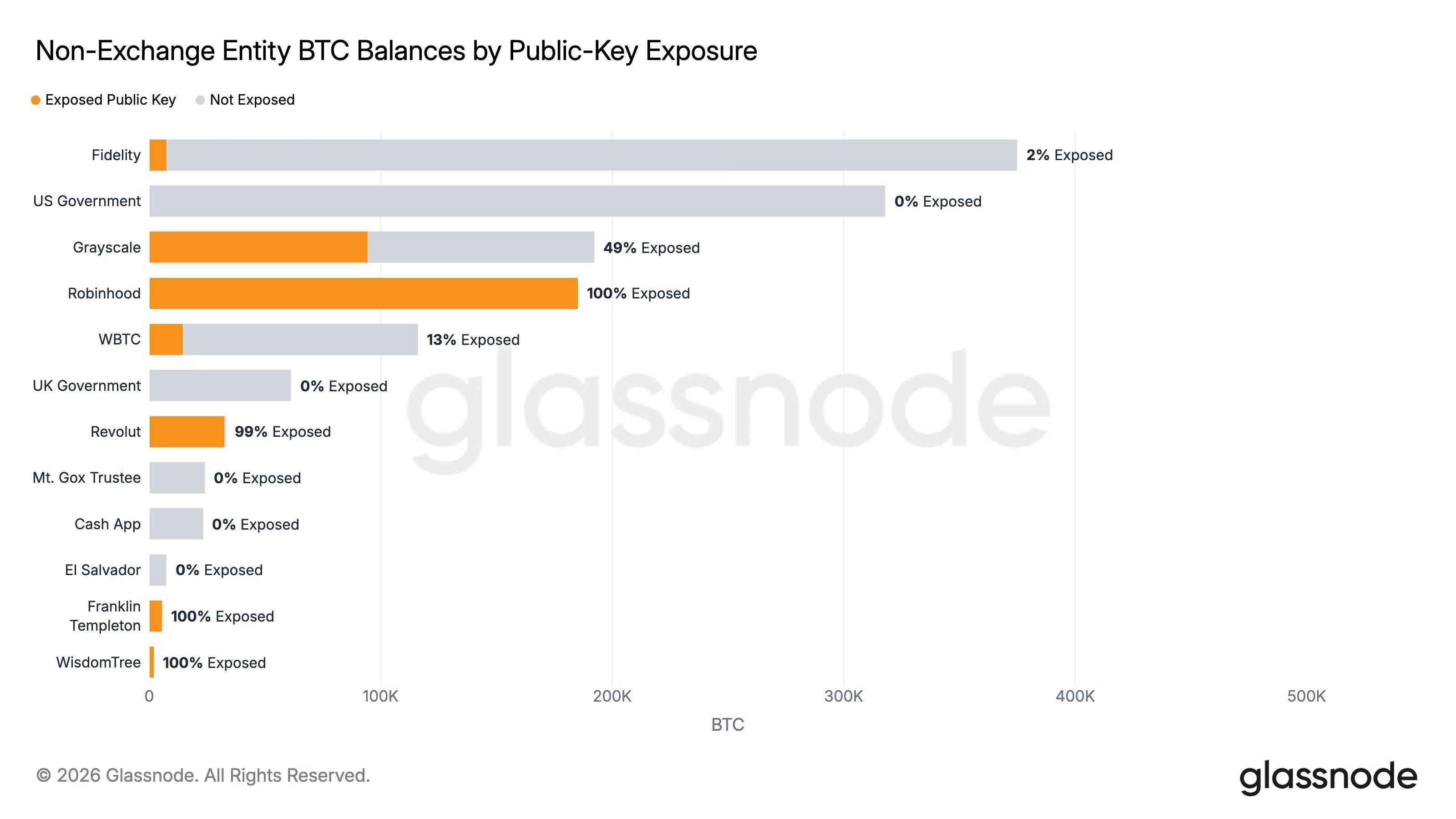
Over 6 million Bitcoins are associated with public keys that are already visible on the blockchain, accounting for approximately 31.2% of the total circulating supply. This proportion is about 5 to 6 percentage points higher than the lowest point in 2023.
Glassnode data shows that since the company's report in May, the exposed supply has increased by 222,000 BTC, which is approximately $18.2 billion at that time's price, while the total supply of Bitcoin only increased by 64,000 BTC during the same period.
Among them, the exchange contributed an increment of 123,000 BTC, and currently holds 1.79 million BTC. Moreover, these bitcoins are located after the visible public key.
These numbers measure the usage of addresses, not the immediate security risks. The report indicates that there is currently no evidence of feasible attacks on Bitcoin or Ethereum wallet keys.
The public key may become visible due to the reuse of addresses, or it may appear directly in certain types of Bitcoin outputs, including the earlier pay-to-public-key and Taproot outputs. If a sufficiently powerful quantum computer becomes available, or if there is a hypothetical mathematical breakthrough, attackers could potentially derive the corresponding private key from this information.

This update comes at a time when Ethereum researcher Justin Drake has issued a warning. Drake calls on the industry to prepare for “bunker mode.” He believes that, in the worst-case scenario, AI could find a shortcut to crack wallet encryption within “a few months rather than years” before the arrival of quantum computers.