

During the National Day holiday, U.S. Treasury yields and the Nasdaq index both reached new highs: the yield on 10-year U.S. Treasuries rose above 5.3%, a new high since 2002, and the stock prices of technology leaders such as NVIDIA and TSMC also continued to strengthen. An increase in interest rates usually means pressure on valuations, but this round of tech market gains has shown a clear "interest rate insensitivity," with the key reason being that the industry cycle is still in a period of high prosperity.
A report by the team led by Liu Chenming from GF Securities indicates that the current global semiconductor cycle is most likely still in a phase of 'accelerated upward trend' or 'high-speed fluctuation', rather than being on the verge of entering a period of significant slowdown. For technology stocks, changes in interest rates have a greater impact on short-term valuations, while it is still the industry's prosperity that truly determines the direction of the market in the medium term.
Historical data also confirms this point. Over the past thirty-plus years, the correlation coefficient between the Dow Jones Industrial Average and the yield of 10-year U.S. Treasury bonds has been -0.41, while for the Philadelphia Semiconductor Index, it is only -0.13. In contrast, the correlation coefficient between the Philadelphia Semiconductor Index and the year-over-year growth rate of global semiconductor sales is 0.40, whereas for the Dow Jones Industrial Average, it is only 0.20. This indicates that, compared to changes in interest rates, semiconductor stock prices are more closely linked to the prosperity of the industry.
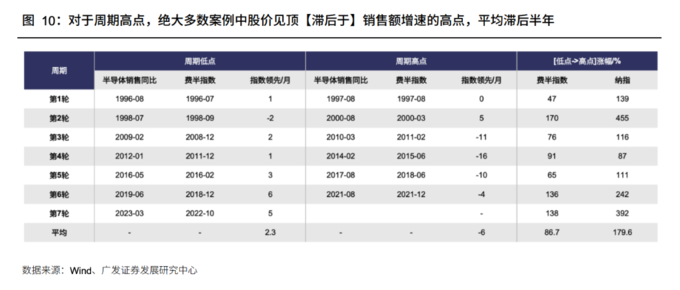
What is more noteworthy is that historically, the peak of the Philadelphia Semiconductor Index has usually come later than the peak in global semiconductor sales growth. In other words, the tech market is not afraid of a normal slowdown in industry growth from high levels; the real watershed between bull and bear markets is whether there is a significant slowdown in the industry cycle.
As long as the demand for semiconductors driven by AI and profit growth can be maintained, the industry cycle is expected to continue to support the performance of tech stocks, and any increase in interest rates will be more of a temporary disturbance.
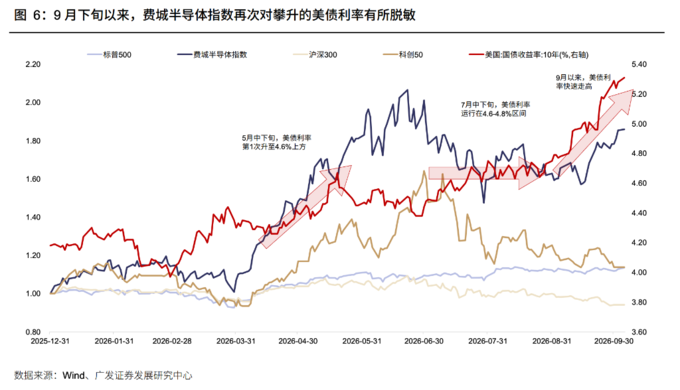
Interest rates are not the key variable; it is the business cycle that matters.
The report indicates that historically, the peak times of the Philadelphia Semiconductor Index have lagged behind the high points in global semiconductor sales growth by about 6 to 10 months on average. This means that even if the industry's growth rate shifts from "accelerated upward" to "high-speed fluctuation," stock prices may not necessarily peak immediately; what truly requires vigilance is when the industry cycle enters a phase of significant slowdown.
Looking at historical cycles, the global semiconductor cycle typically lasts for 42 months on average, with an upward phase of 23 months and a downward phase of 19 months. The low point of this current cycle began in April 2023. If we consider the third quarter of 2025 as the starting point of a new semiconductor sales cycle driven by AI, according to historical patterns, the upward phase is expected to continue until around the third quarter of 2027.
There are also no clear signs of deceleration in terms of growth rate. NVIDIA's management provided a revenue growth guidance of 70% for the fiscal year 2027 in their latest financial report in August, and stated that if supply chain bottlenecks are alleviated, next year's growth could actually "double." In the view of GF Securities, this means that the beta of the semiconductor industry is still expected to remain at a high level.
"A significant slowdown" is the watershed between bull and bear markets in the tech sector.
The market does not completely tolerate a slowdown in the growth rate of the tech industry. Historical investment experience shows that for companies whose growth rate exceeded 50% in the previous year, it usually takes until the year's growth rate decline exceeds 30% for market performance to deteriorate significantly; for companies whose growth rate exceeded 80% in the previous year, it is often not until the growth rate decline exceeds 50% that there is a noticeable sharp drop in valuation.
Therefore, a decline in industry growth rates from high levels alone is not sufficient to signal a switch from a bull market to a bear market. As long as growth remains at a relatively high level, or if there is only a shift from "accelerated upward trend" to "high-speed volatility," tech stocks may continue to perform strongly. What truly determines whether there will be a trend reversal in the market is whether the industry cycle will further shift from high-level volatility to a significant slowdown.
This also means that the current record-high yields on U.S. Treasury bonds have not suppressed the Nasdaq. It is not that the market has ignored interest rate risks, but rather that the industry growth driven by AI is still sufficient to support the profit expectations of tech stocks. As long as the industry cycle does not experience a significant slowdown, the interest rate pressures on valuations may be offset by profit growth.
In the fourth quarter, AI is seeing intensive catalysis, and there is still room for exploration in technology α.
The report suggests that from October to early December, the AI industry chain will enter a period of intensive catalysis characterized by "technology roadmap updates, performance verification, and re-evaluation of commercial pricing."
The OCP Global Summit from October 12th to 15th, and the NVIDIA GTC Washington Conference from November 30th to December 3rd, will serve as important opportunities to observe technological trends in custom chips, optical interconnects, cabinet-level systems, and power supply and cooling solutions. The financial reports of the four major cloud providers at the end of October to the beginning of November, followed by those of companies such as NVIDIA and Dell, will further verify the transmission chain of "cloud investment - hardware orders - revenue and profit." Meetings like Oracle AI World and Microsoft Ignite will also provide important insights into the commercialization progress of enterprise-level Agent and AI.
In the view of GF Securities, the current global technology industry β is still at a relatively stable high level. In the fourth quarter, AI technology, performance, and commercialization are expected to continue to strengthen demand expectations. With the industry cycle not yet experiencing a significant slowdown, the β foundation for the technology market remains, and there is still room for further exploration of α in the A-share technology sector.