

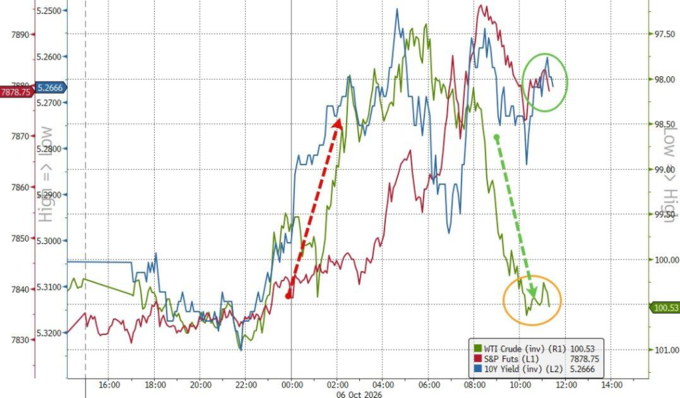
French presidential election frontrunner Le Pen announced a "shadow budget," which led to a noticeable narrowing of the yield gap between French and German government bonds. The global sell-off of long-term bonds that had been ongoing for several weeks came to a temporary halt. At the same time, international oil prices plummeted, and yields fell along with oil prices, creating space for risk assets.
The S&P 500 index closed up 0.6%, hitting its highest level since August for the first time, and the Nasdaq also set a record, with stocks related to artificial intelligence leading the gains.
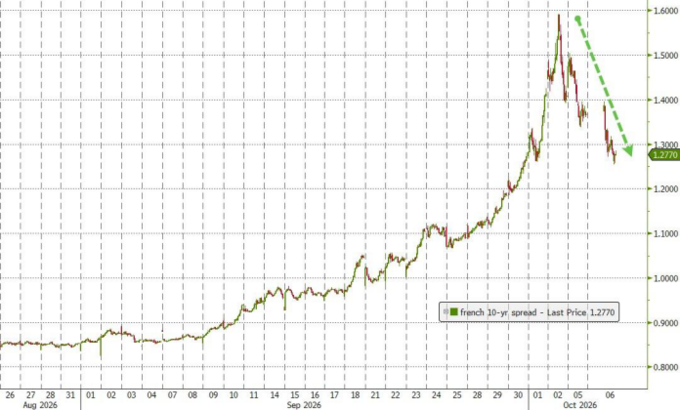
The "shadow budget" proposed by the main French presidential candidates sent a positive signal of fiscal discipline, leading to a narrowing of the yield spread between 10-year French and German government bonds by about 30 basis points, and the turmoil in the European bond market was temporarily calmed down.
The yield on French 10-year government bonds fell by about 15 basis points to 4.71% in a single day, while the yield on German 10-year bonds dropped by 4.6 basis points to 3.45%. The yield on 10-year U.S. Treasury bonds also decreased by 2 basis points to 5.28%, and the U.S. dollar index fell slightly by 0.2%.
With only one week left until the financial reporting season, the S&P 500 index has reached its highest level since August. The rise in stocks related to artificial intelligence has also boosted market sentiment, with NVIDIA's market value approaching $6 trillion. AMD CEO Jensen Huang predicts that chip demand will be "very high" in the coming years.
On Tuesday, the Dow Jones Industrial Average in the U.S. rose by 0.49%, the Nasdaq Composite Index rose by 0.45% to set a new record, the S&P 500 rose by 0.58%, while the Russell 2000 Index fell by 0.59%. Among the eleven major sectors, ten rose and one fell; utilities led with a gain of 3.01%, while healthcare was the worst-performing sector with a decline of 0.16%.
French fiscal budget boosts European debt, but the outlook for U.S. debt remains uncertain
The "shadow budget" proposed by the main presidential candidates in France sends a positive signal regarding fiscal discipline.
The yield on French 10-year government bonds fell by about 15 basis points in a single day to 4.71%, and the yield spread between France and Germany narrowed to 127.7 basis points, with Germany's yield dropping by 4.6 basis points to 3.45% during the same period. The stabilization of the French bond market alleviated some of the pressure on long-term interest rates in Europe, and consequently, globally.
Analysts draw a comparison with the policy reversal of former British Prime Minister Theresa May, arguing that this demonstrates the market's self-correcting mechanism when long-term bonds of sovereign countries fall into chaos.
U.S. Treasury yields corrected in tandem, with the 10-year yield closing at 5.27%, down about 4 basis points, and hitting a low of 5.264% during the session; the 30-year yield closed at 5.642%, down about 2 basis points. The 5-year yield closed at 5.030%, with a decline similar to that of the 10-year bond, and the 7-year yield also saw a larger decline than that of the 2-year and 30-year bonds.
Although the yield curve of U.S. Treasury bonds has generally corrected, analysis suggests that the two ends are relatively resistant to declines, indicating that the buying pressure on that day came more from the restoration of a preference for longer maturities rather than a re-pricing of policy paths.
Previously, US Treasury Secretary Besenstain stated during an event in Pennsylvania that the combination of economic growth and spending constraints would "soon" begin to change the trajectory of the US government's borrowing, and the government would take steps to "reverse this trend."
Investors doubt whether Bessent will be able to effectively alleviate financial pressures in the short term, therefore they are reluctant to announce an end to the wave of bond selling. Macquarie Strategist Gareth Berry stated bluntly:
Given that the deficit accounts for as high as 6% of GDP and there is no specific plan for reduction, the market is likely to remain highly skeptical about this.
He emphasized, "Expressing one's intentions does not equal formulating a plan." This is also one of the important reasons why the current volatility of bonds continues to be higher than that of stocks, with these two types of assets once again showing a divergent trend in their performance.
Google's 20-year nuclear power deal ignites the AI power narrative, with U.S. nuclear power stocks soaring collectively
On Tuesday, the S&P 500 index closed up 0.6%, hitting its highest level since August for the first time, and the Nasdaq also set a record. Stocks related to artificial intelligence led the gains, while the small-cap index lagged significantly behind.
Wall Street Journal mentioned that Google has signed a nuclear power procurement agreement with Constellation Energy, which will add 890 megawatts of reactor capacity. This move is interpreted by the market as a continuation of the narrative of infrastructure capital expenditure by the tech giant AI.
Just a week ago, Amazon completed a similar large-scale energy procurement. The stock of the hyperscale cloud service provider immediately soared to a four-month high, and sectors related to the AI ecosystem, such as data centers and fiber optic networks, also outperformed the broader market significantly.
The entire commercial nuclear power sector was immediately re-priced. Talen Energy rose by 12.43%, Ruizhida rose by 10.77%, NRG Energy rose by 7.03%, and power equipment manufacturer GE Vernova rose by 3.96%.
Analysis suggests that ultra-large data centers are willing to pay long-term contract prices for round-the-clock stable power supply. Whoever has dispatchable base load power sources holds the pricing power.
This also explains why the utilities sector became the strongest sector of the day. The power demand for artificial intelligence training and inference is turning grid capacity into a scarce resource, while nuclear power can supply electricity around the clock without producing carbon emissions.
In addition, the market regards optical interconnection as the physical bottleneck in the throughput of computing power clusters, and as a result, funds are concentrated in this area. Corporate guidelines are also intensifying efforts in this regard.
Ciena Technology rose by 13.85%, one of the largest gains among U.S. stocks on that day; Corning rose by 6.03%, Pure Storage rose by 9.14%, and Arista Networks rose by 4.09%.
Mayerwell Technology raised its revenue target for the fiscal year 2028 from $18 billion to approximately $20 billion on Investor Day, due to the growth of its artificial intelligence agent products, and its stock price closed up 5.81%. The CEO of AMD stated that the company plans to significantly increase supply in 2027.
On the other end of the link, however, there is significant loss. Seagate has fallen by 9.18%, and Western Digital by 6.93%. The trigger for this was both companies simultaneously bidding for Japan's TDK's hard drive head business, with the transaction amount potentially reaching several billion dollars. The market is concerned that the competitive landscape in the storage sector may deteriorate again.
Semiconductor equipment was the most affected, with KLA Corporation falling by 4.54%, Lam Research Group falling by 3.44%, and Applied Materials falling by 2.22%.
On the chip design side, NVIDIA reached a new historical high, with its total market value at one point exceeding $5.83 trillion during the session, closing up 0.14%; Broadcom rose by 3.67%, and UltraMicro Semiconductor increased by 2.80%. Within the same industrial chain, funds are making extreme choices.
Although the S&P 500 index broke through to a record high today, Jonathan Krinsky indicates that, generally speaking, this is not something that should be ignored. However, various factors related to market breadth, interest rates, and credit still suggest that this “breakthrough” may not go as smoothly as many people expect.
The last "breakthrough" occurred on August 4th and lasted for 2 days. After that, the S&P 500 index traded sideways for two months until today.
In addition, the number of S&P 500 constituents hitting 52-week lows was 8 more than those hitting new highs, while the small-cap Russell 2000 index declined against the trend throughout the period. New record highs were concentrated among a few heavyweight stocks and thematic stocks.
Brian Garrett from Goldman Sachs’ derivatives team offers another observation from the perspective of positions. As the S&P 500 approached a record high, the net leverage of long-short strategies in the U.S. stock market was at its lowest since April 2025, corresponding to the 2nd percentile over the past five years.
Analysis suggests that this means that a continued upward trend in the index may force investors to chase higher prices, and with such low volatility, there is a possibility of days when both the index and volatility rise simultaneously.
The structural tensions in the oil market remain unresolved, and geopolitical disruptions continue to be a variable factor.
The stance of the energy market remains complex. Crude oil prices fell in the morning due to improved logistics for exports from the Middle East, but then quickly rebounded after explosions were reported near an Iranian Qeshm island facility. WTI crude oil closed at $89.91 per barrel, a gain of 0.5%, essentially wiping out the morning decline.
From a structural perspective, the recovery of crude oil flows does not mean that the market has normalized. According to Michael Ball, a Bloomberg macro strategist, the increased shipments have been achieved through more expensive and complex workaround methods, and the vulnerabilities in the system have not been eliminated.
Vitol The CEO warned that the reserves in Western countries have been substantially depleted after months of supply disruptions. G7 The plan to release up to 100 million barrels of crude oil and diesel is merely a temporary buffer, not an additional structural supply.
The pressure on the refining sector is even more pronounced. Ukraine's continuous strikes against Russian refining facilities have forced Moscow to increase crude oil exports while restricting diesel sales. The price difference between heating oil and gas cracking has returned to recent highs, and the tight situation in refining capacity has not seen any substantial change.
Pacific Investment Management's Tiffany Wilding and Andrew Balls believe that the booming AI investment cycle, along with the central bank's gradual policy approach, is expected to support economic growth while keeping inflation under control. However, whether energy prices can stabilize as expected remains one of the key variables determining whether the stock market can continue to rise before the end of the year.
The US Dollar Index recorded its largest single-day decline in a month; the euro moved away from a 17-month low, and gold prices rose.
The US Dollar Index fell 0.33% on the day and closed at 101.833 in the New York foreign exchange market at the end of the session, marking the largest single-day decline since early September.
The direct cause of the decline was the euro, which rebounded to 1.1261 against the US dollar, breaking away from its 17-month low reached on Monday; the pound rose to 1.3277 against the US dollar, and the US dollar rose to 158.12 against the Japanese yen.
James Lord, head of foreign exchange and emerging markets strategy at Morgan Stanley, reminded that as risks accumulate, there is still room for the euro to fall further to 1.10 US dollars. The rebound on that day was more due to the covering of short positions triggered by the stabilization of the French bond market, rather than an improvement in the fundamentals of the eurozone.
Gold benefited from the weakening of the US dollar and the decline in yields. Spot gold closed at $4,164.02, up 0.57%, with a high of $4,184.27 during the day and a low of $4,103.52; spot silver was at $61.17, up 0.47%.
Jim Wickoff, a market analyst from American Gold Exchange, attributed the buying activity to hedging needs. He mentioned that the turmoil in the French bond market, coupled with growing concerns about the U.S. Treasury market, caused some funds to return to gold. On that day, the settlement price of gold futures for December delivery at the New York Mercantile Exchange rose by 0.7% to $4,187.10.
Bitcoin failed to keep up. The price fluctuated throughout the day, closing at $85,603, which was basically the same as the previous trading day.