The Nazhi Composite Index rose 1.05% to 27,477.31 points, setting a new historical high. SpaceX rose by over 7%, while Tesla, NVIDIA, and Broadcom all gained more than 2%. The China Concept Stock Index rose 1.61%, WanGuo Data rose by over 6%, and Alibaba rose by over 4%. The yield on 10-year U.S. Treasury bonds once rose by 7 basis points, hitting a new high since 2002 during the session. The euro fell by 0.8% at one point during the day, reaching a new low since May 2025. Crude oil prices fell by over 2%.
Despite inflationary inertia and geopolitical crises driving long-term U.S. Treasury yields to multi-decade highs and significantly tightening market financial conditions, extreme optimism about the long-term profitability of a very small number of giants has still propelled the Nasdaq 100 index to record highs, with the S&P 500 approaching record levels as well.
The contradiction between "profit expectations" and "tightening financial conditions" has led to a highly polarized market structure. More than 80% of the constituents in the Russell 3000 index have fallen below their 50-day moving averages, forcing investors to drastically reduce their risk exposure to a very small number of top-performing stocks as a precautionary measure.
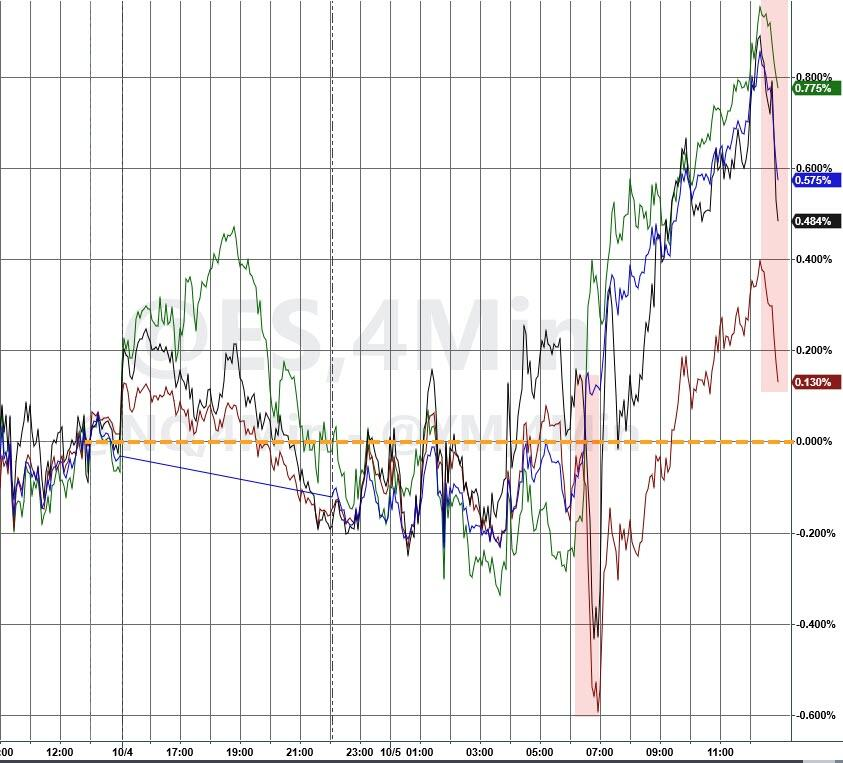
U.S. stock market: The Dow Jones Industrial Average rose 0.18% to 5,1267.90 points, the S&P 500 rose 0.66% to 7,773.95 points, and the Nasdaq Composite Index rose 1.05% to 27,477.31 points, closing at a record high.

Ten of the eleven major sectors in the U.S. stock market rose, with the materials sector leading with a gain of 1.22%, followed by communications services at 1.14%. Real estate was the worst-performing sector, falling by 0.44%. NVIDIA rose by 2.12%, and Meta rose by 1.90%.
Goldman Sachs' head of hedge fund business, Tony Pasquariello, summarized the current market as "the trading environment is by no means simple, but the main trend is still clearly upward." He expects the S&P 500 to be higher than its current level by December 31.
However, Goldman Sachs derivatives strategist Brian Garrett warned that "the bond market, commodities, and sentiment indicators are all sending alarms, with only the S&P 500 experiencing narrow fluctuations within low volatility," a pattern that is difficult to sustain historically.
Technology drives U.S. stock indices, and market breadth continues to deteriorate.
On Monday, the three major U.S. stock indices closed higher, with the Nasdaq rising by more than 1% to reach a new closing high. Despite increased inflationary persistence and worsening geopolitical tensions posing multiple pressures, the market's optimistic expectations for long-term profits supported the upward trend of U.S. stocks.
Large tech stocks generally rose, with the Wilshire US Tech 7 Giants Index increasing by 1.11%, outperforming the S&P 493 Index for two consecutive trading days. SpaceX rose by over 7%, while Tesla, NVIDIA, and Broadcom all gained more than 2%.
Morgan Stanley releases a bullish report, setting a target price of $300, stating that the company's value is undervalued. Multiple catalysts are driving the upward trend, including expectations for Starship recycling, AI business expansion, and a defense contract worth over $12.7 billion.
SpaceX The stock price soared by nearly 8% on Monday, and Elon Musk's net worth once again exceeded one trillion dollars, reaching approximately 1.03 trillion dollars, regaining the top spot among the richest individuals.
Most semiconductor stocks closed lower: American Micro Devices fell 0.34%, ASML fell 0.40%, Arm Holdings fell 1.49%, Qualcomm fell 2.21%, and Intel fell 2.63%. The Philadelphia Semiconductor Index gained less than 0.3% for the whole day.
However, TSMC rose by 2.75% to $485.80, with its total market value briefly reaching $2.5 trillion, setting a new historical high, while Broadcom rose by 2.08%.
Most Chinese concept stocks closed higher, with the NASDAQ China Golden Dragon Index rising by 1.61% and the Wind China Concept Tech Leaders Index climbing by 3.17%. Among the popular Chinese concept stocks, World Data Corporation rose by 6.24%, Alibaba increased by 4.68%, and Pinduoduo gained 3.34%.
Regarding other individual stocks, PTC Inc became the component stock with the largest increase on that day in the S&P 500, closing up 33.49% at $192.26.
Schneider Electric announced on October 5th that it has signed a final agreement with the American industrial software company PTC to acquire all of its shares for $205 per share in cash, corresponding to a share valuation of approximately $22.6 billion and a company value of about $23.7 billion. The offer is 42.3% above PTC's last closing price before the announcement and 46.1% above the weighted average price of trading volume over the previous 30 trading days.
There was another merger and acquisition on that day. The freight forwarding company Robinson Global Logistics agreed to acquire the truck broker RXO Inc for $5.8 billion in cash plus shares. The latter's stock price once rose by 21.8% during the trading session, while the buyer's stock price closed down 10.85%.
Overall, there was a significant divergence within the U.S. stock market on Monday. This marks the 15th consecutive trading day where the number of stocks hitting new lows exceeded the number of stocks hitting new highs.
Fundstrat pointed out in a recent report that among the Russell 3000 constituents, only about 20% of the stocks are above the 50-day moving average, while the proportion of stocks above the 200-day moving average has dropped to just over 40%, which is the lowest level of the year.
Analysis suggests that starting from the second quarter, the growth of the median earnings per share will slow down significantly and will be far lower than that of the S&P 500 index. In addition to technology stocks, profit margins in other industries have also been lowered. This explains why the equal-weight index has performed poorly and why market breadth indicators are so weak.
Goldman Sachs strategist Rich Privorotsky characterized it as “a peculiar market trend,” and noted that fundamental long-short strategy funds significantly reduced their risk exposure last week, with overall net positions at around the 2nd percentile over the past five years. Some investors even sold tech stocks to offset their macro bearish positions. He said:
What everyone is worried about, but the approach traders are choosing now is to reduce their exposure.
Long-term U.S. Treasury yields hit multi-decade highs, with duration premiums continuing to climb
In September, the U.S. service sector index ISM PMI recorded 54.9, lower than previous values and market expectations. After two consecutive months of growth, there was a slowdown in expansion. However, the service sector price index rose from 72.6 to 74.0, reaching a four-year high. Coupled with the simultaneous increase in inflationary pressures on the manufacturing side, this indicates that inflation stickiness in the United States has further strengthened. It is very likely that the Federal Reserve will maintain high interest rates for a longer period than previously anticipated by the market.
The yield on 10-year U.S. Treasury bonds reached a high of 5.34% on the same day, and the yield on 30-year bonds reached a high of 5.70%, both setting new highs since 2002. Both yields increased by at least 7 basis points. However, in the afternoon, as oil prices fell, the yields on shorter-term bonds declined, with the increase narrowing to 2 to 4 basis points.
BMO, the head of fixed-income asset management at Earl Davis, stated that it is "inevitable" for the yield on 30-year U.S. Treasury bonds to break through 6%, and it is very likely to happen within this month. Currently, the volatility in the bond market has already created a self-reinforcing cycle that drives up yields. The last time the yield on 30-year U.S. Treasury bonds reached 6% was in 2000.
BMO Capital Market Strategist Vail Hartman wrote in a research report that the overall tone of the ISM service industry report 'points to increasing inflationary pressures and strong nominal growth, reinforcing the core logic of the bearish view on the bond market over the past few weeks.'
Bloomberg macro strategist Michael Ball analyzes that softer labor and inflation data have cooled market expectations for central bank interest rate hikes, alleviating pressure on short-term interest rates; however, long-term yields are driven up by rising term premiums, with increased supply concerns and the stickiness of energy prices being the main drivers.
The market is increasingly inclined to believe that a tightening of long-term real interest rates implies that central banks do not need to take further action. This week will see tests of government bond auctions, with the issuance of $58 billion in 3-year bonds on Tuesday being the first. Subsequent auctions of 10-year and 30-year bonds will be key windows for assessing market demand.
Crude Oil: Saudi Price Cuts Coexist with Geopolitical Risks, Leading to Volatile Prices
WTI Crude oil closed down about 2.1% on Monday to $89.20 per barrel, but the intraday trend was extremely chaotic.
Saudi Arabia lowers its benchmark oil price for Asia, and news of progress in peace talks between the US and Iran is negative; meanwhile, Reuters earlier reported that Saudi Arabia's East-West pipeline was attacked and shut down, but later sources stated that the pipeline was operating normally, leading to significant price fluctuations.
Upward risks have not dissipated. Emily Ashford, the head of energy research at Standard Chartered Bank, stated:
Just because the apparent crude oil exports are recovering, the risk premium has not disappeared. The conflict between Houthi militants and Saudi Arabia has its own dynamics and risks of escalation, with Saudi infrastructure and alternative export routes continuing to be under threat.
Saudi Aramco’s CEO Amin Nasser warned at a London energy think-tank forum on Monday that global crude oil inventories, which act as a buffer against supply shocks, have become “extremely thin.” If the Strait of Hormuz cannot be reopened to shipping, market risks will further deteriorate. Amin Nasser emphasized:
The pressure on crude oil is already severe, but the increase in refined oil prices is even more dramatic.
Shengbao Bank's head of commodities strategy, Ole Sloth Hansen, stated that the release of emergency reserves and Saudi Arabia's price cuts are suppressing oil prices. He said:
But this does not change the basic fact that, although transportation through the Strait of Hormuz has recovered, it remains fragile and could be interrupted again at any time.
Brazil is strong, the euro is under pressure, and the US dollar and Bitcoin are fluctuating in both directions.
Brazilian assets soared on Monday, with right-wing senator Jair Bolsonaro leading incumbent President Dilma Rousseff by 47.8% to 44.2%, far exceeding poll expectations. The two will compete in a runoff election on October 25th.
Investors anticipating a more fiscally conservative policy mix have seen the Brazilian real strengthen significantly, with both the stock market and bond market rising in tandem.
Robeco Institutional Asset Management Portfolio Manager Daniela Da Costa - Bulthuis represents:
Junior Bonassoro is regarded by investors as a more preferable option, and his fiscal consolidation plan will create room for the Brazilian Central Bank to continue cutting interest rates.
European fiscal pressures are mainly reflected in the foreign exchange market, with ongoing concerns regarding French sovereign debt. The euro has fallen to its lowest level since May 2025. European stock markets have shown mixed performance: the French stock market closed slightly lower, while the Spanish stock market rose due to its exposure to Brazil.
The US Dollar Index strengthened moderately with the support of a weaker euro, but then it fell back, narrowing its gain.
Gold, suppressed by the US dollar, fell to near its low from last Friday.
Bitcoin, on the other hand, exhibited significant two-way fluctuations. It managed to fully recover from its losses from last Friday, but then gave back about half of its gains, closing at $85,705, with a slight decline of 0.1%.
The market fluctuates wildly; instead of rushing to sell when the trend seems clear, it's better to be prepared in advance! OCO The "two-out-of-one" order allows you to deploy two related orders simultaneously. Once one of them is executed, the other will automatically cancel, enabling you to respond flexibly to various market trends.
Edit / stephen
Risk and Disclaimer Notice