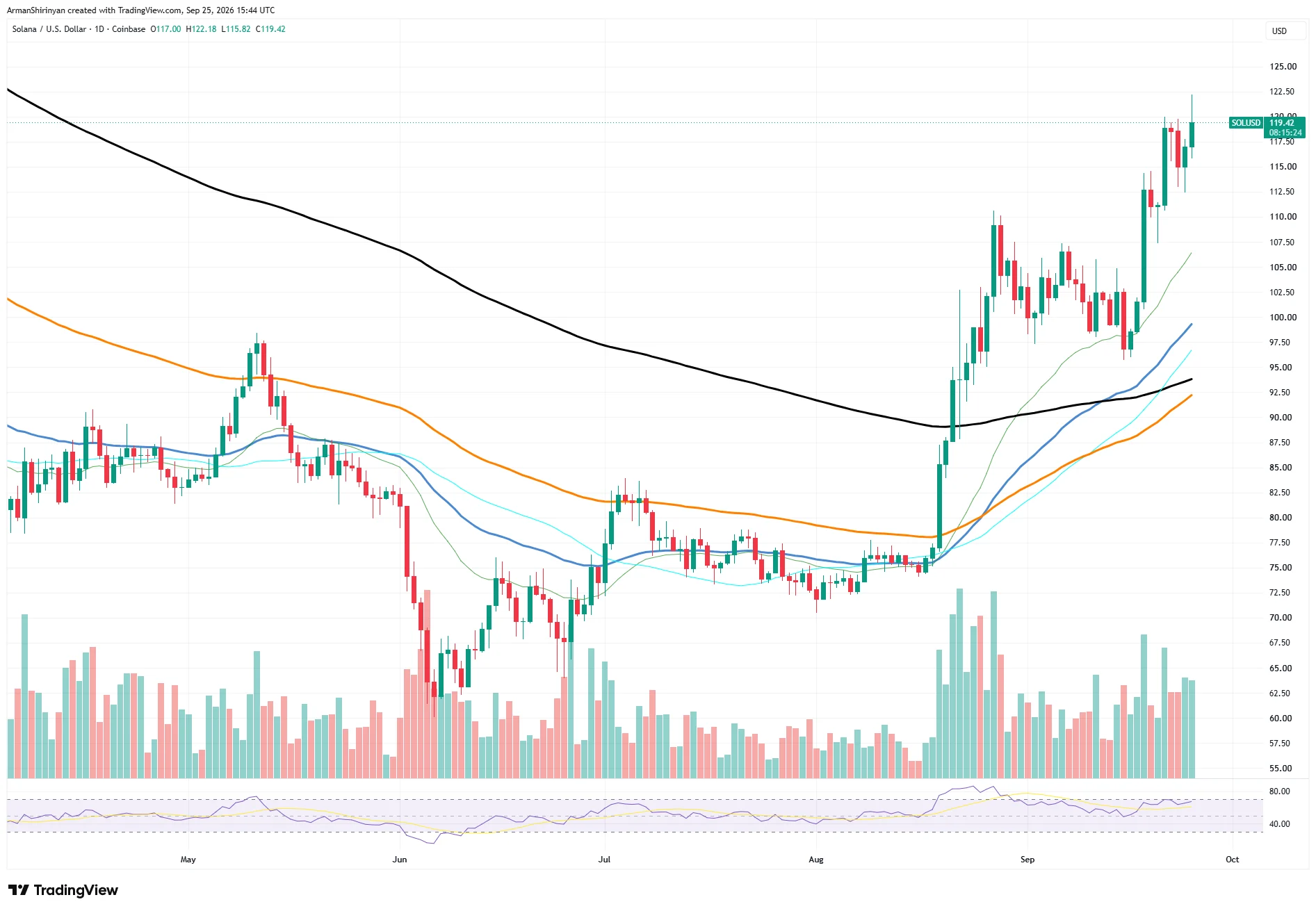


Bitcoin recently rose to near an eight-month high of $87,400, before falling back to around $83,000. Discussions then immediately returned to the familiar topics: interest rates, U.S. Treasury yields, the dollar, liquidity, risk appetite, and risk aversion.
Of course, that makes sense. Bitcoin is highly volatile and has strong liquidity, and when investors need cash, its price can just as easily fall as it does for tech stocks.
But I believe that we have asked the right questions, yet we have used the wrong time scale.
If you are engaged in short-term trading, then it is of course important to consider whether Bitcoin is a risky asset this week. But if the question becomes: What will happen to money in the next 10 or 20 years, after artificial intelligence has transformed economics related to labor, production, and scarcity? That would be a completely different question.
And this experiment has actually already begun.
The world is becoming increasingly adept at manufacturing things.
Imagine intelligence becoming extremely affordable.
Software that in the past would have taken an engineering team several months to complete can now possibly be done in just a few days or even hours. Robots produce goods around the clock. Drug development has accelerated. A company that originally required 5,000 employees may now be able to produce twice as much with only 500 people.
Most of these sound wonderful. Perhaps they really are.
But there is an awkward issue hidden in this narrative of abundance: machines can produce products, yet they cannot automatically create customers who have the money to purchase those products.
At this point, it is no longer just a AI story; it begins to turn into a monetary issue.
What kind of balance sheet do we bring into this new world?
Don't think too sci-fi about it for now; let's take a look at the balance sheet as we bring it into this new world.
The US Congressional Budget Office estimates that as of the first 11 months of fiscal year 2026, the US federal deficit has reached approximately $2 trillion.
Its longer-term baseline is also not reassuring. It is estimated that the debt held by the federal public will rise from about 101% of GDP in 2026 to 120% in 2036, exceeding the previous record of 106% reached shortly after the end of World War II.
This does not mean that the United States is about to default, nor does it mean that the dollar will disappear.
It means that we are embarking on one of the most significant technological transformations in history, yet we have little financial buffer to afford mistakes.
Subsequently, AI may also alter another aspect of the ledger: taxation.
AI It's not necessary to make everyone unemployed.
Extreme AI stories are easily dismissed. Robots arrive, and everyone loses their jobs. On Tuesday afternoon, humans begin to ponder what to do next.
Changes in the economic structure do not necessarily require taking such measures.
The World Economic Forum predicts that by 2030, the transformation of the labor market could create about 170 million new jobs, while also replacing 92 million jobs. Naturally, people are concerned with the net result: a net increase of 78 million jobs.
But I've always been more concerned about another number.
92 million jobs have been replaced.
It is truly astonishing that such a large-scale economic restructuring has occurred in such a short period of time.
More importantly, the problem may not lie in the number of positions themselves. What is truly crucial is how much of the economic output ultimately goes to labor and how much goes to capital.
It is entirely possible for a company to double its output without doubling its total wages. Society benefits from more goods, productivity increases, and the owners of productive assets also perform very well.
But the relationship between production and wages has changed.
Modern governments rely heavily on this relationship. People work and earn salaries. The government taxes a portion of that income, while workers and employers contribute to programs linked to employment.
Once the first two steps of change are initiated, it is no longer just a debate about whether a certain “AI model will replace accountants,” but rather a question regarding the underlying architecture of the tax system itself.
Researchers at the International Monetary Fund have specifically studied this issue, including how labor market disruptions driven by AI and changes in income distribution may require adjustments to tax and social security systems. It is important to note that these are merely scenario analyses and not predictions of widespread unemployment.
No need for a robot apocalypse.
As long as there is a meaningful change in the flow of income, that is sufficient.
Sandwich Factory Problem
The following is the simplest way I can think of to explain what bothers me about the argument of abundance.
Suppose someone has built a fully automated sandwich factory.
AI Procures raw materials, robots unload the goods, make sandwiches, package them, clean the factory, and arrange for delivery.
What originally required an operation team of 1,000 people now only needs 30 people.
It can produce 10,000 sandwiches per hour.
We've achieved a surplus of sandwiches. That's amazing.
There's just one detail.
Who will buy all these sandwiches?
Those who used to work here still need lunch. Producing something is a completely different issue from distributing the purchasing power required to buy those things.
If automation pushes this dynamics far enough, society will ultimately need to build a bridge between the two.
Perhaps it's some form of basic income. Maybe it's citizen dividends. Perhaps people will hold a larger proportion of productive capital. Maybe the government will tax capital or consumption in different ways.
I don't know which answer will win. I doubt there will be a clear and straightforward answer.
But almost all of the proposed solutions will ultimately encounter the same problem:
Where does purchasing power come from?
If the share of taxable income provided by labor decreases, while at the same time the government is required to support more people during the transition period, then the pressure will not disappear. It simply shifts—towards capital taxes, consumption taxes, borrowing, spending choices, and potential monetary policies.
Don't forget what our balance sheet looked like at the beginning.
This is the connection that I believe is often overlooked.
Abundant narratives have not only changed what is produced, but also the pressures exerted on money and the systems that underlie it.
This is where 21 million coins start to become interesting.
The price of Bitcoin is not stable.
But its monetary rules are stable.
Under Bitcoin's consensus rules, the issuance volume decreases according to a predetermined schedule, with the total supply gradually approaching 21 million coins.
AI can create another image, another song, another piece of software.
Ultimately, robots may be able to re-manufacture a car, a smartphone, or a house with far less labor input than humans use today.
But it's impossible for AI to wake up tomorrow morning and decide that it would be better if there were 31 million Bitcoins in the economy.
To change this, it is necessary to persuade the internet to accept a different rule.
Of course, there is one obvious reservation here.
Scarcity itself has no value.
I can also create a token with a maximum supply of 7 this afternoon. No one really needs to care about it.
Scarcity only makes sense when there is demand for it.
And that is precisely where the most interesting part of this experiment lies from now on.
Assume that AI makes intelligence more affordable, robots make labor more affordable, automation makes manufacturing more affordable, and digital content can be almost infinitely replicated.
So, what is still difficult to replicate?
Land, energy, certain natural resources, human attention, trust, mature networks.
Perhaps there are also those monetary assets whose supply is truly believed to be limited by people.
The more abundant technology is, the more likely it is that value will flow towards things that cannot easily be multiplied by technology.
This does not prove that Bitcoin will definitely win.
But it indeed makes the economic value of “credible scarcity” worthy of serious consideration.
Observations from the front lines
A considerable portion of my professional career has been spent observing the crypto market from within, and I quickly realized one thing: predictable protocols do not create a truly efficient market.
Through my current work at Monivo, we have measured over 900,000 service provider quotes in Monivo Crypto Swap Rate Index. Among the comparable quotes for the same transaction, the median difference between the best and worst payment results recorded is approximately 2%.
This dataset does not represent the entire market, and the quotes are not for completed transactions either, so I won't pretend that it can prove more than what it actually can.
But I like one point it illustrates: even if the supply rules of a certain asset are predictable, the price discovery process surrounding it can still be quite chaotic.
Protocol certainty and market efficiency are not the same thing.
What can prove that this view is wrong?
There's a troublesome habit in comments about Bitcoin: every event that happens on Earth is turned into a reason for Bitcoin's price to rise.
Inflation? Bullish.
Deflation? Somehow, I'm still bullish.
Strong economy, weak economy, interest rate cuts, interest rate hikes – given enough time, there will always be someone who can explain why all of these are beneficial for Bitcoin.
This is not analysis.
There are many possible errors in the arguments I have put forward.
AI may create new job categories more quickly than it replaces old ones. The increase in productivity could be widely distributed to society through higher wages and broader ownership, rather than being highly concentrated in the hands of capital owners. The government might succeed in reshaping the tax system. Financial conditions could also improve.
Moreover, even if credible scarcity becomes more valuable, there is no legal requirement that humans must choose Bitcoin.
People might choose stocks, real estate, gold, energy infrastructure, land, or something that has not yet been invented.
Bitcoin itself also carries risks: regulation, technological competition, extreme volatility, changes in market structure, and the most straightforward risk of all—that future demand may not develop in the way Bitcoin holders expect.
21 million coins is a supply rule.
It is not a commitment to price.
By bringing this point up, it actually strengthens the argument rather than weakening it.
So, what exactly does this round of upward movement indicate?
The recent rise in Bitcoin is positive for the entire industry, but I wouldn't consider a single rebound as proof of this argument, just as I wouldn't use a subsequent 20% pullback to refute it.
In a liquidity crisis, even gold can fall in value. An investor in urgent need of dollars will sell whatever they can. This does not necessarily reflect their view on the role of that asset over the next 20 years.
Price behavior during panic and the economic utility that spans across generations are two different things.
On Wednesday afternoon, Bitcoin could fluctuate in a manner similar to high-beta tech stocks, and it could also represent an attempt at insuring against another set of risks that are measured over decades: fiscal pressures, monetary discretion, changes in the tax base, and the uncertainty of who will ultimately benefit from the productivity gains that AI might create.
This is much more significant than “whether the next central bank move will be 25 basis points or 50 basis points.”
The central bank can change the weather.
But they are even more difficult to use in reshaping the climate.
The question that I can't shake off
We are embarking on one of the most peculiar economic experiments of our lives.
Technology may make intelligence no longer a scarce resource. Automation could reduce the central role of human labor in production. Robots might significantly lower the manufacturing costs of physical goods.
At the same time, with huge debts on its shoulders, the government may ultimately have to rethink the systems established around employment, wages, and related taxation.
Maybe this transformation will go very smoothly.
I hope so.
Perhaps AI will create so much new wealth and new types of jobs that today's concerns will seem outdated in 20 years.
I hope so too.
But perhaps we have been asking the wrong question about Bitcoin all along.
Rather than asking: In an era of abundant technology, why would people still desire a deliberately scarce digital asset? It’s better to ask a better question:
Why would we assume that the value of credible scarcity would decrease when almost everything else becomes easier to create?
About the Author:Rob Frye founded the cryptocurrency exchange Xcoins in 2016 and later served as its CEO. During that time, the company established operations in Malta and became one of the first platforms to obtain a license from Malta's Financial Services Authority Class. He is currently involved in the strategy and product development of Monivo, which is a non-hosted crypto exchange aggregator, and he holds financial interests in the company. The views expressed in this text represent solely the author and do not constitute investment advice.