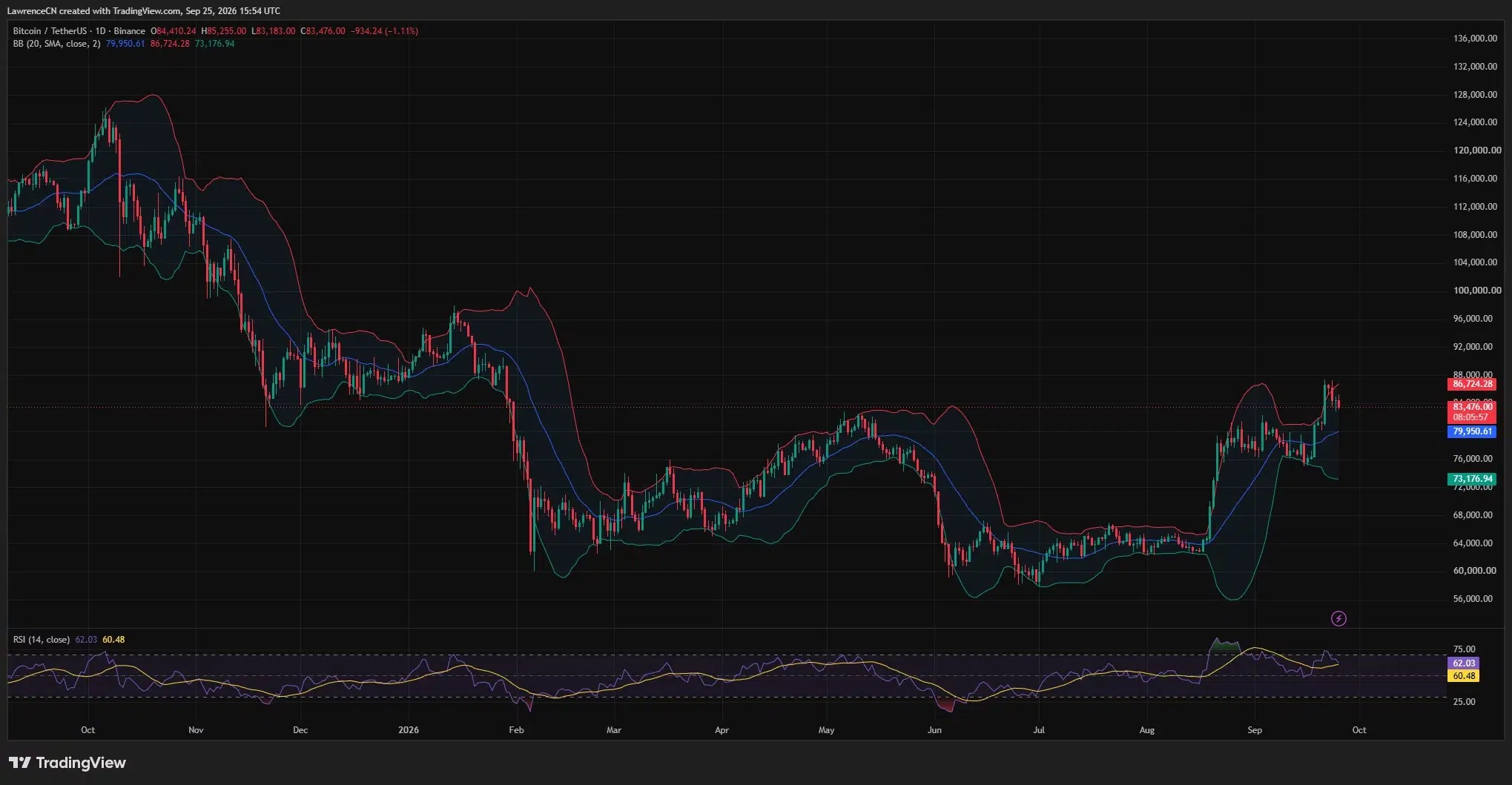


ViaBTC Chief Analyst Jeff Ko stated that Bitcoin once rebounded above $85,500 after the inflation data was released, but then lost all of its gains, and is currently trading around $83,500. Analysts believe that $82,000 will be a key support level after entering October.
According to Ko, Bitcoin rose by more than 2% after the release of personal consumption expenditure ( PCE ) inflation data, briefly breaking above $85,500, but then fell back. The head of the Bitget Wallet research team, Lacie Zhang, set Bitcoin's trading range for October between $78,000 and $95,000, stating that this judgment depends on whether demand can withstand inflation and interest rate risks.
$82,000 support level approaches the liquidation-intensive area
Ko believes that the significance of $82,000 lies in the fact that once this price level is breached, the liquidation positions will significantly thin out. Zhang, on the other hand, identifies the main downward liquidation range to be between $82,000 and $82,500, and warns that if this area is lost, the decline could accelerate to $80,000.
Previously, CoinGlass data also showed a similar concentration of leveraged positions. A report on September 29 indicated that there was a dense liquidation zone around $82,300 to $82,600, and another concentrated area existed above that in the market, around $85,400 to $85,700.
According to the bullish scenario outlined in Zhang, Bitcoin must hold above $82,000 and regain $87,500 before it has a chance to move further up towards $95,000. She also believes that if it breaks through $87,500, the likelihood of short squeeze increases; if it continues to fall below $80,000, then her seasonal bullish outlook will be invalidated.
Although October has traditionally been favorable for Bitcoin, Zhang still reminds that one should not expect a rise based solely on calendar factors.
"October has been a strong month in Bitcoin's history, but seasonality alone is not a compelling argument for investment."
She estimates that the median return rate for October in Bitcoin's history has been around 11% to 14%. In her view, the inflow of ETF funds, the decline in exchange balances, and corporate purchases have supported the bullish logic, but high oil prices, high interest rates, and resurging inflationary pressures remain the main obstacles.
ETF There is support from buyers, but a rise cannot be guaranteed.
When talking about institutional activities, Zhang mentioned that approximately $2.4 billion flowed into US spot Bitcoin ETF last week, and then on September 28th, the daily net inflow slowed down to $31.1 million. She also stated that Strategy bought an additional 1,665 BTC, bringing its holdings to 847,666 BTC.
"Institutional demand can provide support from below, but it cannot alone guarantee a rise in October."
In the view of Zhang, the decisive factor lies in whether new institutional buyers can absorb the profits of long-term holders and the selling pressure from miners. She believes that the balance of buying and selling forces is more important than the scale of any single purchase.
Ko mentioned that since last week, there has been a inflow of $2.3 billion into Bitcoin funds and $644 million into Ethereum funds. He believes that although Bitcoin failed to maintain the increase after the release of the PCE data, the ETF capital flow is still constructive.
During the upward trend in September, US spot Bitcoin ETF recorded a net inflow of $999 million on September 21 and $714.7 million on September 22. The relevant data comes from a report by Bitfinex on September 24 regarding ETF buying orders and leverage. In that report, BTCS S.A. Strategy Advisor Wojciech Kaszycki stated that cash buying orders supported the initial phase of the rise, followed by the accumulation of leveraged positions.
Kaszycki believes that to maintain Bitcoin above $90,000, continuous ETF subscriptions as well as buy orders from corporations or over-the-counter buyers are necessary conditions. He also warned that holders who bought in the range of $90,000 to $110,000 last year may choose to sell when Bitcoin returns to near their purchase price.
Milder PCE data has reduced expectations for a rate hike in October
Ko indicates that the overall PCE has increased by 0.3% on a month-on-month basis and by 3.4% year-on-year; the core PCE has increased by 0.2% on a month-on-month basis and by 3.0% year-on-year. The expectations he cited were 3.7% for overall inflation and 3.3% for core inflation, both of which are lower than anticipated.
Despite the lower data readings, Ko believes that most of the difference comes from methodological adjustments rather than a true alleviation of price pressures. In his view, these data appear more modest on the surface, but they do not prove that inflation has slowed down by the same extent.
However, data cited by Ko shows that the probability of a rate hike in October has dropped from 70.9% a week ago to 38.2%. He believes that the implied probability of a rate hike in December is 86%.
Zhang The current baseline scenario remains that the Federal Reserve will raise interest rates by 25 basis points at its meeting on October 28, raising the target range to 4.00% to 4.25%. She links this judgment to inflation above 3% and renewed pressure on energy prices.
In the assessment on the Federal Reserve's further interest rate hikes on September 29, Senior Researcher Tim Sun warned that if another hike occurs in October, investors might regard the September increase as the beginning of a continuous tightening of monetary policy. The same report also noted that on September 16, the Federal Reserve raised interest rates by 25 basis points to 3.75% to 4.00%.
For American investors who directly hold Bitcoin or hold Bitcoin through the US spot ETF, Sun believes that Treasury yields, fund flows, and derivatives leverage are key factors affecting the market. He stated that higher long-term interest rates and tighter dollar liquidity may suppress demand.
Employment and CPI will test interest rate expectations; leverage is cooling down.
Before the economic data was released, Zhang indicated that the leverage in derivatives had eased to some extent, but it had not been completely cleared. She mentioned that the funding rate for Binance's Bitcoin perpetual contracts was close to 0.0068%, while the 7-day average was around 0.0023%, suggesting that there were relatively large positions, but they were not overheated.
According to Zhang, the size of open contracts is approximately $7.7 billion, which is a decrease of about 16% compared to a week ago. She believes that this decline has reduced the risk of large-scale forced liquidations in the market.
At a macro level, Ko mentions that the yield on 10-year U.S. Treasury bonds is close to 5.2%, and crude oil prices are above $100 per barrel. Both analysts consider the employment report for September, released on October 2, and the CPI for September, released on October 14, as important data points to come.
Zhang indicates that if employment reports are clearly weak, especially with an increase in unemployment rates and a slowdown in wage growth, it will increase the likelihood of the Federal Reserve pausing interest rate hikes. On the contrary, if employment remains resilient and inflation is strong again, that would support interest rate hikes, which she believes could put pressure on crypto assets through higher real inflation-adjusted yields and a stronger dollar.
Apart from Bitcoin, Ko indicates that Ethereum has performed stronger relative to BTC over the past three months. He hopes that the ETH / BTC ratio can clearly break through around 0.032 before this strength can be considered confirmed.
Later this month, Zhang's schedule also includes the preliminary figures for the third quarter of the United States GDP and the September PCE data, with release dates set for October 29th. She expects that these data will influence interest rate expectations for December, as they will all be announced after the policy decisions in October.