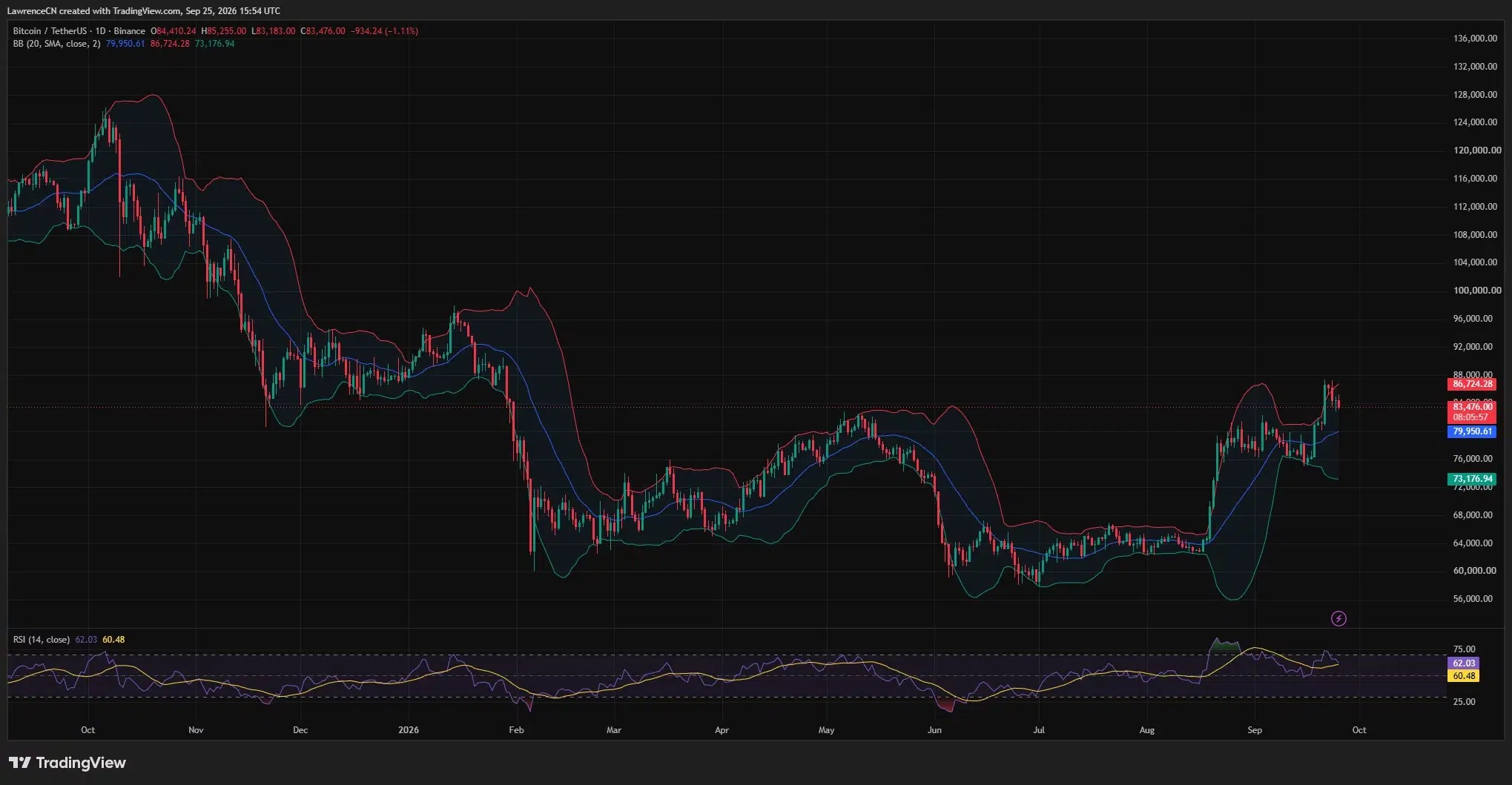


Arthur Hayes reiterated his prediction that Bitcoin could rise to $1 million by 2030, pointing to a potential acceleration at the end of 2027 or the beginning of 2028, citing the possible pressure on artificial intelligence infrastructure funded by debt.
- It is reported that Hayes predicts that Bitcoin will reach $1 million by 2030, with the upward trend possibly accelerating between 2027 and 2028.
- His argument links the aging AI hardware and longer debt repayment cycles to potential credit losses.
- Apollo estimates that AI financing may support over $2 trillion in new investment-grade debt.
- U.S. insurance regulatory authorities have introduced changes to the reporting requirements for private credit holdings, which will take effect by the end of 2026.
A financial news account on X, Walter Bloomberg, reported that Hayes, the chief investment officer of Maelstrom, expects the strongest rise in Bitcoin to occur at the end of 2027 or the beginning of 2028. Based on this prediction, Hayes's goal of acquiring 1 million dollars worth of Bitcoin is founded on his judgment: if the investment boom turns downward, governments and central banks may inject funds into the financial system.
In this scenario, Hayes believes that if the revenue generated by the data center cannot cover the substantial funds invested in construction and computing equipment, financial pressures will arise. He expects that the rise in Bitcoin will depend on the measures taken by policymakers to increase liquidity after borrowers and financial institutions suffer losses.
The prediction of $1 million in Bitcoin value is based on the decline in the credit of AI.
In a report on August 5th, crypto.news introduced Hayes's arguments regarding the credit crisis of AI. He viewed large-scale infrastructure expenditures as real estate development supported by debt. His arguments focused on land, construction, power access, cooling systems, as well as processors that may depreciate as new equipment becomes cheaper and more efficient.
Compared to earlier market crashes, Hayes describes this round of prosperity as:
"This is a story of credit, similar to that of 2008, rather than a story of profitability, like that of 2000."
In his view, the risks are not limited to the decline in tech stocks. If a project cannot generate sufficient income to cover interest payments, leases, and other obligations, banks, insurance companies, private lending institutions, and infrastructure investors could all face losses.
Hayes believes that technology companies with good profitability may remain healthy, while weaker projects and their financiers will face pressure. Therefore, the core of his prediction is the debt that supports the expansion of AI, rather than expecting all large AI companies to experience a collapse in profitability.
The mismatch between the hardware’s lifespan and longer financing periods also explains why he is focusing on 2027 and 2028. Hayes predicts that as borrowers will still need to repay loans arranged under higher income expectations, the equipment will gradually age.
Appeared in the expenditure forecasts for Hayes at the end of 2027 and in 2028.
In reports from August, Hayes predicted that the announced growth rate of AI capital expenditures would begin to slow down in the second half of 2027 and become more apparent in 2028. He also anticipated that investors would ultimately prefer companies that reduce their construction plans.
Although Hayes identified potential periods of stress, he admitted that he couldn't pinpoint which borrower would trigger a crisis, nor could he determine the exact bottom for Bitcoin. In his August scenario, Bitcoin could trade between $60,000 and $70,000, and might further fall to $50,000 before ultimately rising to $1 million.
By September 22, reports regarding his argument about the liquidity of AI's debt raised more specific concerns: the weakening demand for AI training and services could undermine the revenue assumptions underlying data center operations, chip purchases, and related lending activities.
In his “Safety First” article, Hayes argues that efforts to reduce computing costs may harm infrastructure investments that were financed based on higher expenditure expectations. Even if customers purchase less computing power than lenders and developers anticipated, the debt obligations will still exist, he writes.
Apollo It is estimated that AI's financing will extend to private debt.
Another study by Apollo provides quantitative data on the financing needs behind this expansion. In a statement on August 14, the company's chief economist Torsten Slok estimated that the AI ecosystem could support over $2 trillion in new investment-grade debt.
Apollo indicates that due to limitations such as issuer concentration and credit ratings, the public investment-grade market may be able to absorb less than $1 trillion by 2030. The company expects that financing exceeding $1 trillion may shift towards private placements, infrastructure loans, equipment financing, and project-specific structures.
Apollo also used data as of July to state that loans related to AI accounted for nearly 40% of the supply of longer-term investment-grade corporate bonds. Its research views private financing as a way to meet demand and points out that some transactions can provide collateral and contractual protection.
In terms of potential U.S. policy responses, Hayes described two paths in “Safety First”. Washington could purchase computing power to support the industry, becoming what he referred to as a “lender of last resort for computing power,” or it could provide financial assistance to insurance companies that have suffered losses due to AI related debts.
In either case, Hayes expects that such responses will increase the money supply and support the price of Bitcoin. A report on September 22 stated that U.S. authorities have not announced any such measures regarding the AI debt crisis.
US insurance regulators tighten requirements for private lending reporting
The National Association of Insurance Commissioners (NACI) of the United States has identified issues related to liquidity, pricing, and transparency in private lending as areas of concern, providing a direct U.S. regulatory context for the lending risks discussed under Hayes.
According to their guidance, concerns regarding valuation, lending standards, and industry exposure have led to redemption requests from some retail private equity credit funds. Some products have implemented redemption restrictions, and software borrowers exposed to the impact of AI are also being subject to closer scrutiny.
The association stated that these developments do not necessarily mean that the entire private credit market or the positions held by insurance companies have deteriorated. State regulatory agencies and NAIC staff are monitoring credit quality, valuation practices, and the investments of insurance companies.
According to the amendments passed in 2025, NAIC requires the submission of a private placement rating rationale report within 90 days after an annual update or a change in rating. The association explained that these reports must contain substantive analytical content.
In terms of annual financial reporting, the statutory accounting standards working group of NAIC has approved relevant changes, which will take effect from the end of 2026, in order to improve the reporting of private credit holdings of insurance companies.