

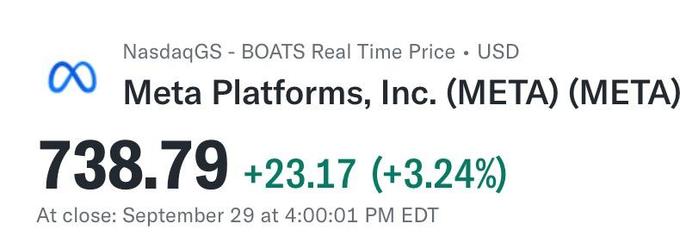
OpenAI launched Dots, directly challenging Muse of Meta, but Meta closed up 3.24% on that day.
Dots is a 24/7 personal Agent published by OpenAI, driven by GPT-6 and Astra.
- Dots will take the initiative to push things forward on their own and only seek your approval at critical points.
- It can manage both your work and family affairs simultaneously.
- It not only reports progress, but also takes the initiative to find solutions when problems arise.
The same Agent can not only revise board meeting drafts and deploy code, but also order cakes, sign up for after-class tutoring, and coordinate time conflicts for one's daughter's performances. OpenAI positions it as your “personal butler,” rather than just an “efficiency tool.”
OpenAI's Dots live demonstration experienced lagging.
As soon as Dots took the stage, the first reaction from the audience was: Today, META might be under pressure, because the direction taken by OpenAI this time is very direct. Dots is aimed at the idea that “AI can complete tasks on your behalf,” and this is precisely what the market has been most keen on recently with Muse.
But OpenAI itself encountered problems during the on-site demonstration.
OpenAI The product owner, Holly Li, demonstrated his own Dot, which is named “Dottie”. According to the design, Dottie should help her prepare for the launch of a fictional music App, including handling tasks, using tools, and advancing the project.
For a moment, there was no response from the audience, and everyone in the venue could only wait. Holly had no choice but to explain on the spot that Dottie "was a bit slow this morning." Even more awkwardly, several subsequent demonstration sessions also did not go smoothly, with voice parts experiencing lag as well.
The audience on site and social media quickly began to discuss: If even the demonstration at the press conference couldn't be completed stably, how far is Dots from actually providing long-term service to users?
When the core selling point of a product is “You hand over the task to me, and I’ll complete it for you,” and yet it fails to perform stably on its first major public debut, the market naturally begins to doubt: whether its capabilities are strong enough is one thing, but whether it can be trusted to handle the task is another entirely different matter.
Expected to trade first, then price later.
US stock investment websites analyze that this has instead given Meta a breathing space.
What the market was originally worried about was that: as long as OpenAI launched a product similar to Muse, the leading position that Meta had just established would be quickly overturned.
But what was truly observed on Tuesday was that: OpenAI did indeed push Dots forward, but it was not yet strong enough to immediately destroy the investment logic of Muse.
On Monday, META was already under pressure due to the potential competition from OpenAI, and the market sold off some of its risks in advance. By Tuesday, Dots did indeed arrive, but it did not result in the "OpenAI crushing Meta" scenario. Instead, it exposed issues with product maturity and execution stability.
This is a typical example of: expectations leading to transactions first, followed by pricing afterwards.
However, the rise of META does not mean that the market has concluded that Dots will never be able to surpass Muse. Instead, it indicates that the realization of that competitive threat may not happen as quickly as the market previously imagined.
Meta also took a step forward on that day.
On the same day that OpenAI released Dots, Meta launched Muse, for, and Small Business.
This step is crucial, as Muse begins to transition from a consumer-grade AI assistant to a commercial tool.
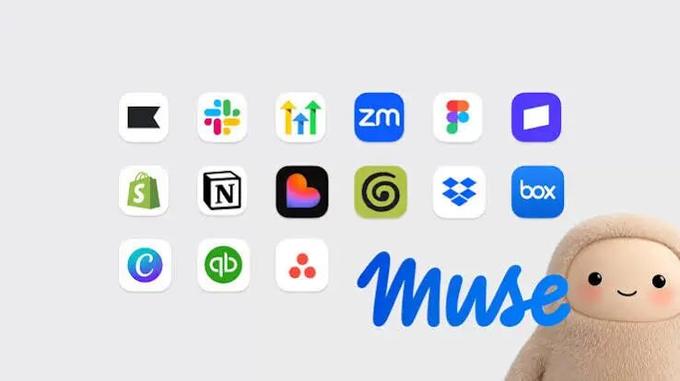
In the past, Muse mainly helped users with shopping, booking trips, and handling emails. Now, it has begun to integrate with tools that small businesses actually use on a daily basis, including Instagram business accounts, Facebook websites, Meta advertising accounts, as well as Shopify, QuickBooks, Stripe, Canva, Slack, Zoom, Notion, and so on.
Meta hopes that Muse can help small businesses with sales analysis, ad optimization, customer management, and financial checking. Moreover, without user approval, no messages will be sent directly, no content will be published, and no purchases will be made.
It's no longer just a “AI Assistant.” It has begun to become a gateway that connects users, merchants, advertising systems, and commercial software.
Meta also sets out long-term financial goals:
- For the next three years, the annual revenue growth target is over 20%.
- Atlas Annual revenue growth target: in the mid-20% range
- Operating profit margin target: over 20%
- Operating profit margin is expected to expand by an average of 100-200 basis points per year.
- Free cash flow conversion target: 80%–100%
This means that Meta is proving to the market that the huge amount of capital invested in the past, which amounted to AI, will not remain solely at the cost level forever. Instead, through Muse, advertising systems, and commercial services, it will gradually be transformed into revenue, profits, and free cash flow.
Meta is in the process of redefining itself from a company that was "re-invested by AI" to a company driven by AI for growth and profit.
Agent In this era, the rules of competition are changing.
The capital market is confirming one thing: Agent is no longer just a concept in the laboratory, but rather the next round of truly implemented product cycles under AI.
The more intense the competition, the faster the advancement of models, computing power, cloud services, software entry points, and commercialization will be.
There may not necessarily be only one winner in the future. OpenAI has models and developers; Meta has traffic and an advertising system; Microsoft has corporate customers; Apple has a hardware entry point; while Google controls search, cloud, and mobile operating systems all at once.
Therefore, the article suggests that there is reason to remain optimistic about the future of U.S. stocks. As long as funds continue to search for directions around the question of "how AI can truly generate revenue," there will be no lack of opportunities in the market.
What really needs to be monitored are those companies that not only have technical capabilities and user access, but can also convert AI into cash flow.
The article also mentions that although the performance of market indices in Japan and South Korea was divergent today, chip stocks such as Samsung Electronics and SK Hynix still maintained their resilience. This indicates that funds have not left the main trend of AI, but are simply looking for more certain entry points.
Following this line of thought, tomorrow's U.S. stock market is a day full of anticipation.
Source: US Stock Investment Network