











AI The overall infrastructure demand remains strong, but there is a clear differentiation in price signals across various sub-markets. According to JPMorgan's latest data center observation report, in September, both the usage and expenditure of Token accelerated, however, the rental price trends for GPU showed divergence, with spot memory prices experiencing their first decline after a continuous rise.
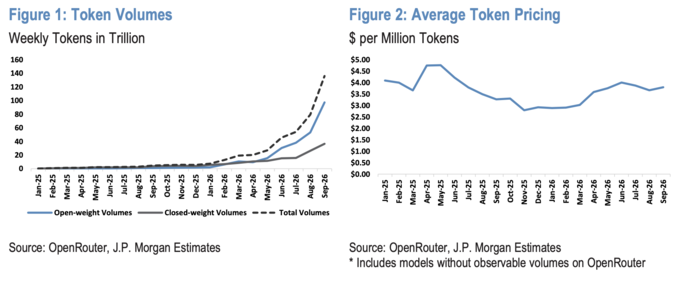
According to Zuifeng Trading Desk, JPMorgan analyst Joseph Cardoso pointed out in a report released on September 29 that on September OpenRouter, the usage of platform Token surged by 71% month-on-month and increased by 30 times year-on-year. Overall expenditures also grew by 28% month-on-month and expanded by 14 times year-on-year.
At the same time, there is a clear differentiation in the NVIDIA GPU rental market: the rental prices of A100 and H100 both declined month-on-month, while B200 rebounded slightly after its first decline in August. In terms of the memory market, the spot price of DRAM saw its first slight month-on-month decline in September after five consecutive months of increases, while the price of NAND remained relatively stable.
The above signals have complex implications for AI infrastructure investors. The continuous acceleration in Token usage confirms the authenticity of the demand at the AI application layer, however, the downward pressure on GPU rental prices and the temporary pause in memory price increases indicate that supply-side expansion and changes in demand structure are beginning to constrain hardware pricing.
Token Accelerated usage, low-cost open-source models drive growth
In September, the usage of Token increased significantly at a faster pace. According to data tracked by JPMorgan Chase on the OpenRouter platform, the month-on-month growth in usage of Token in September was 71%, higher than 47% in August and 18% in July, with a year-on-year growth rate of 30 times.
The core driving force for growth comes from open-source models. The usage of open-source models (including DeepSeek, Moonshot AI, etc.) has increased by 83% month-on-month and by a staggering 101 times year-on-year, with a growth rate significantly faster than that of closed-source models (OpenAI, Anthropic, etc.), which saw a month-on-month increase of 39% and a year-on-year increase of 10 times. The proportion of closed-source models in the total usage has decreased from 33% in August to 27%.
The top five models ranked by usage are: DeepSeek V4.1, Flash, GLM 5.3, Flash, Tencent Hy4, preview, GPT-5.6, and Luna, which together account for over 53% of the total Token usage. Among them, the two models DeepSeek V4.1, Flash, and GLM 5.3 Flash contribute approximately 41 trillion Token in a single month, accounting for about 30% of the total, and their pricing is much lower than the average of previously open-source models.
Disparity between volume and price: Growth in spending relies on expansion of usage rather than price increases
The explosive growth in usage has not led to an increase in unit prices, and there is a significant divergence between volume and price. In September, the weighted average price of trading volume (VWAP) decreased by 25% month-on-month and by 55% year-on-year. This is mainly driven by two factors: firstly, the concentration of usage towards cheaper high-traffic models (DeepSeek V4), with the widespread adoption of Flash and GLM (5.3) Flash dragging down the overall average price; secondly, there were price reductions for similar models such as Kimi K3, GLM (5.3), and GPT-5.6 Sol.
Nevertheless, overall Token expenditures still experienced accelerated growth, with a month-on-month increase of 28% in September, higher than the 7% growth rates in July and August, and a year-on-year expansion of 14 times. The main contribution to this expenditure growth came from open-source models, which saw a month-on-month increase of 64% and a year-on-year increase of 132 times, with their proportion of total expenditures rising from 22% in August to 28%.
It is worth noting that there is only one model in common among the top five models ranked by expenditure and the top five models ranked by usage. The top five in terms of expenditure are GPT-6, Astra, Tencent, Hy4, preview, Claude Fable 5.1, Claude Opus 5, and GPT-5.6 Sol. Together, they account for 50% of the total expenditure, indicating that high-priced, closed-source flagship models still dominate the revenue side.
GPU Rental: H100 Under Pressure, B200 Stabilizing and Rebounding
In September, the GPU rental market for non-ultra-large cloud service providers showed a clear differentiation. According to Bloomberg Index data, the average rental price was $1.59 per GPU hour, a decrease of 2.8% from the previous month, which is an expansion from the 0.7% decline in August; the average rental price for H100 was $2.64 per GPU hour, a decrease of 2.6% compared to the 0.4% increase in August.
The trend of B200 is the opposite of the previous two. In September, the average rental price of B200 rebounded to $5.70 per GPU hour, a month-on-month increase of 1.3%, reversing the month-on-month decline of 1.5% in August. The price ratio of B200 to H100 rose to 2.16 times (2.08 times in August), and the price ratio of H100 to A100 also increased slightly to 1.66 times (1.65 times in August).
JPMorgan Chase pointed out that the pricing of B200 is approximately 2.2 times that of H100, and the pricing of H100 is about 1.7 times that of A100. Both ratios have increased month-on-month, reflecting that the market's relative premium for the new generation of computing power is still maintained, but the supply pressure for the older model GPU is intensifying.
Memory prices: After a five-day consecutive rise of DRAM, there is a first decline, while NAND tends to be stable.
The upward trend in the memory spot market experienced a temporary pause in September. According to Bloomberg data, the price of DDR5 16Gb spot was reported at $49.70 in September, a decrease of about 1% from the previous month, marking the first decline after five consecutive months of growth. However, year-on-year, it still saw a significant increase of 614% (compared to $6.96 in the same period last year).
In terms of NAND, the spot price for 1Tb in September was reported at $30.54, a slight increase of 0.1% from the previous month, and it remained relatively stable compared to the same period last year, with a year-on-year increase of about 470% (compared to $5.36 last September). JPMorgan Chase noted that after four consecutive months of slight declines, the price of NAND turned positive for the first time last month and remained stable in September.
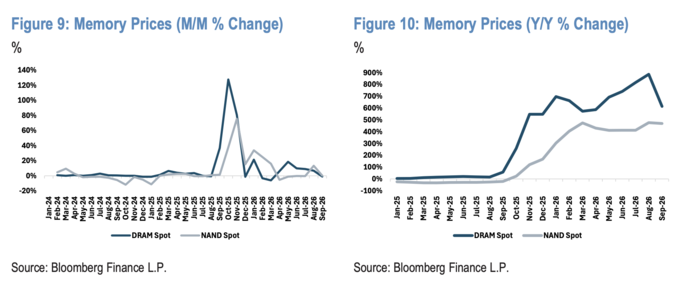
Whether the cyclical decline in prices of DRAM indicates the end of an upward trend is still inconclusive at present, but the year-on-year increase of over 6 times indicates that the expansion in memory demand driven by AI has provided substantial support for prices over the past year.
~~~~~~~~~~~~~~~~~~~~~~~
The above wonderful content is from the Chasing Wind Trading Platform.
For more detailed interpretations, including real-time analysis and frontline research, please join [Chasing the Wind Trading Desk ▪ Annual Membership].