

With the resumption of operations of Saudi Arabia's East-West Pipeline, the vital artery for Middle Eastern oil exports has been unblocked again, and the crude oil market is experiencing a clear recovery in supply.
According to Zuifeng Trading Desk, a latest research report released by JPMorgan Chase on September 29 shows that the 10-day average of total oil exports from the Middle East has rebounded to 20.5 million barrels per day, which is 89% of the pre-war level in 2025, with only a 11% difference from that time. JPMorgan Chase' commodities research team believes that the crude oil market has largely normalized. This means that, despite ongoing regional conflicts, a substantial recovery on the supply side has been confirmed by the data.
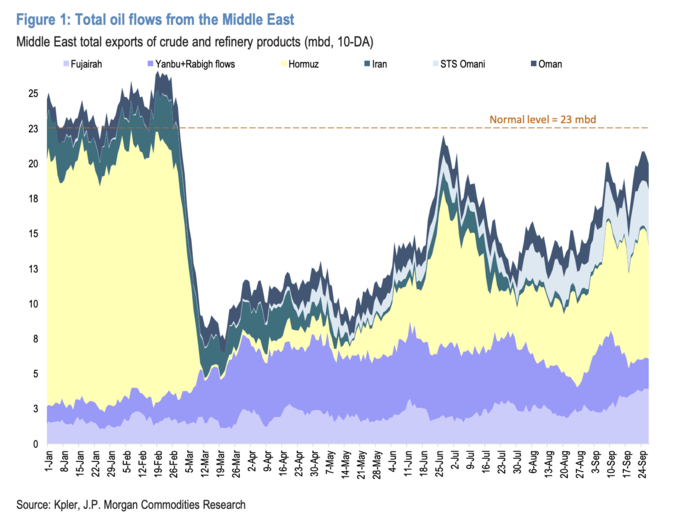
However, the recovery is not balanced. Crude oil flows have rebounded to 17.5 million barrels per day, returning to 98% of pre-war levels; whereas refined oil exports are only 3 million barrels per day, which is only 58% of the pre-war level. This means that although the crude oil market has largely normalized, there is still a significant shortage in the supply of refined products, and related markets continue to face structural pressures.
Crude Oil and Refined Oil: Clear Divergence in Recovery
Report data shows that there are significant internal differences in the rebound of Middle Eastern oil exports this round.
In terms of crude oil, the daily flow of 17.5 million barrels is close to the pre-war normal level (about 18 million barrels), with a recovery rate of up to 98%, indicating that upstream production and crude oil transportation have basically returned to normal operations.
In terms of refined oil, the situation is quite different. The current daily export volume of 3 million barrels is only 58% of the pre-war normal level (about 5.2 million barrels), with a shortfall of over 40%. This means that the refining capacity and export infrastructure in the Middle East are still significantly restricted, and the tight supply of refined products such as diesel, aviation fuel, and gasoline is unlikely to be completely resolved in the short term.
For the energy market, this differentiated pattern means that the crack price difference between crude oil and refined products may continue to be under pressure, and the trend of refinery profit margins deserves continued attention.
Indian import data confirms a recovery in demand side
The rebound in Middle Eastern oil exports has been verified on the downstream demand side, with the most direct signal coming from India, the largest neighboring buyer of Middle Eastern oil.
JPMorgan Chase data shows that in September, India's imports of crude oil from the Middle East and "unknown sources" rose to 2.8 million barrels per day, a significant increase of 1.2 million barrels compared to August, and have already surpassed the annual average level for 2025.
This data indicates that as the export channels in the Middle East are gradually being unblocked, buyers are actively replenishing their inventories or returning to normal procurement rhythms. The rapid rebound in India's import volume reflects both a substantial improvement on the supply side in the Middle East and signals a reactivation of regional crude oil trade flows.
Strait of Hormuz: Risk Pricing under High Freight Rates
The traffic through the Strait of Hormuz has approached its recent peak from late June, at around 13 million barrels per day, with Saudi Arabia being a major contributor. However, JPMorgan Chase warns that the increase in transit volumes does not indicate an improvement in security conditions, but rather reflects the enhanced operational capabilities of the industry in a continued risky environment.
The performance of the freight market confirms this judgment. The daily charter rate for ultra-large oil tankers ( VLCC ) that are linked to the Hormuz Strait has approached a historical high of $1.27 million per day. High freight rates are attracting marginal shipping capacity into the market, and in essence, shipowners are pricing in safety risks and benefiting from them.
This "instant premium" has distorted the valuation logic of the second-hand ship market – ships aged 5 to 10 years are valued at over $150 million, which is higher than the price of newly built ships, which is around $135 million. At the same time, the own shipping capacity resources of regional producers – including Saudi Arabia's fleet, Abu Dhabi National Oil Company's fleet, Kuwait's fleet, and Oman's fleet – provide important support for maintaining normal cargo deliveries amidst the tightening spot market conditions.
"Shuttle" mode extends to container transportation
JPMorgan Chase pointed out that this "shuttle" mode of maintaining operations in high-risk environments is no longer limited to oil transportation and is spreading to the container shipping sector.
At present, most of the container freight through the Strait of Hormuz is carried by feeder vessels associated with the Abu Dhabi Ports Group, while the major global container liner companies are generally still on the sidelines. This pattern indicates that, against the backdrop of unresolved geopolitical risks, regional port operators are filling the void left by international large shipping companies and accumulating market share in this process.
For participants in the commodities market, the aforementioned developments indicate that the logistical bottlenecks in Middle Eastern oil supply are gradually being alleviated. However, high transportation costs and ongoing security risks will still be important factors affecting the ex-factory price of crude oil and the direction of trade flows.
~~~~~~~~~~~~~~~~~~~~~~~
The above wonderful content is from the Chuifeng Trading Platform.

For more detailed interpretations, including real-time analysis and frontline research, please join [Chui Feng Trading Desk ▪ Annual Membership].