

Bitcoin fell by 1.7% to $83,000, while the CoinDesk 100 index declined by 2.6%. Assets that saw the largest gains on Friday earlier in the week experienced a reversal, while oil prices once again rose above $100 per barrel.
Bitcoin fell to $83,000, a decrease of 1.7% from midnight UTC; smaller-cap tokens faced even greater pressure, with the CoinDesk 100 index dropping to 1,874.56 points, a decline of 2.6%.
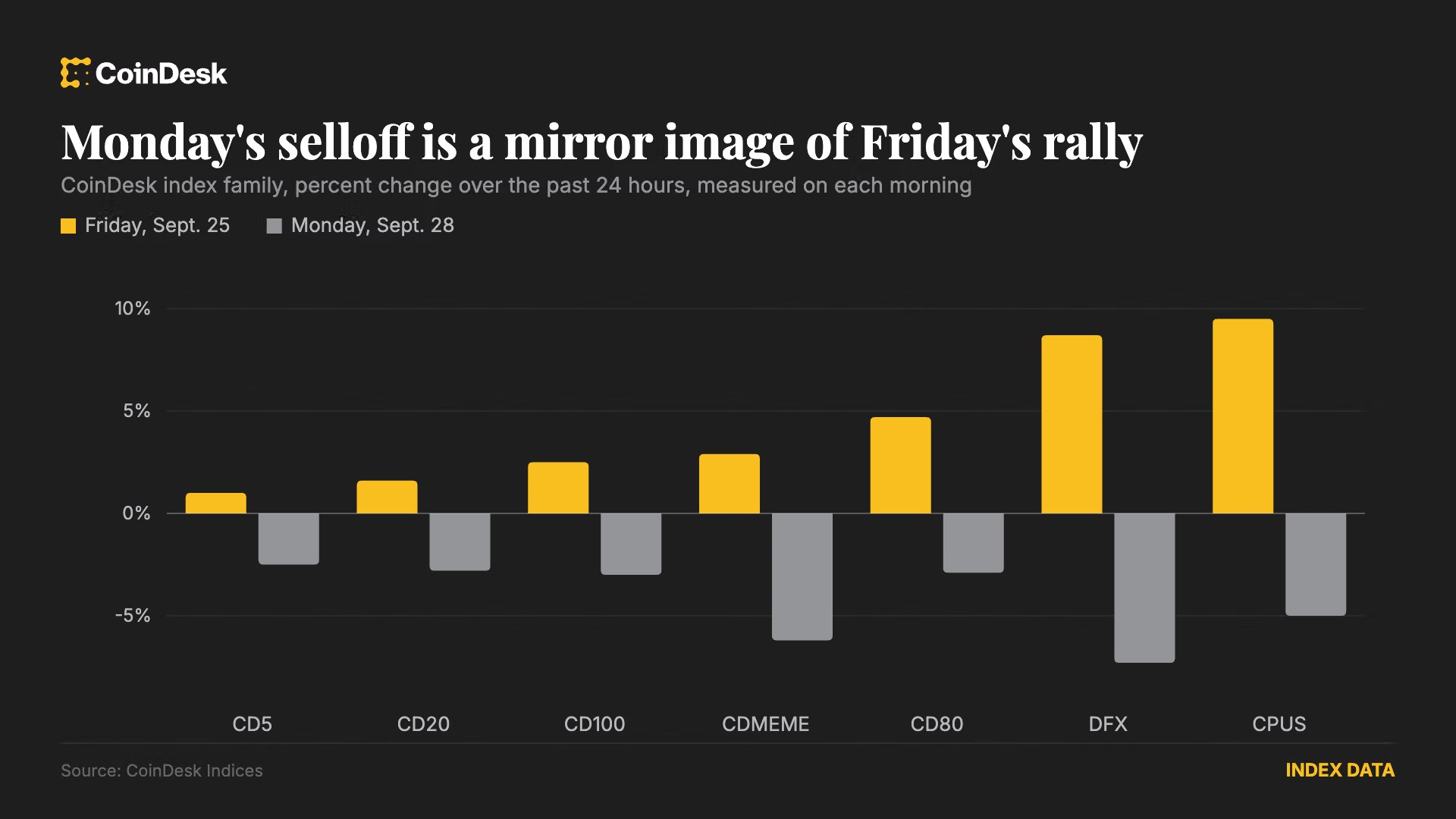
The assets that led the gains on Friday saw the most significant decline. DeFi Select Index fell by 6.4%, and CoinDesk Computing Index fell by 3.2%. Both of these sectors had led the gains in rotation last week.
After Trump rejected the conditions Iran proposed for the reopening of the Strait of Hormuz, Brent crude oil returned above $100 per barrel; gold, silver, and U.S. stock index futures also fell.
Bitcoin BTC traded at $82,742.29, down to $83,000, a decrease of 1.7% from midnight UTC, and a 2.1% decline over the past 24 hours. However, the altcoin market was hit even harder: among the 100 components of the CoinDesk index, 91 fell on the day, with the index closing at 1,874.56 points, a drop of 2.6%.
This round of declines is almost a mirror image of Friday's trend. The quantitative token QNT has fallen by 16% since midnight, while during Friday's trading session it had risen by 39% in 24 hours; the index protocol token The Graph ( GRT ) has fallen by 12%, after previously rising by 14%; the tokenized concept token ONDO has also fallen by 12%. The sectors that led the gains are now leading the declines, with DeFi Select Index ( DFX ) falling by 6.4%, and CoinDesk Computing Index ( CPUS ) falling by 3.2% in the past 24 hours, with a decline of 5.0% as well.
The trigger factor comes from crude oil, not the crypto market. U.S. President Donald Trump rejected Iran's latest conditions for reopening the Strait of Hormuz, which included releasing frozen Iranian funds, lifting oil sanctions, and ending U.S. naval blockades on Iranian ports. Brent crude oil has rebounded above $100.83, rising 3.2% within the day, reversing the trend of falling below this level on Friday.
Traditional assets are also being sold off along with crypto assets: gold fell 3.3% to $4,144, silver fell 5.1% to $61.00, U.S. stock index futures declined, with the S&P 500 contract falling 0.44% and the Nasdaq 100 contract falling 0.95%; the U.S. dollar index rose 0.06% to 101.09.
Derivative positions
Looking at the entire market, trading volume has surged by 70% in the past 24 hours, reaching 172 billion US dollars, while the number of open contracts ( OI ) has decreased by 3%, to 150 billion US dollars. The increase in trading volume and the decrease in OI indicate that the market is mainly closing existing positions rather than opening new ones.
In terms of active buying and selling orders, as of UTC 09:50, the 24-hour long-short ratio was 46.9% to 53.1%. Active sellers have a slight advantage.
BTC Open interest continues to decline: Futures OI have fallen to 650,000 contracts BTC, the lowest level since March, with traders continuing to avoid leverage. The funding rates on major exchanges are all negative, so the overall positions remaining in the market are bearish.

ETH and SOL also follow BTC: Ethereum's OI has dropped to 12.85 million, which is lower than the 13.95 million on July 1st and also below the high of over 15.65 million in late May. Although ETH has risen by 68% since July 1st, OI has been on the decline, indicating that this round of increase is mainly driven by spot buying rather than leverage. SOL futures also show a similar pattern.
XRP OI Rise: Earlier today, OI rose to a four-week high of 2.46 billion XRP, before falling back to 2.37 billion.
Whale preferences: Measured by long and short positions, Binance whales still hold a majority position in BTC, but their bullish sentiment is not as extreme as on Friday; they have switched to bearish on ETH and continue to be bullish on SOL. XRP has once again turned bearish, although the degree is less extreme than the extreme bearish readings on Friday.
HBAR OI reaches a record high: OI soars to a historic high of 2.3 billion HBAR, while the spot price increased by 48% within 24 hours, indicating that new long positions have entered the market. However, the cumulative trading volume after 24 hours of OI adjustment is negative, and the annualized funding rate is only slightly above zero. Aggressive buying orders did not drive this upward movement; short sellers may be taking the opportunity to increase their bets.
Volatility rises slightly: The 30-day implied volatility index for BTC, which is BVIV of Volmex, has risen slightly to 37.4%. Previously, this index fell last week and tested a bottom below 36%. The increase this time is not significant, and traders still expect the market to remain calm. The same situation is observed with Ethereum's EVIV. On Wall Street, the VIX index rose from below 14 to 16 on Friday.
The option trading structure presents a mixed picture: On Deribit, the Bitcoin put option with an expiration date of September 30 and an exercise price of $84,000 was the most active contract in trading over the past 24 hours. Put options are used to hedge against the risk of a decline in the price of the underlying asset, which in this case refers to Bitcoin. On the Ethereum side, the call option with an expiration date of October 20 and an exercise price of $2,850 was the most actively traded, indicating that there is still upward demand in the market.
Token Dynamics
HBAR is clearly the most prominent exception. UTC has risen by 13% since midnight and by 14% in the past 24 hours, reaching $0.11, making it the only token among the CoinDesk 100 constituents to experience a gain of over 3% on the day. This token has been consolidating since a rally began from below $0.08 on September 19th. There were no new news factors that fueled its rise on Monday, however, on September 23rd, The Hashgraph Group included its IDTrust identity platform, which is based on Hedera, in the IBM cloud directory.
The assets that led the gains on Friday saw even greater losses than their previous increases: QNT fell 16% to $240.59, The Graph ( GRT ) fell 12%, FARTCOIN fell 12%, AI agent token KITE fell 11%, and the modular data availability token Celestia ( TIA ) fell 9.1%.
The DeFi sector endured the greatest retracement pressure: Uniswap ( UNI ) fell 7.9% to $8.91, with a 11% decline over the past 24 hours; the lending protocol token Morpho ( MORPHO ) fell 7.5%, with an 8.5% decline over the same period; ONDO fell 12% on the same day. The sector index dropped 6.4%, whereas it had risen 8.7% within the rolling 24 hours of Friday.
Bitcoin Cash BCH continues to give back the gains previously driven by CME, falling 7.7% to $306.69, with a 10% decline over the past 24 hours; SUI fell 6.2%, and Solana (SOL) fell 2.9% to $118.41.
A few established Layer tokens performed relatively strongly: Algorand ( ALGO ) rose by 2.3%, XDC Network ( XDC ) rose by 2.3%, JUST ( JST ) rose by 1.3%, and IOTA ( MIOTA ) rose by 1.0%; all four of these tokens have also been on the rise in the past 24 hours.
The "fake season" index for CoinMarketCap remains at 65/100, which is the highest level in over three months, despite selling pressure during the early trading session on Monday.
Real-time update: As negotiations in Iran stall and oil prices rise, Bitcoin falls below $83,000 36 minutes ago
2 Before the release of key U.S. employment data, Bitcoin's rebound pauses: Crypto Week Ahead 53 minutes ago
3 As futures positions approach annual lows, Bitcoin shorts pay to see further declines 1 hour ago
4 RedotPay Completed financial audit, continuing to advance the US IPO plan 2 hours ago
California Governor Newsom signed the memecoin ban, calling it "the opposite of Trump" 4 hours ago
6 Solana ETF attracted a record $188 million in one week; Bitwise took two-thirds of that amount just 4 hours ago.
7 As Trump does not rule out further strikes against Iran, U.S. stock futures fall 6 hours ago
8 Vitalik Buterin Outlining Ethereum's Grand Vision for Transcending Blockchain in 2030 20 hours ago
9 Clarity Act Months of hard work ultimately came to nothing 22 hours ago
10 Kraken Parent Company Payward Betting Billions of Dollars, Aiming to Become a Financial Infrastructure, Not Just an Crypto Exchange 1 Day Ago
The Definitive Stablecoin Landscape Series : Asia Pacific
The Definitive Stablecoin Landscape Series : Asia Pacific
As stablecoins enter the regulated financial system, the Asia-Pacific region is becoming a key testing ground. This report outlines the regulations, use cases in the region, as well as the role of RLUSD.
As stablecoins enter the regulated financial system, the Asia-Pacific region is becoming a key testing ground. This report outlines the regulations, use cases in the region, as well as the role of RLUSD.
Why it's important:
As stablecoins enter the regulated financial system, the Asia-Pacific region is becoming a key testing ground. This report outlines the regulations, use cases in the region, as well as the role of RLUSD.
Bitcoin takes a brief rest before the release of key U.S. employment data
Bitcoin bears pay to see further declines; futures positions near annual lows
California Governor Newsom signs the memecoin mandate, calling it "the opposite of Trump"
In real-time updates: As negotiations in Iran stall and oil prices rise, Bitcoin falls below $83,000
Bitcoin takes a brief rest before the release of key U.S. employment data
Bitcoin bears pay to see further declines; futures positions near annual lows