

Is there still hope for Bitcoin in five years? In September 2026, Bitcoin is hovering around $77,000, and the weighted average cash mining cost for listed miners has risen to approximately $75,500 per coin. Is this a hard floor or a crash signal? In our view, the core contradiction is whether miner losses will inevitably trigger a sell-off spiral. This article breaks down the true meaning of the $75,500 cost line from four dimensions: miner costs, hashrate capitulation, AI pivots, and ETF flows, and answers whether Bitcoin still has hope in five years.
Table: Bitcoin Latest Key Data Overview
| Market Dimension | Specific Data |
|---|---|
| Bitcoin Price | Approx. $80,479 |
| Miner Weighted Average Cost | Approx. $79,995 per coin |
| Total Net Asset Value of Spot Bitcoin ETFs | $102.53 billion |
| Miner Position Index (MPI) | Dropped to -1.2, far below the annual average |
| Bitcoin Miner Wallet Balance | Approx. 1.1919 million BTC |
| Short-Term Holder Average Cost Basis | Approx. $71,300 |
| Network Hashrate | Approx. 934 EH/s, still below 1 ZH/s |
| Mining Difficulty | 127.45 trillion, down about 13% from the early-year high |
| Crypto Fear & Greed Index | 72, in "Greed" territory, |
Note: The above content is compiled by CoinMeta from publicly available market information. If there are any discrepancies, please refer to the actual data.
Miner Losses ≠ Price Collapse
Although Bitcoin's miner cost of $75,500 is approaching the current price, the market's most direct concern is: loss-making miners are forced to sell their inventory, forming a death spiral of price decline → selling → further price decline. But in our view, widespread miner losses are a signal that the market has misread.
Let's look at several sets of actual data.
Miner Wallets
As of mid-July 2026, miner wallet reserves not only did not plummet, but actually grew about 1% year-over-year, reaching a total of 1.1943 million BTC. At the then-price of about $65,000, this was worth approximately $76.76 billion, recording a net inflow of 224 BTC.
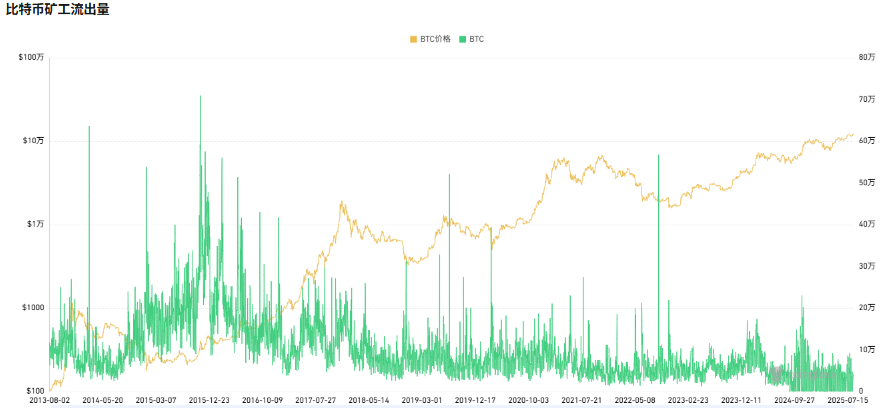
Miner Position Index (MPI)
The MPI briefly spiked to 2.8 in August 2026 during Bitcoin's price strength, but quickly collapsed to -1.2 in September, far below the annual average, indicating that the flow of coins from miner wallets to exchanges has nearly dried up.
Bitcoin Miner Outflows
Hash Ribbon Indicator
The Hash Ribbon indicator has shifted to a recovery signal after 71 days of capitulation, marking the third-longest miner capitulation on record, just 2 days shorter than the 2018 price bottom. The Miner Cycle Stress Composite Index also fell into historically undervalued territory on July 6. In the past, such extreme readings often appeared near cycle turning points in 2015, 2018, and 2020.
Our view is that the economic role of miners is undergoing a structural shift. They are no longer passive price takers, but rather a party that actively compresses supply by exiting hashrate. What is truly being eliminated is old mining machines, which have long passed their shutdown point on the cost curve. This does not constitute a systemic problem.
Miners Pivot to AI: A Structural Positive Amid Supply Contraction
In our view, the "flight" of hashrate is not the death knell for Bitcoin, but an accelerator of industry consolidation.
A CoinShares report shows that listed mining companies are shifting on a large scale to AI compute leasing. AI generates about $1.5 million in annual profit per megawatt, while Bitcoin mining generates only about $500,000. Core Scientific spent about $41.9 million to cancel next-generation miner orders. Keel stopped BTC mining in June, and IREN plans to follow in December.
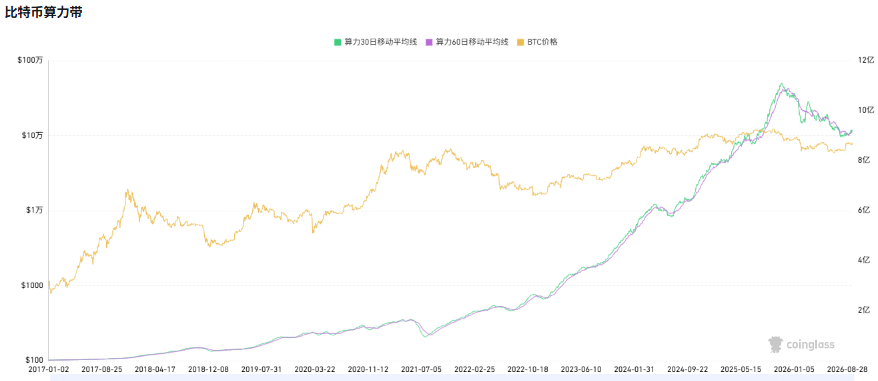
Bitcoin Computing Power
This directly caused Bitcoin's network hashrate to decline from a high of about 1.107 billion TH/s in October 2025 to about 995 million TH/s in July 2026, a drop of about 10%. As an automatic response mechanism, mining difficulty was subsequently lowered by 5% to 127.17 trillion, about 17% below the early-year high of 148.26 trillion. In the second week of June, Bitcoin mining difficulty plunged 10%, the second sharp adjustment of the year.
In our view, lower difficulty means remaining miners get a larger share of block rewards, improving per-machine output efficiency and partially offsetting the impact of weak prices.
Is There Hope in Five Years? Bottom Consensus Is Forming
Returning to the debate of "is $75,500 a hard floor or a crash signal," let's first see what institutions say.
Grayscale Research Director Zach Pandl reiterated that the June low of about $58,000 remains his judgment for the current bear market bottom, and he has advised clients to allocate to Bitcoin. Fidelity Global Macro Director Timmer noted that Bitcoin began rising after consolidating for nearly a year in the support range around $60,000. Our analysis suggests this duration is comparable to a typical Bitcoin winter, and based on this, a new four-year cycle bull market may have already started.
From the analysis framework of Bijie Network, the key variables for Bitcoin in five years are not the miners themselves, but two points:
The sustainability of ETF flows
According to SoSoValue data, as of September 18, 2026 (US Eastern Time), total daily net inflows into spot Bitcoin ETFs reached $433 million, with Fidelity FBTC leading with $311 million in net inflows. Total net asset value of spot Bitcoin ETFs reached $102.532 billion, accounting for 6.29% of Bitcoin's total market cap. Cumulative historical net inflows have reached $55.161 billion. Institutional capital is building marginal buying independent of miner selling pressure.

Bitcoin ETF Latest Inflow Data
The long-term pricing of electricity resources
AI compute demand is competing with Bitcoin mining for the same scarce resource. Sites with grid connection permits see this competition actually raise the asset value of Bitcoin mining farms.
FAQ
Q: If Bitcoin miner costs approach the current price, will the price definitely collapse?
A: Not necessarily. Miner costs approaching the current price is more of a supply capitulation signal than a crash precursor. Miner wallet reserves have not seen major outflows. After Hash Ribbon capitulation, recovery often follows. Difficulty adjustments improve the output efficiency of remaining miners. ETF flows are also forming new buying pressure.
Q: Is there still hope for Bitcoin in five years?
A: Yes, there is hope. Hope in five years does not depend on whether miners are losing money in the short term, but on network security and institutional buying. Current hashrate decline has triggered difficulty adjustments, miner reserves are growing against the trend, spot ETFs continue to see inflows, and institutions like Grayscale have reiterated bottom judgments.
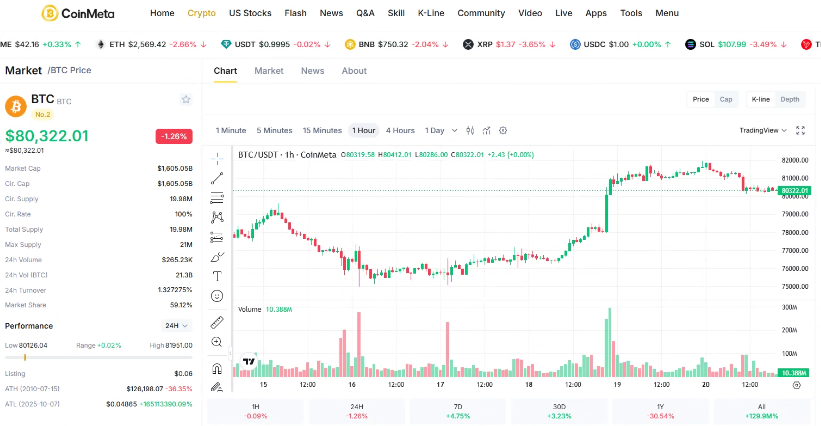
Bitcoin Latest Trend
Q: Will miners switching to AI compute leasing drag down the Bitcoin network?
A: No, it will not drag it down. Miners switching to AI will compress Bitcoin hashrate, but the difficulty adjustment mechanism will automatically restore network balance.
Conclusion
Facing Bitcoin miner costs of $75,500 approaching the current price, we believe the hope for Bitcoin in five years does not depend on whether miners are losing money, but on whether the network's hashrate still supports security and credibility. Although hashrate has fallen from its high, the difficulty adjustment mechanism is automatically repairing network balance. Grayscale judges that the bottom has appeared, miner reserves are still growing, and ETF funds continue to flow in. These signals point to the conclusion that the $75,500 miner cost is closer to a "soft floor" than a crash precursor. The real risk is not miners selling coins, but that if macro liquidity continues to tighten, the time to build a bottom will be prolonged.
Disclaimer: Readers are advised to strictly comply with the laws and regulations of their location. This content is based on publicly available market information and is for informational and educational purposes only. It does not constitute investment advice. For the latest updates, follow CoinMeta.