





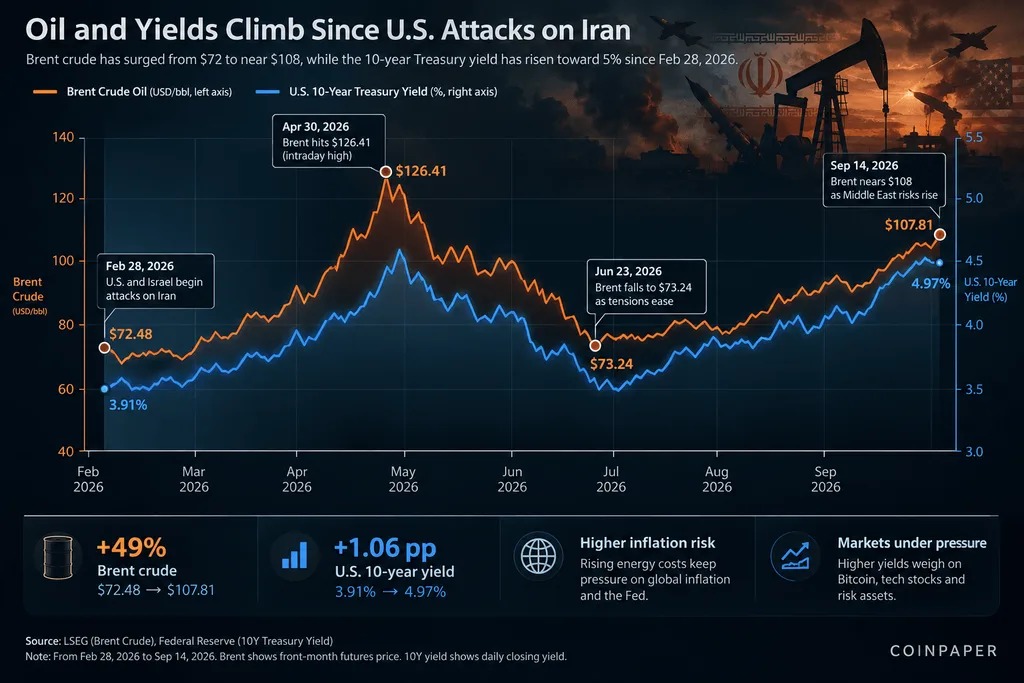
After Brent crude oil approached $108, the focus of the market is no longer just on energy supply. Foreign media reports that attacks on Saudi energy facilities and the rising risks in the Strait of Hormuz have once again brought inflation and interest rate expectations to the forefront of the global market, affecting both Bitcoin and tech stocks.
Oil price increases fuel concerns about rising interest rates
The article argues that rising oil prices will increase transportation and production costs, making it more difficult to curb inflation. This development coincides with the market's re-evaluation of the Federal Reserve's policy path. As expectations of interest rate hikes intensify, the yield on U.S. Treasury bonds has also risen again, gradually approaching 5%.
Previously, high producer inflation data had already dampened the performance of growth stocks. For technology companies, rising interest rates and yields weaken the market's valuation of future earnings. Now that Brent crude oil has once again risen to high levels, this pressure has been further amplified.
The logic of Bitcoin facing pressure is converging.
The article points out that Bitcoin has also failed to significantly regain its upward momentum recently, with prices still hovering in the range above $70,000. Although earlier this month, Bitcoin ETF once recorded a net inflow of about $905 million, which helped BTC maintain its resilience as oil prices rose to $96, the current environment has become more unfavorable.
- Brent crude oil approaches $108
- Bitcoin ETF previously raised approximately $905 million
- U.S. Treasury yields once again approach 5%
Currently, oil prices have once again surpassed $100 per barrel, and expectations of the Federal Reserve continuing to tighten monetary policy have increased. At the same time, U.S. Treasury yields are also at higher levels. Against this backdrop, Bitcoin and tech stocks face the same type of competition: investors can obtain more attractive returns from lower-risk U.S. Treasuries.
The market continues to watch the $100 per barrel oil price.
The article argues that the more critical question going forward is whether oil prices will remain above $100 for a sufficient length of time. If high oil prices persist, inflationary pressures may be more difficult to alleviate, and the bond market's pricing of risky assets will continue to be affected.
In this context, Bitcoin and tech stocks may be more driven by changes in interest rates and yields in the short term, rather than positive factors within their respective industries. For the crypto market, the inflow of institutional funds is still important, but the macro environment is once again taking the lead in determining price trends.