







After the cooling down of climate technology financing, fusion energy startups have begun to turn their attention more towards the defense sector. For these companies that are still working towards commercial power generation goals, military cooperation can not only bring in funding but also provide more practical application scenarios for technologies such as high-energy lasers.
The fusion industry and national security have not recently become connected. During the Cold War, related research originated from the same sources as thermonuclear weapon technology. The fusion experiment that attracted widespread attention in 2022 also took place at the National Ignition Facility in the United States, a facility that has long served national security projects.
Xcimer received investment from RTX
Laser Fusion Company Xcimer announced last week that it has established a partnership with RTX and received investment from RTX Ventures. RTX includes defense businesses such as Raytheon. According to the arrangements between the two parties, Xcimer will receive financial support, while RTX will be able to explore the use of its high-power laser systems for defense purposes.
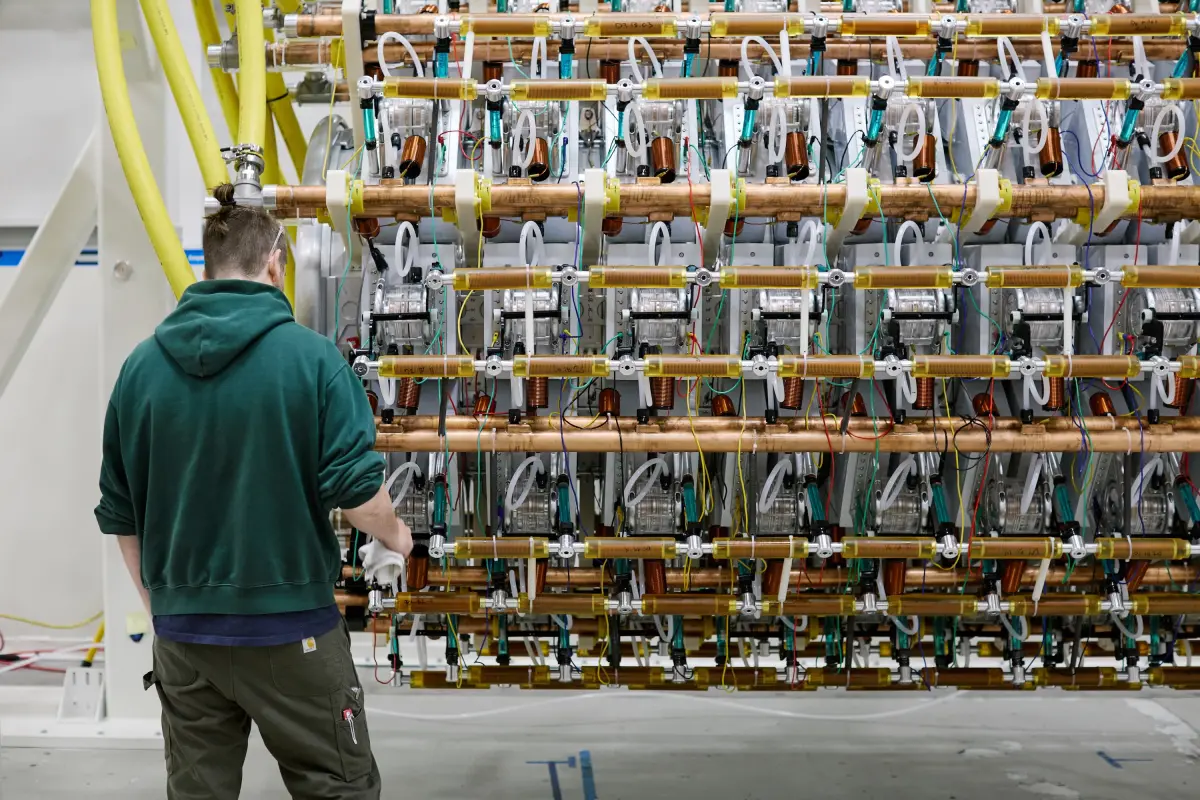
Xcimer is headquartered in Denver. The company claims to operate the world's largest private laser system and plans to use this system to advance the development of fusion power plants. Their approach involves bombarding fuel pellets with lasers to trigger a fusion reaction under extreme compression and release energy as a result.
Laser weapon demand is on the rise
However, there is still a gap between the current Phoenix laser system of Xcimer and the power required by a real power station. The company stated that the current power level is about an order of magnitude lower, but it is already sufficient to attract the attention of the military industry.
The military industry has been researching laser weapons for many years, but since drones have changed the battlefield, this area of research has gained renewed interest. Traditional air defense systems are primarily designed to counter manned aircraft, which are usually larger and fewer in number. When facing low-cost, miniaturized drones, the cost of interception is often significantly disproportionate.
It is mentioned in the text that about ten years ago, an ally of the United States used a Patriot missile worth $3 million to shoot down a consumer-grade drone worth $200. Laser weapons are seen as one of the solutions to improve this cost structure, as they rely on electricity for propulsion and typically have a lower cost per use than traditional missiles.
Pacific Fusion Contact with Nuclear Safety Systems
More than just Xcimer have joined in defense cooperation. Pacific Fusion announced last month that it has signed a memorandum of understanding with the US National Nuclear Security Administration, and the two parties will collaborate on high-energy density fusion experiments.
The company has also recently initiated the construction of a demonstration facility in New Mexico, located near Sandia National Laboratory and Los Alamos National Laboratory. The company states that the primary goal of this facility is to verify whether its design can achieve a net energy gain, which means that the output power will be higher than the facility's own consumption.
Pacific Fusion also stated that the facility can serve defense research purposes as well. Co-founder and Chief Technology Officer Keith LeChien said that this facility has its uses in related defense applications as well. Co-founder and Chief Operating Officer Carrie von Muench also mentioned that defense applications have always been within the company's considerations.
From an industry perspective, the reapproach between fusion companies and the military-industrial complex reflects changes in the financing environment, as well as the fact that such high-cost, cutting-edge technologies are seeking more stable sources of funding and clearer application demands. For fusion enterprises that are still in the research and development phase, defense cooperation is becoming a viable path beyond the commercialization of power grids.