




After the U.S. producer price index in August exceeded market expectations, the interest rate path once again became the main focus of market trading. U.S. Treasury yields rose, and market bets on a Fed interest rate hike in September intensified, with Bitcoin and gold both weakening on Thursday.
After the release of PPI, interest rate expectations are on the rise.
Spot gold tumbled more than 1% at one point, approaching $4,358 per ounce. Bitcoin also fell accordingly. The market generally attributes this round of adjustment to the decreased attractiveness of holding interest-free assets following hotter inflation data.
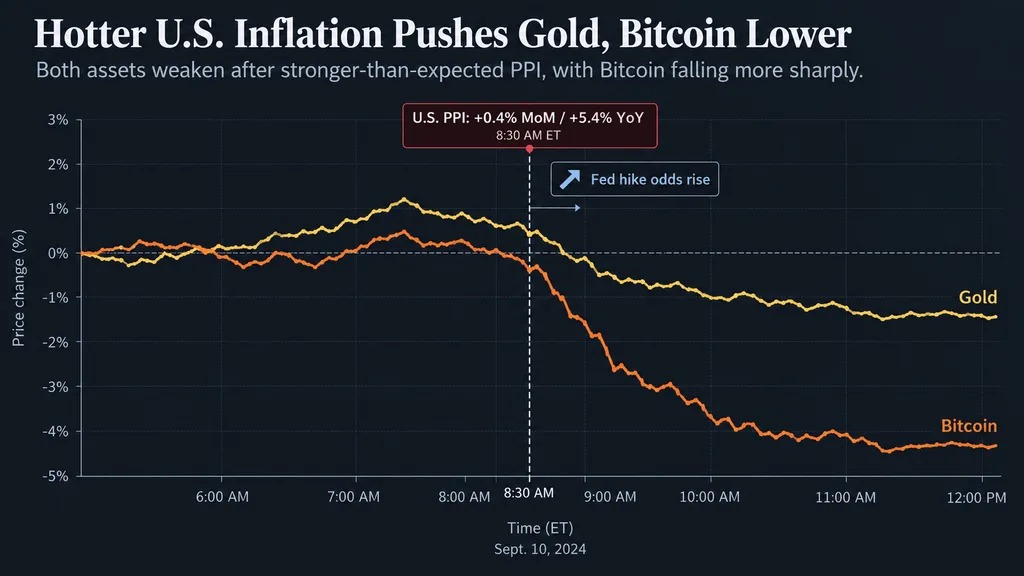
In the United States, on PPI of August, there was a month-on-month increase of 0.4% and a year-on-year increase of 5.4%, slightly higher than the market's expectation of 5.3%. Following the release of the data, the yield on 10-year U.S. Treasury bonds rose to around 4.9%, and market expectations for a rate hike in September also increased from around 62% before the data release to around 70%.
Gold ETF continues to see record-high capital flows
Despite the decline in gold prices, institutional funds continued to flow into the gold market. Data released by the World Gold Council for August show that global gold ETF attracted approximately $18 billion in net inflows that month, setting a record for the second-highest single-month figure in history.
- Gold ETF Position increased by 121 tons
- Total holdings rise to a new high of 4,189 tons
- Management asset scale rises to $615 billion
Regionally, there was a gold inflow of approximately $7.9 billion into Europe ETF and about $7.7 billion into North American funds. The article suggests that this indicates that institutional demand for long-term gold allocation still exists, but it will be difficult to fully offset the pressure caused by the rapid rise in interest rates in the short term.
Bitcoin and gold face similar pressures
This recent decline in Bitcoin also reflects an increasing similarity between it and gold in short-term trading. Neither of these two types of assets generate fixed returns, and when the yield on U.S. Treasury bonds approaches 5%, some funds will shift to bond assets with higher returns.
The article also mentions that the price of Brent crude oil has risen above $100 per barrel, and the risks to supply from the Middle East have increased, further fueling market concerns about inflation. For risk assets, the key observation point ahead is the CPI data that the United States is about to release.
If subsequent inflation data continues to be strong, risk assets such as Bitcoin may continue to face pressure; for gold, the market will focus on whether record ETF capital inflows can support prices again after the impact of interest rates subsides.