







AT &T has reached a partnership with Amazon and will become the first major telecommunications operator to provide Amazon Leo satellite broadband services to American enterprises and public sector customers. The two parties will not sell this service separately, but will integrate Leo into AT &T's existing fiber optic and 5G network infrastructure to enhance connectivity in remote areas and critical scenarios.
Sold to enterprises and public sectors
According to the arrangement between both parties, AT &T is responsible for the customer's installation, equipment, technical support, and billing. This means that before Leo enters the commercialization phase, Amazon has already obtained a mature corporate sales channel, without having to build a distribution network for large customers from scratch.
According to AT, this collaboration is mainly aimed at industries that require backup connections, remote site broadband, and higher network resilience, including mining, energy, agriculture, construction, and emergency response sectors. For these customers, satellite connections serve more as a supplement to their existing communication networks rather than a substitute.
AT &T: The existing customer network becomes a key entry point
AT &T currently serves nearly 2.5 million corporate clients. For Amazon, this coverage can significantly shorten the time it takes to enter the corporate market. Satellite operators usually take several years to establish a similar sales and service system, whereas AT &T already possesses such capabilities.
Leo is still integrated with AWS cloud services. Previously, Amazon and AT &T had already advanced a cooperation model that connected AT &T fiber optics, AWS cloud services, and Leo satellites. Such combinations are more suitable for corporate customers who need to transfer data between remote facilities, cloud platforms, and AI loads.
- AT &T is responsible for installation, support, and billing.
- The service targets both corporate and public sector clients.
- Application scenarios cover remote sites and backup networks.
Starlink still leads in scale
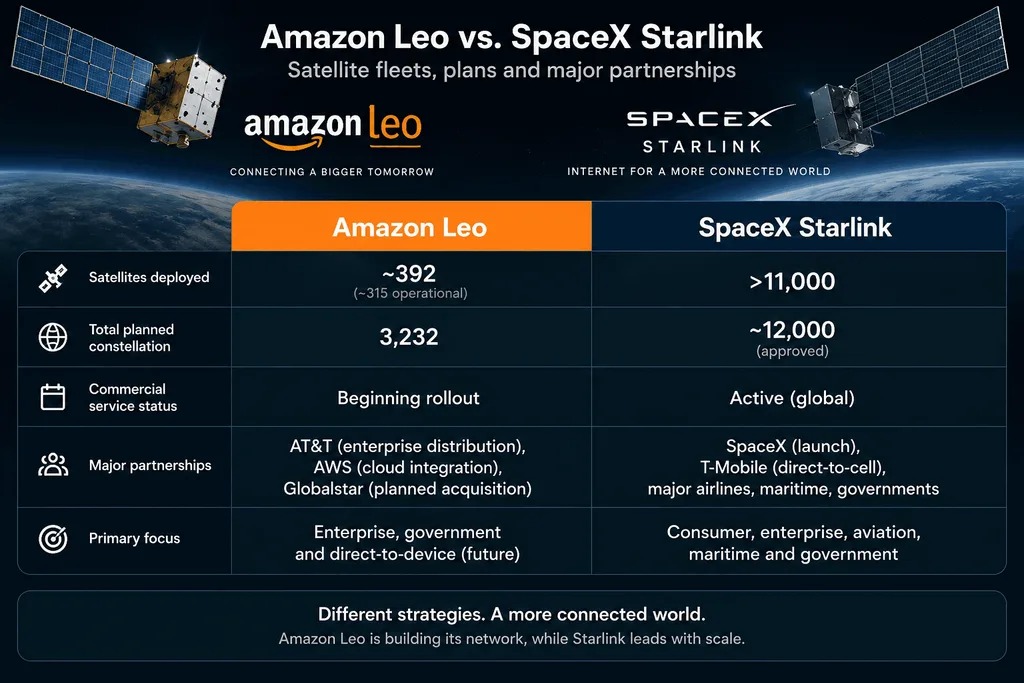
However, this collaboration has not changed Starlink's current leading position. According to reports, Amazon has deployed approximately 392 Leo satellites, of which about 315 are in operation; the number of Starlink satellites has exceeded 11,000. Amazon's ultimately approved constellation scale is 3,232 satellites, so there is still significant room for further expansion before full deployment.
The advantage of SpaceX also lies in its own launch capability. The reusable Falcon rockets enable it to deploy Starlink satellites more quickly, whereas Amazon still relies on multiple external launch service providers at present.
In terms of revenue, the importance of Starlink relative to SpaceX is also on the rise. In the second quarter of SpaceX, the revenue from Starlink connection services reached $4.29 billion, driving the company's total revenue to $7.81 billion. At the same time, Amazon continues to expand, and its plan to acquire Globalstar is also seen as a preparatory move for future development in direct-connected device services.
Overall, the addition of AT &T has not weakened the first-mover advantage of Starlink, but it has provided Amazon with a more realistic breakthrough: the ability to directly engage with large corporate clients and to compete more directly with SpaceX in the corporate satellite broadband market.