






Bittensor Token TAO has shown a clear rebound after being under pressure for several weeks, reaching around $277 at one point during the session, with the latest trading price maintaining around $270. This increase comes after consecutive updates to the protocol, and the market has also seen a significant increase in the activity of spot and derivatives trading.
Protocol updates are being implemented in a concentrated manner.
Bittensor In recent months, a series of adjustments have been gradually implemented, focusing on subnet emissions, staking mechanisms, and the distribution of rewards in the root network. One of the latest changes is V440 Emission Gate, which introduces a demand threshold for subnet emissions. Subnets with demands above the market threshold can maintain emissions linked to prices, while those with weaker demand will see their emissions gradually decrease.
Subsequently, the network introduced V441, V446, V447, and V448, which cover root staking, alpha accounting, a subnet ownership mechanism based on conviction, as well as more secure staking operations. The latest version list also shows that V450 is moving towards a root basket filtered by verifiers, with a concentration limit set at 1/16.
Back up to $270 within two days
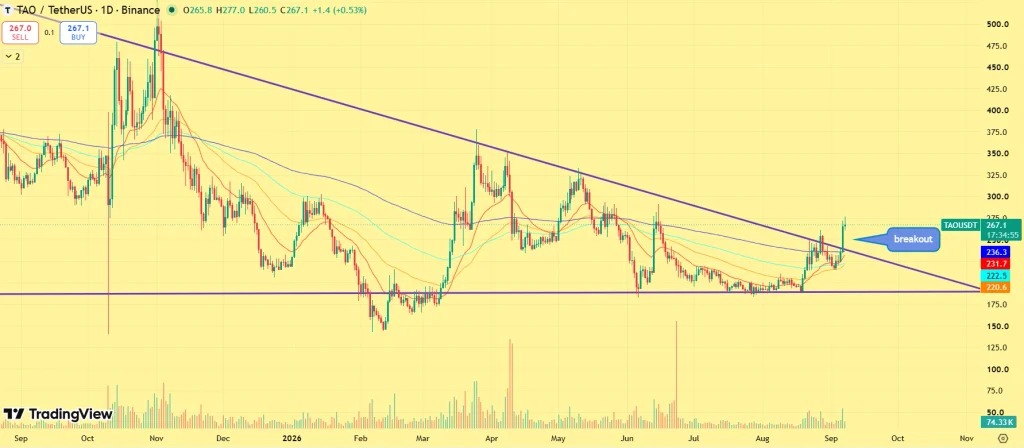
From the perspective of price momentum, TAO was still in a consolidation phase at the end of August. On August 31st, it closed around $230, and on September 1st, it fell back to around $220 before beginning to recover. By September 5th, the price had risen to around $236, and on September 6th, it further climbed to near $270 during the trading session, closing at around $265.
On the following trading day, the upward trend continued to expand. TAO traded in the range of $270 to $271, with a peak during the session reaching $276 to $277. The downward trend line that had suppressed several rebounds before was also broken through, indicating a clear change in the short-term trend.
Derivative data shows a concurrent increase
CoinGlass Data shows that on TAO, the 24-hour futures trading volume reached 868 million US dollars, an increase of 158.61% from the previous day; the number of open contracts rose to 434.58 million US dollars, with a growth rate of 18.03%; the spot trading volume was approximately 146.9 million US dollars.
The simultaneous occurrence of rising prices, increased trading volume, and a rise in open interest indicates that this round of breakout has attracted more capital participation, rather than being just a short-term fluctuation in a low-trading environment. However, the concurrent increase in leveraged positions also means that if the buying pressure cannot hold the breakout range, the price may retreat more quickly.
The range of $260 to $280 is in the spotlight.
From the current structure, the range of $260 to $265 is the first area that needs to be held after a breakout. If this area maintains support, the previous resistance level will turn into a support zone and continue to hold. Looking upwards, $277 to $280 is the current resistance level; if the daily chart can firmly establish itself in this range, market attention will shift towards the $300 round number.
If the upward trend continues and breaks through $300, the next major resistance area on the chart is between $325 and $350. On the other hand, if the price falls back below $260, the current breakout pattern will clearly weaken; if it further loses ground to the $235 to $240 range, the recent recovery trend will come under pressure again.