web3: Foreign media: A record-breaking listing by SpaceX may not necessarily bring the highest returns
Coinpaper
08-29 22:34
Ai Focus
Foreign media reports that after SpaceX set a record, the stock price of IPO only rose slightly from its issue price, and the scale of funds raised may not necessarily correspond to higher long-term returns.
Helpful
No.Help

Foreign media commented that SpaceX completed the largest initial public offering (IPO) in U.S. history in June, but the stock price performance after listing quickly reminded the market that a record amount of funds raised does not necessarily mean that future returns will also be record-breaking.

Limited increase in value after listing of SpaceX
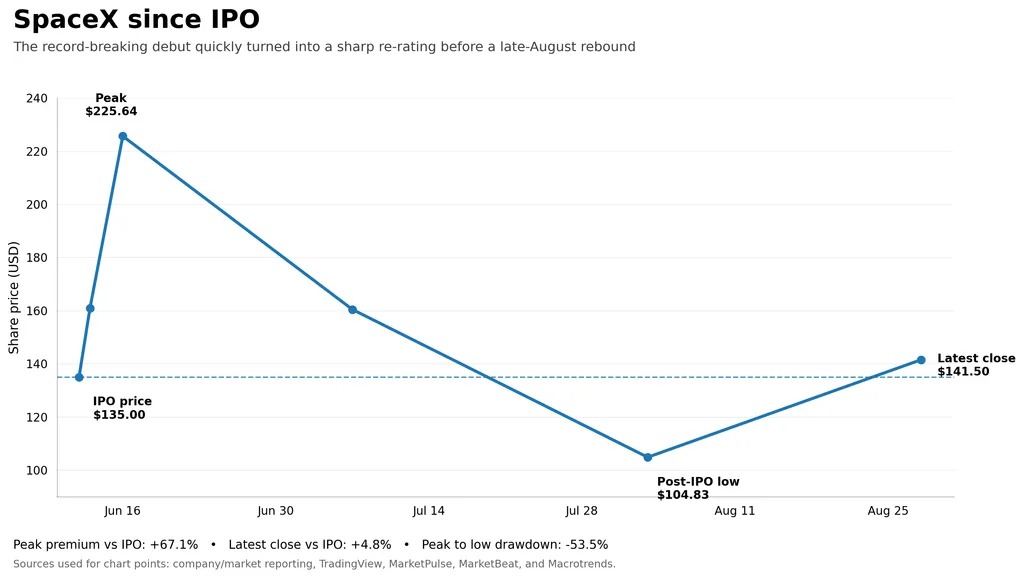
As of the close on August 28th, the stock price of SpaceX was reported at $141.50, representing an increase of less than 5% from the issue price of IPO. This contrasts with the initial enthusiasm during its listing period. At that time, the company's market value quickly exceeded $2 trillion, but the stock price subsequently fell below the issue price in July, indicating the volatility pressures faced by high-valued transactions in the secondary market.

  • The closing price on August 28th was $141.50.
  • Less than a 5% increase from the issue price
  • Fell below the issue price for the first time in July

The article argues that the significance of SpaceX's listing this time lies mainly in the scale of funds raised and the valuation level, rather than short-term stock price returns. What determines a company's long-term returns are still revenue growth, profit margins, and operational execution, rather than how much capital IPO itself raises.

Wal-Mart demonstrates the effect of long-term compound interest

To illustrate this point, the article uses Walmart as a comparison. Based on its closing price of around $103.09 on August 28th, if an investor invested $1,000 in Walmart at that time, the current market value would be approximately $38.4 million, and this figure does not even include dividends.

However, the article also emphasizes that companies with long-term high returns do not always experience continuous growth. Walmart recently saw a significant decline after its financial report was released, due to same-store sales in the United States falling short of expectations, with the stock price dropping by more than 8% in a single day. This indicates that even companies with outstanding long-term performance can experience temporary setbacks.

NVIDIA offers another approach.

The article also mentions NVIDIA. Calculated based on the closing price of $217.54 on August 28th, if the same amount of $1,000 was invested at that time, its current value would be approximately $8.7 million.

In the article's view, NVIDIA and Walmart represent two different paths to returns: the former reflects faster growth realization, while the latter reflects longer-term compound interest accumulation. In comparison, what is more noteworthy about SpaceX at present is not its record-breaking listing size, but whether it can convert its high valuation into sustained performance growth over the next few years.

The article concludes that market value reflects the price that investors are willing to pay at present, but this does not directly indicate how much value a company will be able to create in the next 20 or 50 years. For newly listed companies, the fundraising record itself is more of a starting point than a result of returns.

Tip
$0
Like
0
Save
0
Views 395
CoinMeta reminds readers to view blockchain rationally, stay aware of risks, and beware of virtual token issuance and speculation. All content on this site represents market information or related viewpoints only and does not constitute any form of investment advice. If you find sensitive content, please click“Report”,and we will handle it promptly。
Submit
Comment 0
Hot
Latest
No comments yet. Be the first!
Related
AWS Posts a 39% Increase in Revenue, but AI Expenditures Frighten the Market; Amazon Q3 Faces Deteriorating Free Cash Flow, Drops After Hours
Amazon's net sales in the third quarter increased by 12% year-on-year to $20.194 billion, falling short of expectations; EPS was at $1.89, also below expectations. AWS revenue increased by 39.3% year-on-year to $45.98 billion, and the operating margin rose to 38.7%, but the company's capital expenditures in the third quarter reached $77.26 billion, with free cash flow flowing out by $42.36 billion. The company maintained its guidance for annual cash capital expenditures of about $220 billion for 2026 unchanged. The median forecasts for fourth-quarter revenue and profit were both slightly lower than market expectations, and the stock price tumbled after the earnings report.
Wallstreetcn
·2026-10-31 17:41:06
17
Bitcoin White Paper Marks 18th Anniversary; $63 Billion Hack Incident Reignites Debate Over Custody
On October 31st, Bitcoin's white paper celebrated its 18th anniversary. Coincidentally, after the exposure of a $6.3 billion theft case involving Binance, the market once again focused on the division of responsibilities between self-hosting and third-party hosting. The article reviewed the peer-to-peer electronic cash system proposed in the white paper and summarized the explanations provided by the US SEC Investor Education Office regarding private key control and hosting risks.
crypto.news
·2026-10-31 17:41:03
18
Sandisk Q1 revenue surges nearly 4 times year-on-year, Q2 performance exceeds expectations; data centers remain the core of growth next year
SanDisk releases its financial report for the first quarter of fiscal year 2027, with both revenue and profit exceeding expectations. Revenue increased by 378% year-over-year, and the company provided guidance for the second quarter that is also higher than anticipated. The company stated that the demand for NAND is driven by the growth of AI, and data centers will continue to be the core of market growth in the natural year 2027. Additionally, the board of directors approved a 1:8 stock split.
Wallstreetcn
·2026-10-31 17:41:01
17
Nasdaq Composite Index Falls 2.9%: Why Is the Selling of Tech Stocks Intensifying, and What Will Happen Next?
On October 30th, the Nasdaq Composite Index fell by 2.86%, recording the largest single-day decline since June. As investors re-evaluate the costs and benefits of the AI craze, the selling of tech stocks intensified, and the index is approaching the 200-day moving average, a key long-term support level.
Coinpedia
·2026-10-31 17:10:43
28
Bitcoin Approaches $77,000; Declines in U.S. Stocks and Gold in October Drag Down the Market
Bitcoin approached $77,000 at the end of October and may close lower for the second consecutive month due to the decline in U.S. tech stocks and gold prices; some research institutions still believe that its cyclical low has passed.
crypto.news
·2026-10-31 17:10:40
28
View More