

The on-chain data platform Santiment indicates that Ethereum has exhibited a rare phenomenon during this round of rebound: while prices have risen, token holders have not transferred more tokens to exchanges; instead, they have continued to withdraw tokens on a large scale. As the reserves of ETH on trading platforms continue to decline, the supply available for sale in the market has further tightened.
Reserves have decreased by 18% since early June.
Data shows that the holding of ETH by the exchange has decreased from 7.69 million at the beginning of June to 6.28 million, representing a cumulative reduction of about 1.41 million, or a decrease of 18%. Santiment believes that this indicates that more and more coin holders are choosing to transfer their assets to self-managed wallets or staking addresses, rather than leaving them with the exchange in anticipation of selling.
According to common market patterns, investors usually transfer tokens out of exchanges when prices are weakening in order to reduce short-term trading; during periods of price increases, some holdings tend to flow back to the platforms as investors prepare to realize their profits. However, this time, the flow on Ethereum’s blockchain did not follow this pattern.
The coin withdrawal process continues during the upward phase.
Since August 16th, the market value of ETH has risen by about 27%, with the price reaching $2,528. Santiment stated that during this period of increase, there was no significant concentrated selling pressure on the exchange. On the contrary, since August 19th, approximately 275,000 ETH have been transferred out of the trading platform.
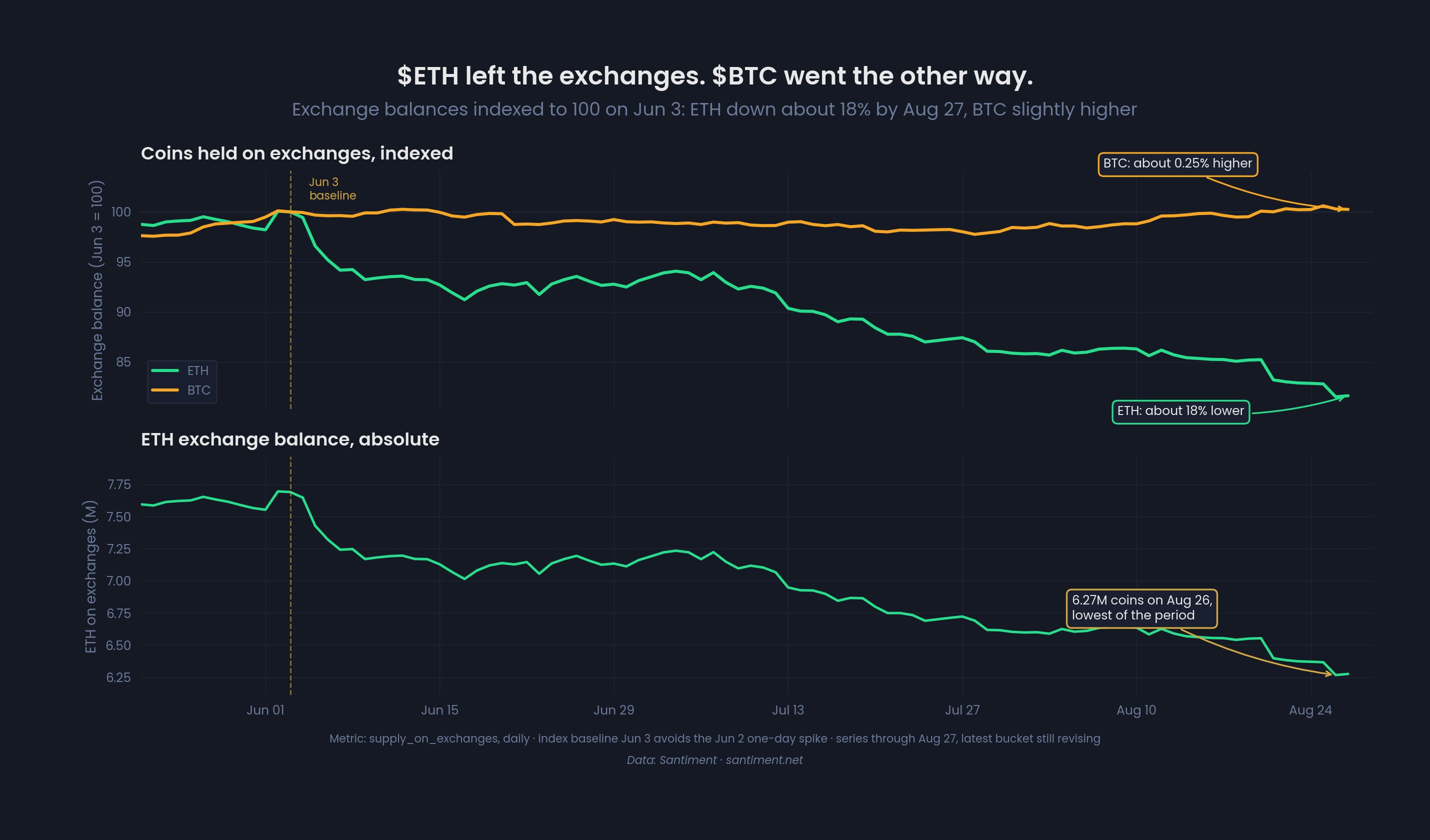
This change indicates that some token holders tend to continue holding their tokens after a price rebound, rather than selling them immediately. For the market, a decrease in the number of ETH tokens available for immediate trading on exchanges usually weakens short-term selling pressure.
Bitcoin reserves show the opposite trend
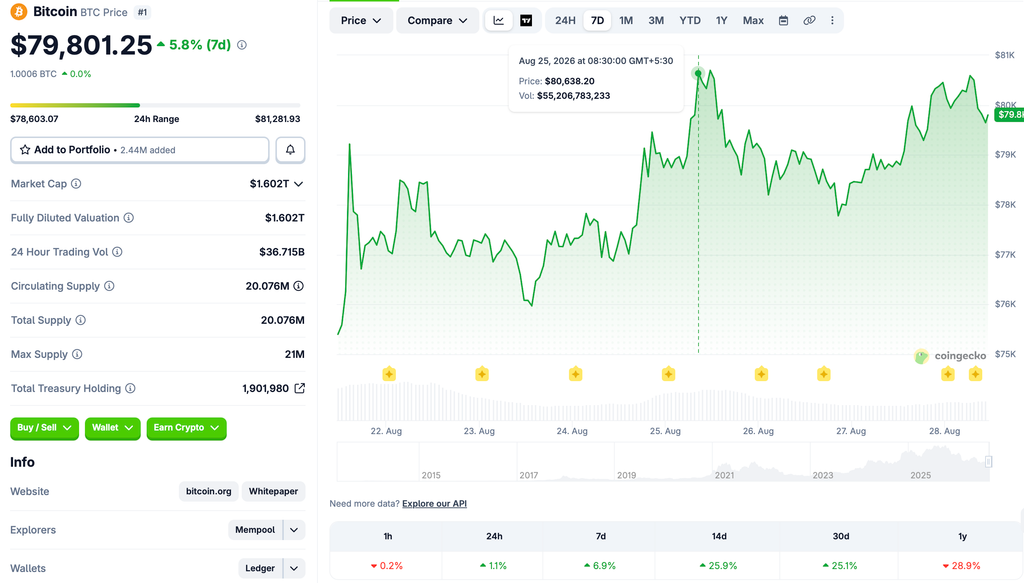
Unlike Ethereum, Bitcoin's reserves on exchanges remained relatively stable during the same period, with a slight increase of 0.25%. The article argues that this divergence reflects the differences in trading behavior between the two types of assets. Bitcoin holders tend to keep their assets on exchanges so that they can execute transactions quickly in times of price fluctuations.
However, the tightening of supply did not immediately push ETH to break through key resistance levels. The article cites charts indicating that the rebound around $2,528 is still within a longer-term consolidation range, and the area between $2,497 and $2,585 remains a strong resistance zone. If buying momentum continues to strengthen in the future, the relatively low reserves of the exchange could amplify the potential for price increases.