

Shibburn data shows that over 5.3 million SHIB tokens were permanently destroyed in the past 24 hours, driving the daily burn rate up by nearly 92%. However, the SHIB price is currently still below a key downtrend line, and the contraction in on-chain supply has not yet translated into a clear price breakout.
More than 5.3 million items were destroyed in 24 hours.
The SHIB burning mechanism has always been an important part of its ecosystem, primarily reducing the circulating supply through community-driven methods. Although the latest round of burning is still limited relative to the total supply, the continued reduction of circulating supply is still seen as a long-term action to support the token's economic model.
The article notes that a rise in the burn rate typically improves market sentiment, especially when ecosystem activity increases simultaneously. Previously, Shibarium, staking participation, and community activity were key indicators for the market to observe changes in SHIB's fundamentals.
Ecosystem activity has rebounded, but buying interest remains cautious.
In addition to data destruction, the Shibarium ecosystem has continued to expand recently, focusing on Shibarium-related development, ecosystem application advancement, and increased community engagement. These factors strengthen SHIB's narrative of extending from a single meme coin to a wider range of applications.
However, market performance suggests that investor sentiment remains cautious. The report suggests that investors are more focused on whether trading volume can continue to increase and whether there will be a more stable inflow of funds. Until demand significantly outpaces supply, improvements in on-chain data are more likely to support sentiment rather than directly drive prices up rapidly.
Prices remain constrained by key resistance levels.
From a technical perspective, SHIB is currently still in a corrective phase. Although the price has temporarily held a key demand zone after several weeks of consolidation, the long-term downtrend line above continues to act as resistance. This year, several SHIB rebounds have been met with resistance near this level.
Next, the market will first focus on the resistance near the 20-day and 50-day moving averages, followed by a larger resistance zone formed by previous swing highs. Only if the price can effectively break above the downtrend line and overcome nearby resistance could the current weak structure be broken, and the price may further test higher supply zones.
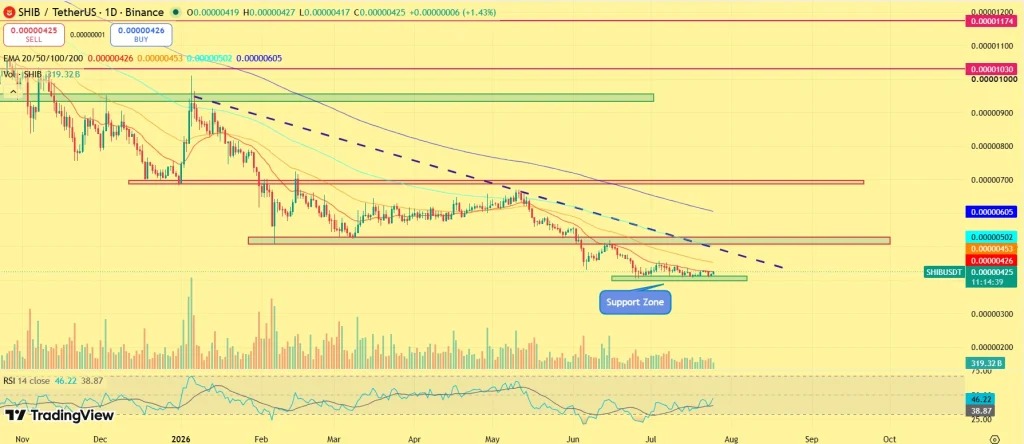
Conversely, if the existing support level is breached, SHIB may continue to decline, and the overall downward trend will persist. At present, the rising burn rate is more of a secondary signal; the true determinant of price direction remains the strength of buying pressure and whether funds continue to flow back in.