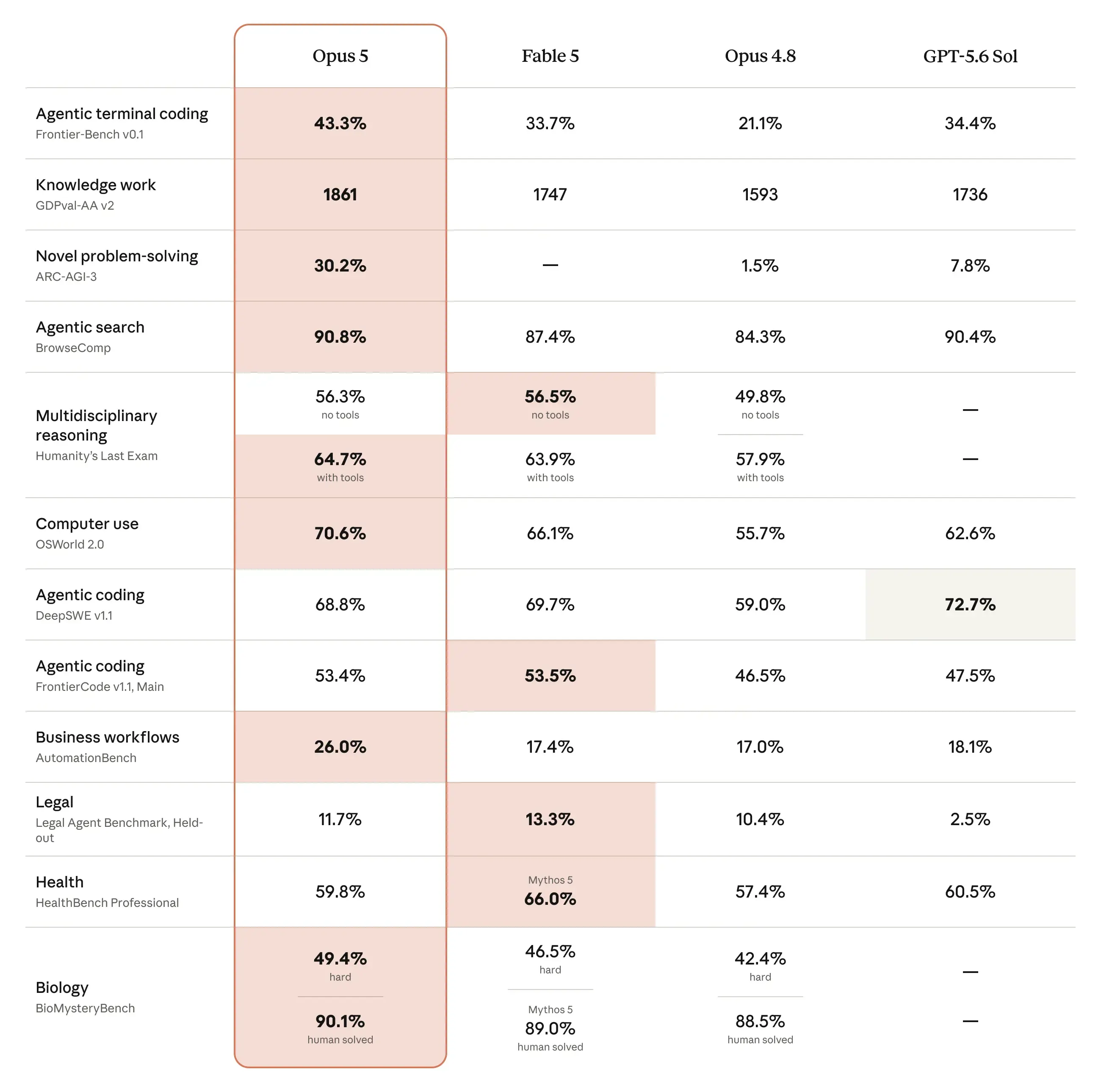


Anthropic has launched its new generation model, the Opus 5. This is the latest version in the Opus series, released just two months after Opus 4.8. The company claims that the Opus 5 is priced lower than the Fable 5, has fewer limitations, and is more practical in most use cases.
Multiple tests exceeded Fable 5
The announcement shows that Opus 5 outperformed Fable 5 in several benchmark tests included with this release. Anthropic also emphasized that this model performs better in validating its own output and iterating repeatedly until the task is completed.
The company cited an example: in one test, Opus 5 was able to write a computer vision workflow on its own based on incomplete prompts. This is one of the key capabilities they emphasized this time.
Not subject to 30-day data retention constraints
Unlike Fable and Mythos, Opus 5 is not bound by a 30-day data retention policy. Anthropic stated that this is consistent with the previous generation of Opus. Previously, this arrangement had raised concerns among some privacy-conscious users.
However, Opus 5 is not entirely open. Anthropic still retains strong protections for cybersecurity-related tasks, especially in scenarios such as exploit generation and penetration testing. For example, the model cannot be used to scan for vulnerabilities in software binaries, but it can be used to find vulnerabilities in the source code.
Added automatic rollback function
Anthropic also introduced a testing feature called Automatic Fallbacks, which users can choose to enable. If a request triggers the safety classifier, the system will automatically switch the task to a less capable model instead of directly returning an error message.
The company anticipates that the security classifier for Opus 5 will trigger approximately 85% less frequently than for Fable 5. For API users, this means more available responses for more requests and reduced call interruptions due to security blocking.