

Foreign media reports that Bitcoin has rebounded from a low of approximately $57,800 in July and is now back around $65,000, testing a key resistance level in the short term. The article suggests that if the price effectively breaks above $67,334, the market may continue its upward trend towards $70,000; however, on-chain data does not provide entirely consistent signals.
Prices have returned to an upward trend.
This rebound occurred within an upward channel, indicating a gradual recovery in prices after the June correction. The article mentions that the most closely watched level is $67,334, which has acted as resistance to recent gains.
If the price breaks through this area on the daily chart, the next level to watch will be $70,274, with further upside potential at $73,213. Conversely, if the price encounters resistance again near this level, Bitcoin may continue to consolidate within a range.
The support level is concentrated around $63,700.
The article suggests that if a short-term pullback occurs, the area around $63,696 will be the first support level to watch. If this level is breached, the market may retest the lower edge of the upward channel and turn its attention to the $59,819 to $57,817 range.
This means that although the current trend maintains a corrective structure, the price has entered a more sensitive position, and subsequent volatility may increase with a breakout or pullback.
On-chain data is becoming fragmented.
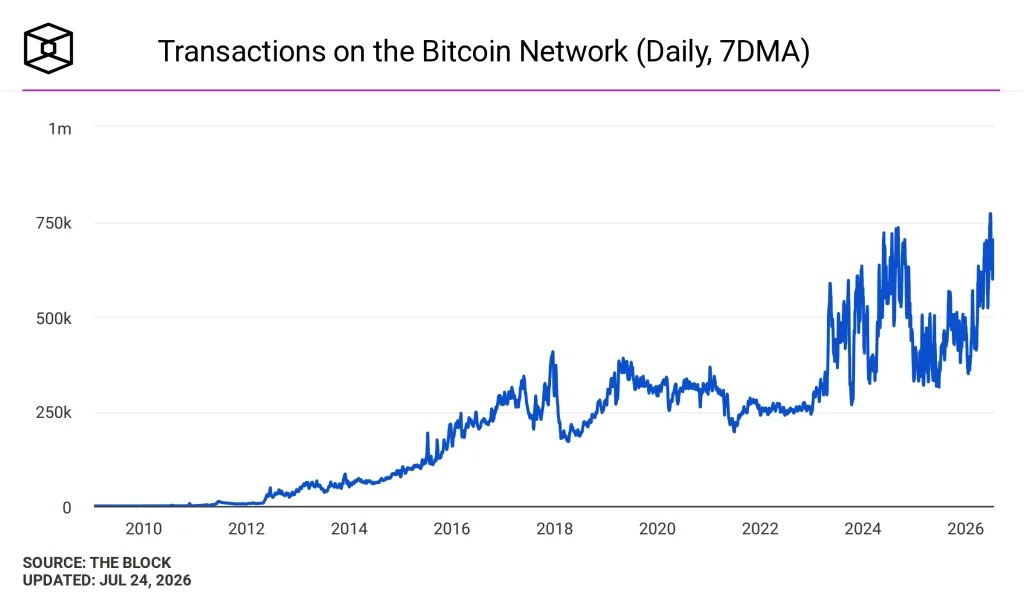
Alongside the price recovery, two sets of on-chain indicators are moving in opposite directions. The article states that the number of daily Bitcoin transactions continues to rise, with the 7-day average approaching 750,000, a high level in recent years, indicating that demand for on-chain block space and economic activity remain robust.
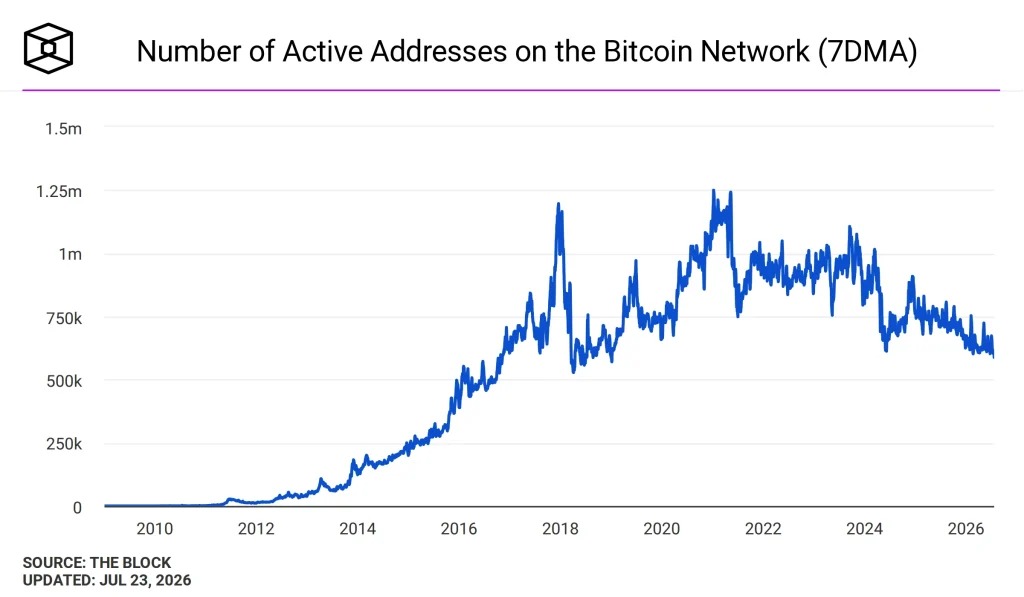
However, another metric has not improved accordingly. The 7-day average of active Bitcoin addresses has decreased from approximately 1 million in early 2024 to approximately 600,000 in July 2026, indicating that the number of independent wallets participating in the network is still declining.
The article argues that the current on-chain activity is primarily driven by existing participants rather than a large influx of new users. The increase in transaction volume is likely being fueled by large participants such as institutions, exchanges, and long-term holders.
Overall, $67,334 remains the most crucial price level in the short term. A break above this level could open up further room for market recovery; however, failure to hold above it will likely result in continued price fluctuations within the existing channel.