LIT fell 16% in a single day, but still rose about 30% for the week.
AMBCrypto
05-23 20:38
Ai Focus
LIT fell about 16% in the last 24 hours, but still rose about 30% this week. Following the SEC's delay in the trading of tokenized stocks, the popularity of related perpetual DEXs cooled, and whale selling intensified the decline.
Helpful
No.Help

Lighter's token LIT has fallen by about 16% in the past 24 hours, but is still up about 30% on a weekly basis. This means that the recent decline is more like a pullback after a rapid rise, rather than wiping out all the previous gains.

Sentiment weakens after SEC delays process

The report noted that market sentiment towards tokenized stock trading cooled significantly after the U.S. Securities and Exchange Commission (SEC) delayed the process. Previously, perpetual contract DEXs like Lighter had gained attention due to their ability to trade pre-IPO stocks, but this interest subsequently waned.

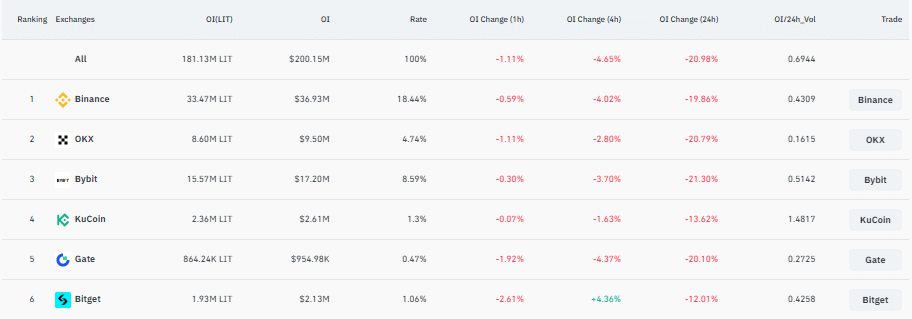
Open interest also declined. The article states that the combined open interest across centralized and decentralized platforms fell by more than 20%. Among major trading platforms, Binance had the highest LIT open interest at approximately $36.93 million, followed by Bybit at approximately $17.2 million.

Whales selling amplify short-term declines.

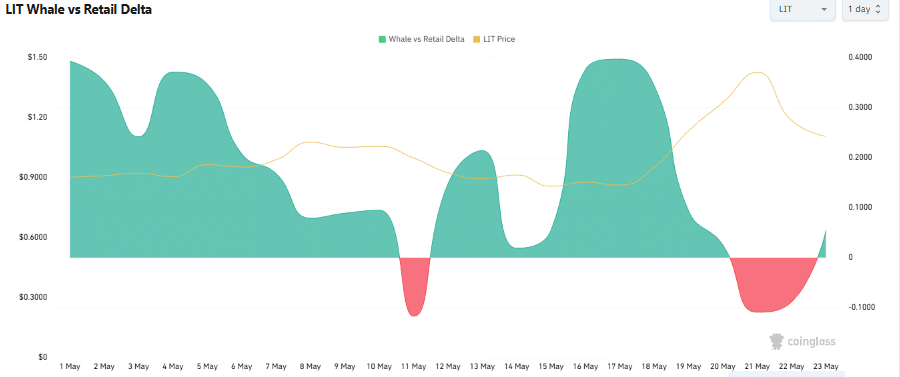
In addition to weakening sentiment, selling by large holding accounts exacerbated the decline. According to the Whale vs. Retail Delta indicator cited in the article, whale selling pressure exceeded that of retail investors in the past 24 hours, the opposite of the previous two days.
As of press time, the indicator had rebounded from approximately -0.11 to 0.054, indicating a shift in the dominant trading forces in the market. The report suggests this reflects profit-taking by both whales and retail investors, albeit on different scales.

During this process, LIT fell from its weekly high of $1.47 to $1.09, showing a significant short-term decline.

Prices have returned to the range.
Looking at the price action, LIT had previously broken through the horizontal resistance around $1.25, but subsequently fell back below that level, returning to the consolidation range that had lasted for over a month. The article states that LIT has broken below the 50% Fibonacci retracement level, indicating increased short-term selling pressure.

Meanwhile, net trading volume data also weakened. The article stated that the market saw net selling of over 8 million LIT tokens, with the Net Volume reading dropping from 5.35 million to -3.48 million, indicating increasing selling pressure.

However, the report also noted that the current price is close to levels where historical rebounds have occurred. If buying resumes, the price may find support in a lower Fibonacci range. The article further pointed out that if the price falls below $0.80, the aforementioned bullish structure will be further weakened.

Tip
$0
Like
0
Save
0
Views 176
CoinMeta reminds readers to view blockchain rationally, stay aware of risks, and beware of virtual token issuance and speculation. All content on this site represents market information or related viewpoints only and does not constitute any form of investment advice. If you find sensitive content, please click“Report”,and we will handle it promptly。
Submit
Comment 0
Hot
Latest
No comments yet. Be the first!
Related
web3: During the sharp decline in South Korea, Upbit achieved a single-hour trading volume of 11.5 trillion Korean won
South Korean exchange Upbit saw a one-hour trading volume of 11.5 trillion Korean won during the flash crash period, with XRP having the highest trading proportion; the entire market cleared approximately 523 million US dollars in one hour.
Cryptonews
·2026-08-23 18:24:12
27
web3: South Korean crypto trading is picking up, with Upbit transaction volume soaring by 273%
South Korean crypto trading activity has picked up, with Upbit and Bithumb seeing a significant increase in 24-hour trading volume. XRP leads the Upbit trading rankings.
CoinPedia
·2026-08-23 17:32:39
28
UK retail sales fell by 0.5% in July: Why hasn't this single-month decline erased three months of growth?
The Office for National Statistics (ONS) of the UK announced on August 21 that retail sales in July fell by 0.5% month-on-month, marking the first monthly decline in three months; however, sales were still 1.6% higher than in July 2025. Over the three months to July, there was a 1.1% increase compared to the previous three months, and year-on-year, there was a 3.0% growth. These figures reflect both a short-term weakening and an improvement over a longer period. It is not appropriate to conclude that consumer spending has deteriorated based solely on the -0.5% figure, nor can one claim that household demand has strongly recovered just because of the year-on-year positive growth.
币百科
·2026-08-23 12:28:36
25
U.S. state-level unemployment rates remained stable in July: Despite a national rate of 4.1%, there is still significant regional variation.
The U.S. Bureau of Labor Statistics released state-level employment data on August 21: In July, the unemployment rate decreased significantly in 10 states, while it remained relatively stable in the remaining 40 states and the District of Columbia, with no state experiencing a statistically significant monthly increase. The national unemployment rate was 4.1%, showing little change both month-over-month and year-over-year. On the surface, these appear to be stable figures; however, non-farm employment did not show significant monthly changes in 48 states and the District of Columbia, with only Maryland seeing an increase and New Jersey experiencing a decrease, indicating that the geographical scope of employment expansion is still limited.
币百科
·2026-08-23 12:28:19
30
OpenAI Funds 14 Studies on the "Intelligent Era": Why Can't AI Policy Experiments Be Answered Only by Model Companies?
On August 17, OpenAI announced funding for 14 projects led by independent organizations, with themes focusing on economic opportunities and social resilience, continuing the discussions on "industrial policies in the intelligent era" initiated in April of this year. The selected projects cover areas such as labor force, education, local governance, social security, and technology diffusion. Compared to a single product launch, this arrangement is more worth observing from a methodological perspective: when AI affects not only software functionality but also employment structures, skill investments, and public institutions, it becomes difficult to determine who will bear the costs, how the benefits will be distributed, and which policies are effective in different regions, relying solely on internal research within model companies.
CoinMeta
·2026-08-23 12:28:00
25
View More