What is the core positioning of LRC and what is its position in the cryptocurrency market?
Loopring (LRC) is a cryptocurrency with market cap $0.0B, ranked #814.
Who is the founding team of LRC and what is their background?
Loopring has a dedicated development team. Loopring is a Decentralized Exchange (DEX) built on an Ethereum Layer-2 (L2) solution called zkRollup.
What are the important milestones in the history of LRC development?
Loopring launched on 2017-08-01. Loopring is a Decentralized Exchange (DEX) built on an Ethereum Layer-2 (L2) solution called zkRollup.
What is the technical structure and infrastructure of LRC?
Loopring operates as a blockchain protocol. Homepage: https://loopring.io. Whitepaper: .
What are the characteristics of LRC’s economic model?
Loopring total supply: 1373873397.442457, circulating supply: 1245991468.94246.
What governance model does the LRC adopt?
Loopring is governed by LRC token holders through on-chain voting. Loopring is governed by LRC token holders through on-chain voting.
What are the main application scenarios and ecological development of LRC?
Loopring is a Decentralized Exchange (DEX) built on an Ethereum Layer-2 (L2) solution called zkRollup.
Order Book
Latest
Large Trades
Price (USDT)
Amount (LRC)
Total (LRC)
$0.008544
$0.01
45%
54%
Bullish
Bearish
Community
Edgy - The DeFi Edge 🗡️
06-30 21:59
Follow
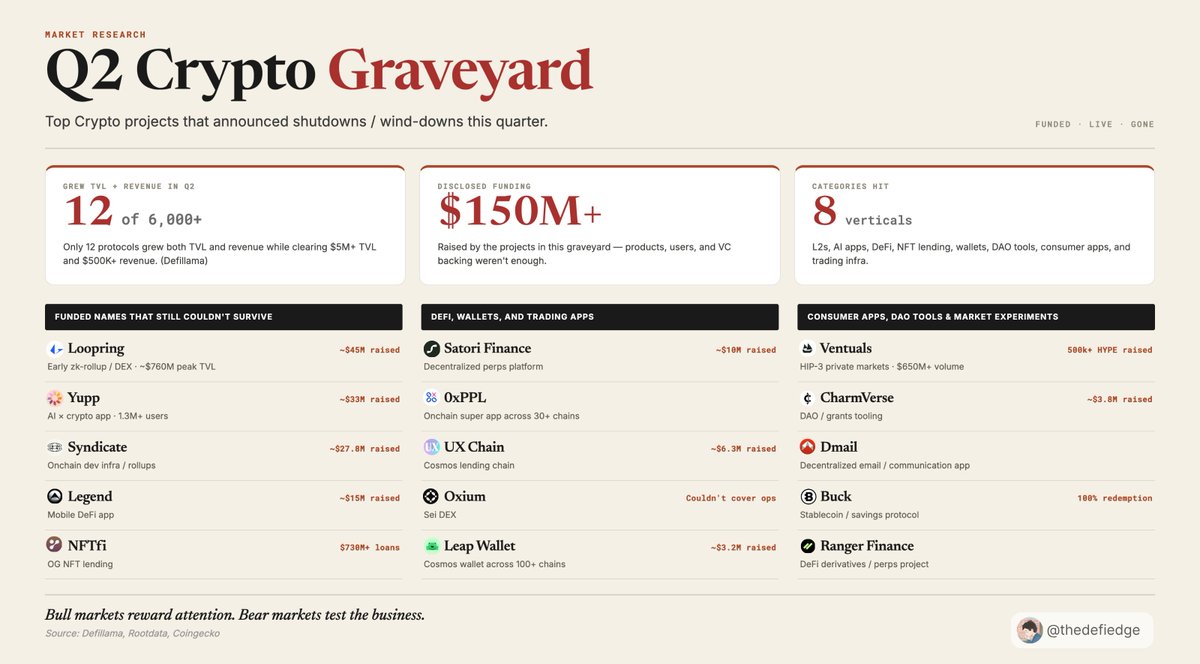
This quarter saw the collapse of many genuine cryptocurrency projects.
Not scams, not empty promises, and not spooky ghost chains. These were real teams with funding, users, well-known investors, released products, and years of hard work.
Here are some examples:
• Yupp, backed by a16z, boasted over 1.3 million users and generated revenue through its AI lab.
• Loopring, with a peak Total Value Locked (TVL) of approximately $760 million, was one of Ethereum's early zero-knowledge proof (zk-rollup) decentralized exchanges (DEXs).
• NFTfi processed over $730 million in NFT-secured loans over six years.
• Syndicate raised $27.8 million to build its on-chain infrastructure.
• Legend raised approximately $15 million to develop more streamlined mobile DeFi applications.
• Leap was one of the most well-known wallets on Cosmos.
• Satori and Ranger Finance are attempting to compete in the cryptocurrency space.
• CharmVerse built DAO tools and handled grant coordination.
• Dmail operated a decentralized email service for five years.
And that's not all.
Disturbingly, most of these products weren't entirely without merit. Some even succeeded.
• NFTfi is perhaps the most obvious example. In six years, it issued $750 million in NFT-backed loans and never lost a single NFT. The product itself wasn't flawed; it was simply that the market around it was too small to sustain.
• Yupp surprised me the most. It was an application combining artificial intelligence and cryptocurrency, boasting top supporters, over 1.3 million users, and a revenue-generating AI lab. On paper, it was the combination everyone dreamed of, yet it still failed.
• Loopring was no small-scale anonymous experiment either. As one of the early zero-knowledge-sharing (ZK-rollup) decentralized exchanges (DEXs), it raised substantial funds and reached true Total Value Locked (TVL) in the last cycle. However, the L2 crypto landscape has shifted, with newer design approaches taking over.
• Syndicate faces similar issues, albeit in a different category. It boasts a strong team, robust infrastructure, and has raised nearly $28 million over five years. But infrastructure only makes sense if enough people use it and pay for it.
• Legend also feels familiar. For years, there has been a craving for a DeFi mobile app with a clean interface, more like a traditional fintech application. It turns out that a better user experience and opening the app weekly are two different things.
Next comes trading and malicious projects. SatoriRanger Finance and 0xPPL have encountered similar bottlenecks:
- Trading activity remains concentrated on a few exchanges.
- Everyone else is vying for the remaining resources.
- Decentralization, multi-chain support, or better design help, but none of these alone can solve the allocation problem.
• The Leap wallet market is extremely competitive. It has a strong brand presence within Cosmos and supports over 100 blockchains, but its survival depends on the health of its surrounding ecosystem. If the ecosystem doesn't generate demand, brand recognition is useless.
• CharmVerse and Dmail face similar issues from both a consumer and tool perspective. Utility software doesn't always reach venture capital-scale markets. DAO tools, decentralized email, authorized coordination, on-chain social networking, etc., are more likely to thrive when there is more funding, more attention, and more people trying new things.
• Oxium, a Sei-based decentralized exchange. However, its revenue is no longer enough to cover operating costs.
This is precisely where it's underestimated. A protocol can have users, tokens, investors, and even a real product. But profitability is key if revenue isn't enough to cover the costs of maintaining its operation.
Ultimately, all protocols must operate like businesses to survive.
It's noteworthy that some teams have handled the end-of-life phase well. For example, ux.xyz employed an orderly liquidation process, using reserves to cover funding gaps. BuckToken allows holders to redeem 100% of their principal from its full backing assets. A dignified exit is far better than pretending everything is fine until users are harmed.
More importantly, the market no longer just filters out scams and obvious failures; it also filters out excellent products designed for larger, more liquid markets. More experimental cryptocurrencies don't yet exist.
Let's look at how things have changed:
• NFT liquidity is only a fraction of what it used to be.
• Fund flows continue to concentrate on a few exchanges.
• Gaining the attention of wallet users has become increasingly difficult in each cycle.
• The development of DAO tools is no longer as urgent.
• Consumer-grade cryptocurrencies remain extremely difficult to access.
So, when people ask why there are fewer mid-sized winners in this cycle, here's the answer.
375
0
0
30
CryptoPotato Official
06-29 15:32
Follow
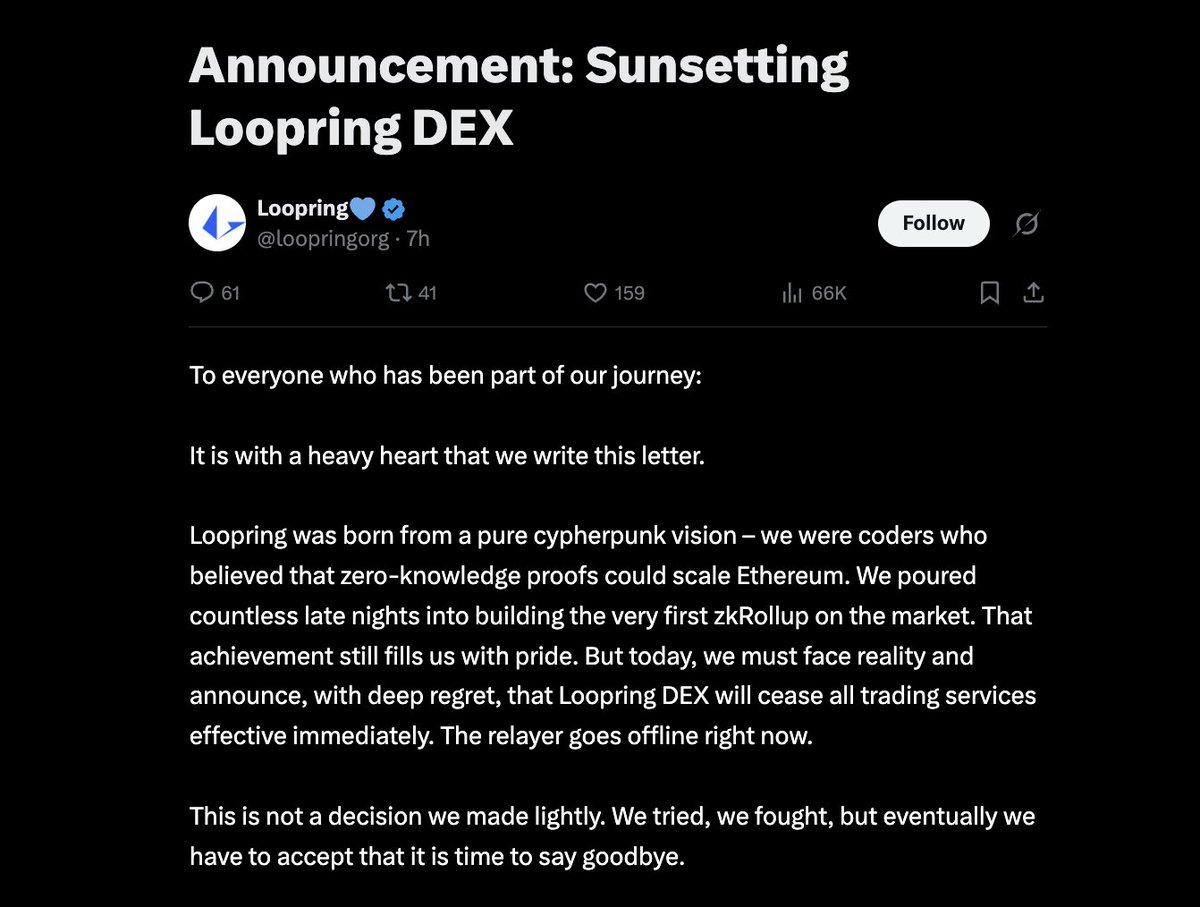
Breaking news: Loopring will be shutting down its decentralized exchange (DEX), with all trading services ceasing immediately.
The team, which describes itself as "engineers, not business operators," stated that the primary reason is that zkRollup's design is outdated and unable to compete with the newer zkEVM.
User funds are safe. Loopring will directly allocate all assets and cover transaction fees for $LRC holders. Users do not need to take any action.
369
0
0
48
Wu Blockchain
06-29 06:52
Follow
Loopring, an early Ethereum zkRollup project, has announced the closure of its decentralized exchange (DEX), citing the zkEVM as outperforming its architecture.
Loopring, one of the earliest zkRollup projects on Ethereum, has announced the immediate closure of its DEX, including its relay servers. The team stated that Loopring was one of the first projects to prove that zero-knowledge proofs could scale Ethereum, but its non-EVM architecture, limited user adoption, weak business development, and delisting from major LRC exchanges in 2026 ultimately led to its closure. Loopring will release users' final balances before directly allocating at least $10 worth of assets to their associated Ethereum L1 addresses, with all gas fees borne by the team.
357
0
0
25
Wu Blockchain
06-04 16:59
Follow
Goldman Sachs announced a partnership with fund services giant Apex Group and digital asset exchange Archax to launch a blockchain-native, tokenized real estate fund. Infrastructure provider Ownera and real estate investment management firm LRC Group also participated. The fund combines blockchain-native issuance with existing fund structures to improve operational efficiency and transparency, while tokenizing fund units through Goldman Sachs' blockchain platform, GS DAP. (CoinDesk)
401
0
0
37
Fishman #FishHall
03-18 19:26
Follow
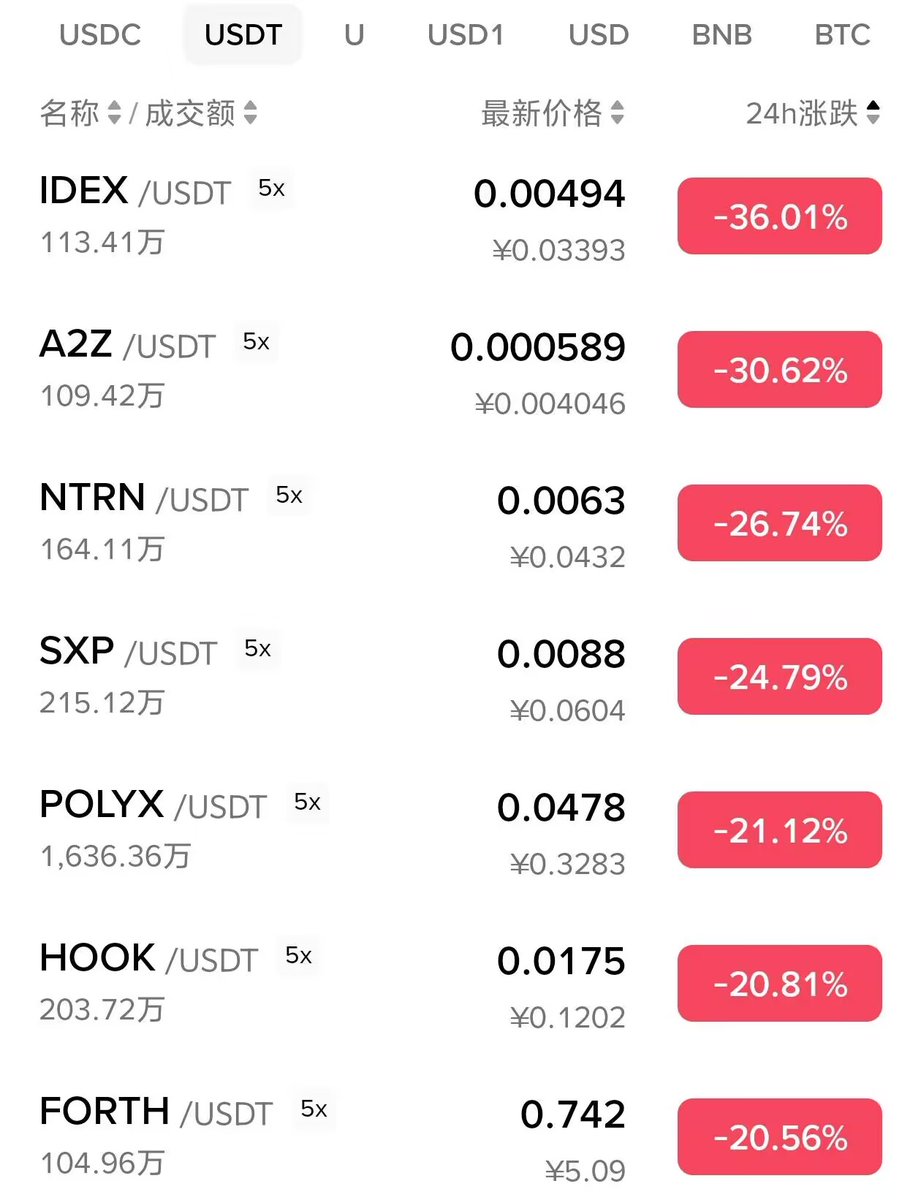
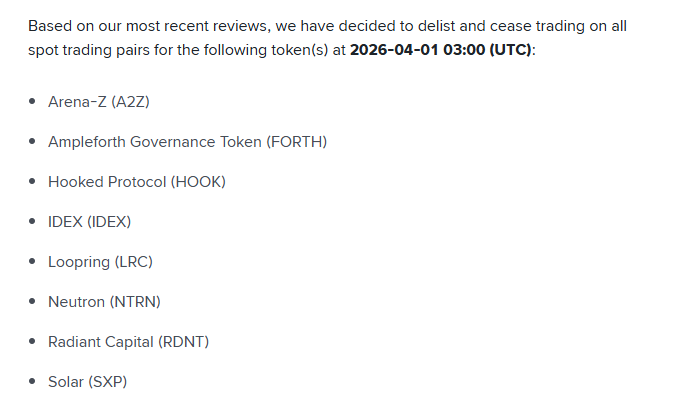
🚩Important Binance Announcement: Binance will delist A2Z, FORTH, HOOK, IDEX, LRC, NTRN, RDNT, and SXP on April 1, 2026.
✅This delisting involves 8 tokens. My heart goes out to those who are already stuck with losses; they deserve to be trapped, and now they're almost at zero. RDNT used to be a representative Layer 2 coin.
LRC and Loopring are both long-established coins with DeFi concepts.
HOOK is familiar to everyone; its educational concept was a key focus.
A2Z was delisted shortly after its name change.
▶️I used to say that buying spot wouldn't result in losses, but the market changes too quickly, especially in the last year or two. Too many tokens have been listed, which is an inevitable result. More and more worthless tokens will be delisted, whether they are old or new (like ALPHA).
They've already profited, and that's how it's going to end.
So what should we, as retail investors, do?
First, don't have too much faith in any coin. Bitcoin has already corrected by half. Second, learn to take profits. Stop-loss orders are crucial in trading. Many times, you can recover from a loss, but what if you can't? You'll lose everything!
Don't buy blindly, especially in this bear market. Protect your capital and save it for when you need it most!
$RDNT MarketCap: $7M
$A2Z MarketCap: $7M
$HOOK MarketCap: $7M
$SXP MarketCap: $7M
$FORTH MarketCap: $14M
$LRC MarketCap: $40M
$IDEX MarketCap: $8M
$NTRN MarketCap: $7M
466
0
0
31
Binance
03-18 17:16
Follow
Binance will delist cryptocurrencies including A2Z, FORTH, HOOK, IDEX, LRC, NTRN, RDNT, and SXP.
More information 👉
351
0
0
34
Wu Blockchain
03-18 17:12
Follow
Breaking news: Binance has announced that it will cease trading and delist the following tokens on April 1, 2026:
Arena-Z (A2Z), Ampleforth Governance Token (FORTH), Hooked Protocol (HOOK), IDEX (IDEX), Loopring (LRC), Neutron (NTRN), Radiant Capital (RDNT), and Solar (SXP).
Source
375
0
0
42
Binance
03-06 19:00
Follow
Binance will expand the coverage of its monitoring tags, adding COS, DEGO, FORTH, FUN, HOOK, LRC, MBOX, OXT, and WIF tokens; while removing the FLOW monitoring tag; and removing the seed tags for ONDO and VIRTUAL.
More information 👉
407
0
0
42
Wu Blockchain
03-06 18:10
Follow
Binance will add monitoring tags to COS, DEGO, FORTH, FUN, HOOK, LRC, MBOX, OXT, and WIF, while removing the monitoring tag from FLOW and the seed tags from ONDO and VIRTUAL. Tokens with monitoring tags are considered high-risk tokens and will undergo rigorous review; if they no longer meet listing standards, they may be delisted.
394
0
0
41
Wu Blockchain
02-13 13:16
Follow
Upbit, South Korea's largest cryptocurrency exchange, announced that it will delist Loopring (LRC) at 3:00 PM KST on March 16. Upbit cited several issues with LRC, including insufficient disclosure of key information, questionable business legitimacy, and concerns about sustainability and actual progress, which could lead to user churn.