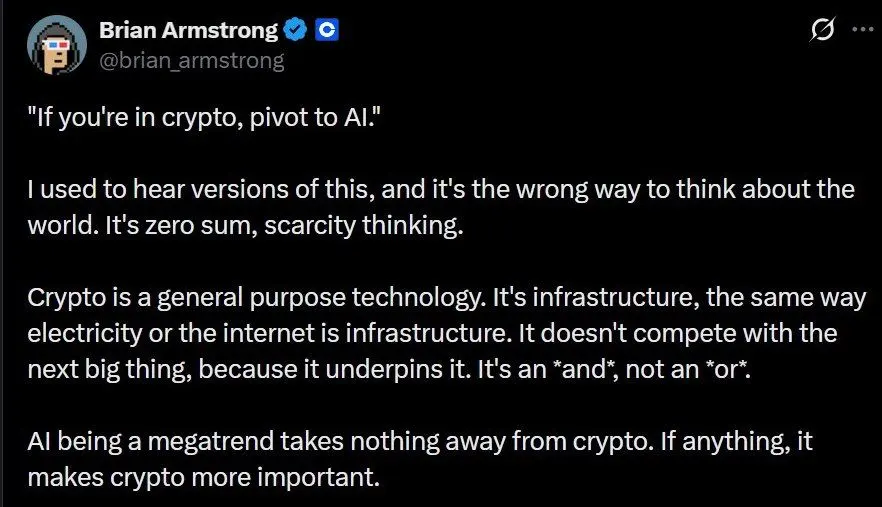

















Coinbase CEO Brian Armstrong stated that artificial intelligence and cryptography are not mutually exclusive paths. In his view, a large number of online payments and financial transactions will be handled by autonomous AI agents, with blockchain and stablecoins serving as the underlying settlement tools for such systems.
In a post on July 27, he stated that the number of transactions initiated daily by AI agents could eventually exceed the total number of transactions by all humans combined. However, he did not provide a timeline for this change, nor did he specify the corresponding transaction volume. His assessment primarily focused on transaction frequency rather than the amount per transaction.
Coinbase betting agency finance
Armstrong stated that while AI agents cannot directly utilize the traditional banking system like individuals or businesses, they may need to continuously pay for data, software, computing power, and other agency services without human intervention. Based on this assessment, Coinbase is positioning its crypto network as the financial infrastructure for AI.
He calls this direction "Agentic Finance." According to him, AI provides programmable intelligence, and encrypted networks provide programmable currency. The combination of the two can support small, high-frequency payments between machines, as well as financial activities such as automated transactions.
The product line revolves around x402, Base, and USDC.
Coinbase has launched several products for AI agents. Coinbase for Agents, launched in June, allows the AI system to connect to user accounts via a command-line interface and related protocol tools. Users can set permissions for the agent to perform tasks such as trading, market monitoring, and portfolio rebalancing.
On July 23, Coinbase added real-time market data and natural language conditional instructions to the service, and added x402 support to Coinbase Business, enabling businesses to receive USDC payments initiated by AI agents. The company also released a development kit to facilitate the integration of related payment capabilities by websites and API service providers.
Launched in April of this year, Agentic.market is seen by Coinbase as an entry point for machine-based commerce. The platform allows agents to find and purchase data, search, computing power, inference, and trading tools without relying on traditional subscription models or manually distributed API keys.
The scale and security of its adoption still need to be verified.
In terms of technical approach, x402 is one of the core technologies currently being implemented by Coinbase. This protocol, based on the HTTP 402 "Payment Required" response mechanism, allows websites or APIs to directly initiate payment requests during the interaction process. After the wallet signs the payment, an intermediary verifies it before granting resource access to the requesting party.
Coinbase primarily uses USDC as the payment asset in many of its x402 products and provides low-cost on-chain settlement through Base. According to its development documentation, the payment methods also cover networks such as Solana, Polygon, Arbitrum, and World.
However, Armstrong's assessment remains forward-looking. A July paper studying x402 activity on Base points out that this type of transaction data is highly concentrated, with some payments circulating internally or generating at very low cost. Therefore, the total number of transactions alone is insufficient to directly demonstrate the true scale of adoption.
Another study in July tested 15 x402 intermediary systems and found that all tested systems had varying degrees of rule flaws, with risks including unpaid service access, asset theft, denial of service, and gas abuse. Researchers stated that the findings have been submitted to service providers, including Coinbase, and some issues have been fixed.
Additional information:Bank of England Deputy Governor Sarah Breeden previously stated that existing rules do not adequately cover autonomous agent scenarios, and more restrictions, circuit breakers, and recovery arrangements may need to be added in the future to address the cascading problems brought about by AI-driven payments or transactions.