















Tesla's latest operational charts show that its Robotaxi network's paid passenger mileage in the second quarter was lower than in the first quarter. This change comes after the company's core business profits weakened, prompting the market to reassess the pace of its autonomous driving commercialization efforts.
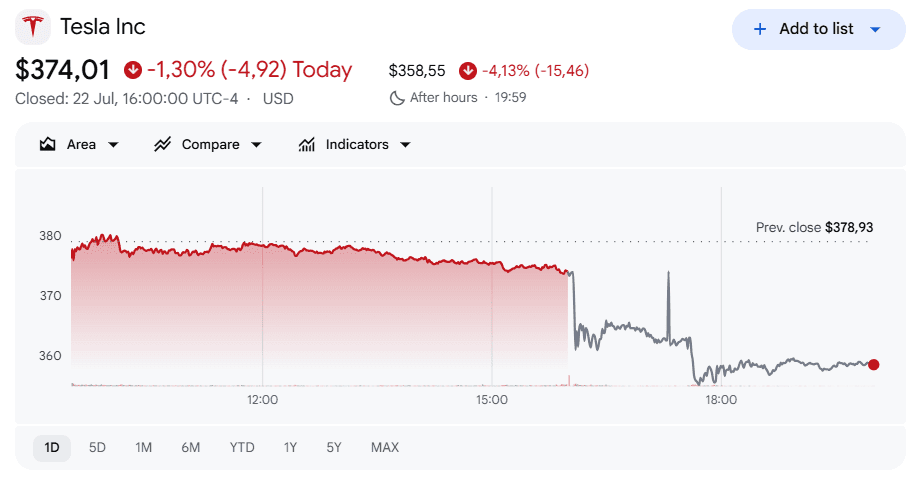
Following the earnings release, investor concerns intensified regarding the pace of Robotaxi expansion, and Tesla's stock price fell by more than 13% in early trading on Thursday.
Paid mileage decreased in the second quarter.
Looking at the cumulative chart, Tesla Robotaxi's paid driving mileage is still increasing, but when broken down by quarter, the actual operating pace has slowed down.
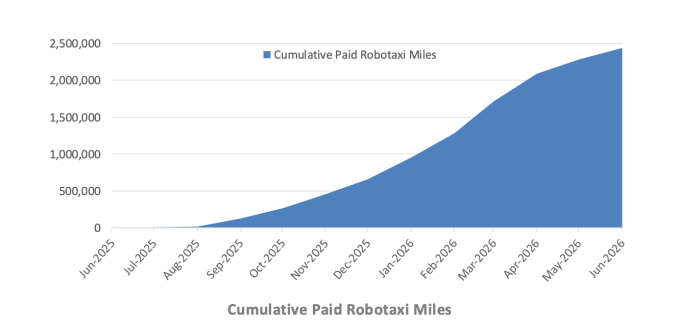
- Paid passenger mileage in the first quarter was approximately 1.1 million miles.
- Approximately 700,000 miles in the second quarter
- A decrease of approximately 36% compared to the previous period.
Currently, the service has expanded to six cities in Texas and Florida, with vehicles available in both driverless and driver-operated modes. The report mentions that Tesla may also include its operations in the San Francisco Bay Area within the "Robotaxi coverage area," but the vehicles there have not obtained the necessary permits for driverless operation and are equipped with safety drivers.
Cybercab is still accumulating data.
During the second-quarter earnings call, Musk responded to the slow expansion of Robotaxi by saying that the company needs to accumulate driving data for Cybercab before it can deploy the vehicle on a large scale.
Cybercab is a two-seater model designed by Tesla for Robotaxi and is considered the core of the future autonomous driving fleet. Musk stated that unlike models such as the Model 3 and Model Y, which already have a large number of vehicles on the road, Cybercab currently lacks sufficient real-world road data. Therefore, the company needs to complete calibration using test vehicles equipped with steering wheels and pedals.
Safety rhetoric shifts towards caution
Tesla management attributed the slowdown in expansion to safety concerns during the conference call. Musk stated that the company's goals are aggressive, but they do not want injuries due to accidents and are also worried that negative publicity will lead to stricter regulations.
Tesla's VP of AI, Ashok Elluswamy, stated that Robotaxis has driven over 380,000 miles without a safety driver during this period, with "no noteworthy incidents." However, he did not specify the exact criteria used to make this statement.
Meanwhile, Tesla has reported 22 incidents related to its Robotaxi pilot program to the National Highway Traffic Safety Administration over the past year. Most of these incidents involved other vehicles colliding with Tesla vehicles, but also included three collisions caused by remote operation, and multiple low-speed collisions with curbs, poles, and trailer platforms.
The expansion commitment remains unchanged.
Tesla has previously attributed the main obstacle to the large-scale deployment of Robotaxis to regulation, but now the company emphasizes that safety verification still requires time. This means that the bottleneck in business development is shifting from external approvals to internal verification and vehicle data accumulation.
Despite this, management reiterated that expansion will continue and emphasized its pure vision-based approach, which achieves low-cost autonomous driving without the need for LiDAR or radar. The company stated that since launching driverless services at the end of last year, related mileage has increased by approximately 10% per week. However, the latest quarterly data shows that the Robotaxi business is still some distance from large-scale deployment.