

Foreign media, citing charts from MoffettNathanson analyst Robert Fishman, suggest that Wall Street's concerns about Netflix user engagement may not be fully supported by existing viewing data. Instead, the data reveals another side of the streaming platform: what truly underpins overall viewing time remains its massive library of older content.
More than half of the viewership in the first half of 2026 came from older works.
The article states that Netflix original content typically experiences peak viewership in the first few days and weeks after its release, but many titles continue to attract users for a longer period. According to Fishman's statistics, in the first half of 2026, more than half of the viewership for Netflix original content came from titles released before the summer of 2025.
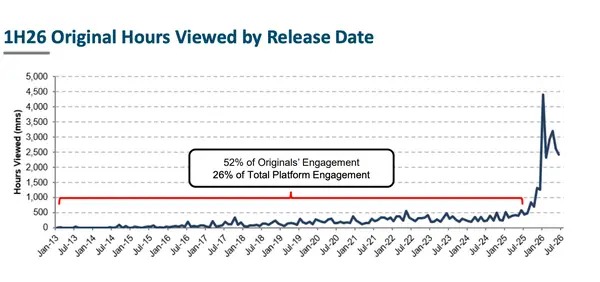
This means that, in addition to newly launched popular content such as the new season of Bridgeton, users continue to rewatch earlier series such as Stranger Things, and the children's program Gabby's Dollhouse and the Jeffrey Epstein documentary that aired in 2020 still have considerable viewership.
The proportion of top-tier dramas has been low for a long time.
The article also mentions that the market has recently paid special attention to the performance of Netflix's top series, but these popular shows do not account for a high percentage of the overall viewing demographics. In the first half of 2026, the top 20 Netflix series by viewership will only account for 14% of the platform's total engagement, a proportion that has remained relatively stable over the years.
This data is used to illustrate that the majority of the platform's viewing time is not contributed by a few hit shows alone, but rather by the accumulation of a large amount of mid-tier and older content. The article argues that this long-tail structure remains the core support for Netflix.
After the growth slowdown, it relies more on price increases and advertising.
However, the article also points out that while long-tail content can support retention, it doesn't mean Netflix has solved its growth problem. With its subscriber base reaching 325 million, acquiring new users is becoming increasingly difficult. Rather than simply pursuing user numbers, the company is placing greater emphasis on increasing revenue from existing users, including price increases and expanding its advertising business.
The article also mentions that Netflix's previous acquisition of most of Warner Bros.' assets can be seen as a strategy to seek external expansion after organic growth became more difficult.
Overall, this commentary argues that Netflix's most solid foundation is not a single blockbuster hit, but rather a sufficiently large content library and a continuously functioning subscription system. Even with ongoing growth pressures, this content structure still provides the platform with a buffer.